





 Portuguese
  English
  Spanish
  6 min of reading
  55 comments


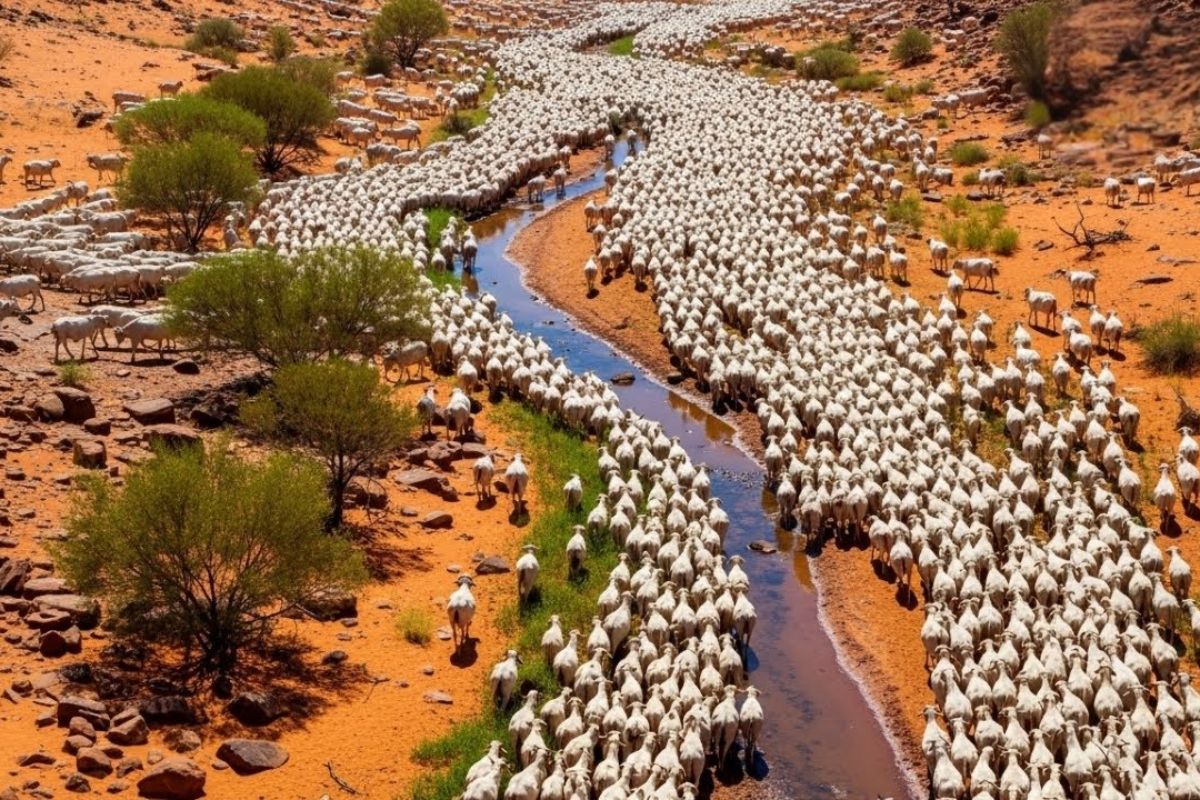


With Sheep Grazing on Abandoned Slopes, Old Dead Lands Returning to Green and Underground Rivers Reappearing Without Machines, Giant Works or Billions in Subsidies, Europe Transformed an Ecological Collapse Scenario into a Living Laboratory of Pasture Recovery, Aquifer Recharge and Biodiversity Rebirth in Just One Decade
For decades, the recovery of degraded ecosystems was synonymous with tractors, heavy engineering works, and investments of many billions of dollars. In this model, deserts are fought with concrete, pumps, and channels, as in China, Egypt, or Australia, where restoration projects took 30 to 40 years to show consistent results. In radical contrast, a simple proposal gained traction in Europe: using loose sheep as a central tool for ecological restoration, replacing machines with hooves, herbicides with grazing, and part of the hard technology with precisely guided natural processes.
By releasing thousands of loose sheep onto lands considered practically lost, the Carpathian Mountains and high regions of Poland began to react in surprisingly positive ways. In about 10 years, old pastures flourished again, the water table rose, and entire ecological chains were reactivated. What seemed merely a cultural decision in defense of traditional grazing turned out, in practice, to be a solution of sophisticated natural engineering, monitored by satellites, soil sensors, and European environmental programs, with a concrete impact on biodiversity, water, and climate resilience.
When Sheep Crossed Mountains and Made History
Long before becoming loose sheep in ecosystem restoration programs, these flocks were already part of the social and economic history of the region.
-
China rejected an entire shipment of beef from Argentina after detecting an antibiotic so dangerous that it has been banned for human consumption for over 30 years, and now the export sector is facing a crisis of international trust.

-
With nearly 500 thousand tons per year, barley production is growing in Brazil, while a decline in beer consumption among Generation Z raises alarms in the sector.
-
With tractors out of reach for small producers, a tricycle created by Embrapa Algodão becomes a cheap and efficient solution and gains national prominence.
-
From 130 producers in the year 2000 to just 15 today: the dramatic decline of passion fruit in Araguari shows how the lack of labor in the Brazilian countryside is killing a decades-old agricultural tradition, even with Brazil being the largest producer in the world.

In the 17th century, nomadic shepherds left the frozen Balkans, crossed the Carpathians, and arrived in the Kraków and Poprad area bringing wooden huts, handmade tools, and their first flocks.
This migration led to a classic model of transhumance: in spring, the flocks ascended to the alpine fields, in autumn they descended back to the valleys, maintaining an annual land use cycle that balanced pastures, forests, and water.
The local economy organized itself around this dynamic, with meat, milk, and wool sustaining entire villages and giving rise to a mountain culture closely tied to sheep.
From the “Kingdom of Sheep” to the Silent Collapse of Pastures

In the post-war period, Poland experienced the peak of sheep farming, with state subsidies, textile factories, and attractive wool prices.
In just a few decades, the country reached millions of animals in its national flock, to the point of being nicknamed a true ovine kingdom in Europe.
The sound of bells hanging from the animals’ necks was part of the sound landscape of the mountains.
This structure crumbled in just a few years. The transition to a market economy, the end of subsidies, and the influx of cheap wool from Australia and New Zealand eroded the economic foundation of the activity.
The number of sheep plummeted by more than 80% in half a decade, mountain villages lost their shepherds, and once green slopes became occupied by dense and homogeneous forests, with little light on the ground, low diversity, and a sharp decline in biodiversity typical of open fields.
The water table receded, habitats for flowers, butterflies, and field birds disappeared, and large areas effectively became dead land in ecological terms.
The Return of Loose Sheep as a Tool of Ecological Engineering

It was against this backdrop that the decision was made to bring loose sheep back to the mountains as “engineers of nature”.
In the mid-2000s, projects like Ala Plus, supported by European environmental programs, began to rebuild flocks and reestablish the seasonal up-and-down cycle in the Carpathian slopes.
The logic was simple and technically robust.
Sheep do not function merely as “living lawnmowers”. With small snouts and agile lips, they select the shoots and invasive shrubs that smother native grasses, making room for the rebirth of traditional pastures.
With each step, their hooves act as micro-plows, lightly turning the top layer of soil, facilitating the infiltration of water and oxygen, and reactivating communities of microorganisms essential for the carbon and nitrogen cycles.
The manure rich in nitrogen, phosphorus, and potassium acts as a slow-release organic fertilizer, rebuilding fertility without chemical inputs.
Seeds stuck in the wool and hooves transform the flock into a mobile dispersal system, carrying native species from one valley to another.
In just a few years, the combined effect of this managed grazing caused pastures to be reborn, reduced soil temperature, and reopened niches for pollinators, rare insects, and field birds.
Culture, Tradition and Restoration Walking Together
Environmental recovery was not merely technical. The return of loose sheep to mountain landscapes reactivated rituals, trades, and identities.
The ancient rite of spring migration, with flocks ascending the slopes adorned with bells, was once again celebrated.
Older shepherds began to serve as masters and advisors, schools created courses in ecological grazing, and universities began to scientifically measure the impact of this return on fauna, flora, and water.
International recognition came when the traditional grazing of the Carpathians was classified as intangible cultural heritage, directly connecting culture and environmental management.
In terms of public policy, the message was clear: the same practice that built historical landscapes is also capable of recovering them when well-planned and monitored.
Loose Sheep in Solar Plants and Even at Airports
With the results in the mountains, the logic of loose sheep as a management solution has been extended to other scenarios.
In solar energy areas, large fields of panels began to host flocks instead of machines and herbicides.
The sheep keep the vegetation low, help retain moisture in the soil, and prevent excessive shading that would reduce the efficiency of the modules.
This model, known as agrivoltaics, reduced maintenance costs, improved panel performance, and preserved the soil as a living environment.
In several countries, thousands of sheep have become part of the routines of solar plants, caring for hectares of energy infrastructure with minimal machine intervention.
Even airports have adopted flocks in operational safety areas.
In fields near runways, sheep help control vegetation, preserve visibility, and reduce the presence of other species that could increase the risk of collision with aircraft.
What seemed improbable became part of the routine: high-tech hubs supported by peaceful flocks doing ecological maintenance work with precision and reduced costs.
What Europe Teaches the World with Its Loose Sheep
The European case shows that loose sheep can be treated as green infrastructure, not just as part of traditional agriculture.
By integrating ancestral knowledge, modern monitoring, and public policy design, the region managed to recover pastures, raise the water table, reduce erosion, and bring back species that had disappeared.
More than an isolated project, this experience points to a restoration model where nature-based solutions compete in effectiveness with heavy engineering mega-projects, often with lower costs, reduced risk, and strong social support.
Rather than replacing technology, these initiatives demonstrate that it can work in partnership with well-understood and managed biological cycles.
In the end, the question remains simple yet powerful: if thousands of loose sheep have managed to reverse decades of degradation in just 10 years, what other territories could achieve by combining tradition, science, and long-term planning?
And you, do you think that solutions supported by loose sheep and natural processes could be more efficient than large billion-dollar works when it comes to recovering degraded areas?








Aqui no Ceará ovelhas dependendo da postagem elas disimam com a postagem.
Com certeza o exemplo está ai
Mas se sem ovelhas, a floresta regenerou, isso é ruim? Pelo que li, as ovelhas não são nativas.