





 Portuguese
  English
  Spanish
  6 min of reading
  0 comments


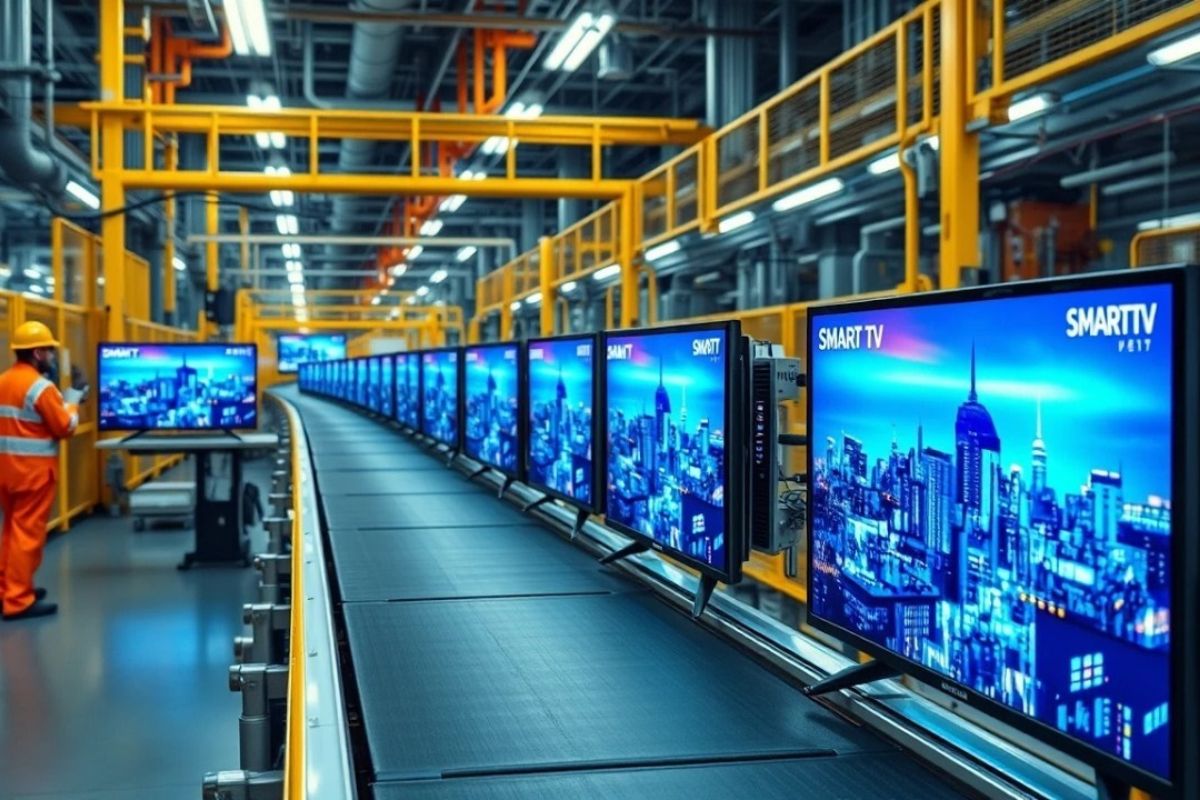
In Highly Automated Production Lines, Smart TVs Come to Life from Panels Manufactured in Clean Rooms, Circuit Boards Assembled by Robots and a Rigorously Sequences of Tests That Validate Image, Connectivity and Durability Before Each Unit Leaves the Factory Straight to the Consumer’s Home.
Worldwide, hundreds of millions of Smart TVs are powered on every year, transforming the living room into the main hub of digital entertainment for every family. Behind the simple act of pressing a remote button lies a complex industrial chain, which starts months earlier on different continents, passes through clean rooms resembling space labs, and ends on assembly lines where humans and robots work side by side.
No brand produces everything on its own. Most Smart TVs are the result of integration work. Microchips can be designed in one country and manufactured in another, the display panel originates from specialized factories, and the plastic casing comes from large petrochemical complexes. The final manufacturer acts as a great orchestrator, bringing together components from dozens of suppliers until transforming glass, metal, and plastic into a single connected device.
Global Supply Chain: The Journey of Components to the Factory

Before existing as a product, a Smart TV is a map of global logistics.
-
Sprinkling dry baking soda directly on the carpet neutralizes odors from sweat and food without wetting the fibers, allowing you to forget about the vacuum cleaner for weeks using a product that costs less than five reais.

-
A bottle thrown into the sea by two Australian soldiers in 1916 on their way to the trenches of World War I was buried in the sand for over 100 years, and the letters inside it were still legible when they were found.

-
China invests over R$ 4.2 trillion, builds the largest water network in the world with 95,000 reservoirs and 1 trillion m³, expands piped water access to 96% of rural areas, attracts R$ 565 billion in foreign investments, and advances with the “longevity gene” in rice.

-
Heineken’s factory in Brazil surprises the world by reducing water consumption for beer production from nearly 10 liters to just 2.2 liters per liter produced, achieving a 23% decrease with real-time technology.
The microchips responsible for image processing, internet connection, and application execution can be developed in design centers and manufactured in foundries dedicated to semiconductors.
Capacitors, resistors, and connectors come from manufacturers specialized in discrete components.
The panel, the most expensive and delicate part, usually comes from companies that only produce screens on a large scale. The plastic or metal structure is made in plants focused on injection and stamping.
Only after all these elements are available can the final assembly factory start the process, setting up the line for that specific model of Smart TVs.
This production model allows for scaling huge volumes and, at the same time, varying sizes, resolutions, and features of each family of products, quickly adapting the line to market demands.
Panels in Clean Rooms: Where the Image of the Smart TV is Born

The panel is the visual heart of the Smart TV. It is produced in environments called clean rooms, where the air is continuously filtered to reduce dust particles to minimal levels.
A single microscopic particle can create a dead pixel and compromise the entire screen, making environmental purity a critical technical requirement.
In LCD panels, the structure is assembled in layers. At the base, there is the backlight unit, formed by rows of LEDs that emit uniform lighting.
On top of this base are placed diffuser and prism sheets, responsible for spreading light evenly.
Next, the two glass plates are added: one receives a thin-film transistor grid, each controlling a subpixel, while the other gets the color filter, with red, green, and blue microstructures.
Between these glasses, a layer of liquid crystal is injected, whose molecular orientation defines the passage of light.
Polarizing sheets complete the assembly, ensuring the optical behavior that produces the final image.
In OLED panels, each pixel is an organic light-emitting diode, which eliminates the need for backlight and allows for deeper blacks, as the pixels can be individually turned off.
All of this is done with micrometric control, as the panel represents a significant portion of the total cost of Smart TVs and is one of the most sensitive elements to defects.
Motherboard: Where the Smart TV Becomes Really Smart

While the panel is produced in a specialized factory, another line prepares the brain of the Smart TVs.
The main board is responsible for transforming a simple monitor into a connected device. It houses the processor, memory, storage for applications, and the operating system.
The process begins with a layer of solder paste applied to the contact points on the board.
Next comes the pick and place machine, which works at high speed positioning resistors, capacitors, chips, and other components in their exact places.
Each board can assemble thousands of pieces in a few seconds, with precision to fractions of a millimeter.
On this same board are installed the connectors that the user sees on the back of the TV: HDMI, USB, network port, antenna, and other interfaces.
The entire assembly is prepared to withstand high temperatures during the soldering stage and later operate stably for years in the home environment.
Final Assembly: Integrating Screen, Electronics, and Casing
With the panel ready and the motherboard assembled, the production of Smart TVs moves to the final integration line.
The back casing, made of plastic or metal, enters the conveyor as the first visible piece of the product.
In sequential stations, human teams and automated systems install the power supply, secure the main board, assemble the speakers, and attach the Wi-Fi and Bluetooth modules.
Cables and flat cables are organized and secured at specific points to ensure ventilation, electrical safety, and ease of maintenance.
Then comes the most delicate moment of the process: the installation of the display panel. It is carefully positioned, aligned with the casing and connected to the motherboard via sensitive ribbons.
From there, the front frame is snapped on, closing the assembly.
In a few minutes, a sequence of isolated parts starts to resemble the Smart TV that the consumer recognizes, although at this stage it is only partially functional.
Software, Firmware, and Extreme Quality Testing
For the Smart TVs to stop being just hardware, the software needs to be installed.
The newly assembled unit is connected to a recording system that loads the firmware and the operating system, whether it’s based on Android TV, Tizen, WebOS or another environment.
This step defines the interface, navigation method, default apps, and how the TV connects to online services.
Shortly after installation, automated tests begin. The TV receives video signals on each HDMI port, USB and antenna.
The Wi-Fi connection is checked, the speakers are tested with calibration tones, and a sequence of images and color patterns is displayed to validate brightness, contrast, and uniformity.
Cameras and sensors can be used to identify defects invisible to the naked eye, such as color variations or faulty pixels.
A representative portion of the production moves to the so-called burn-in room, an environment where the TVs are left on for hours, sometimes at elevated temperatures.
The aim is to anticipate early failures. If any component is unstable, it is likely to fail in this phase, allowing repairs to be made while still in the factory and reducing the risk of problems at the customer’s home.
Packaging, Logistics, and the Path to the Living Room
After passing all stages, the Smart TVs move to the packaging area.
Each unit is placed in protective foam or molded cardboard supports, along with a remote control, batteries, power cord, legs or table mount, and instructional material.
The outer box is sealed, labeled with a serial number and barcode, and then palletized for transport.
From this point forward, logistics comes into play.
The boxes are sent to distribution centers, loaded onto trucks, trains, or ships, and travel long distances to reach physical stores or online sales shipping centers.
Only after this silent journey is the Smart TV finally installed on the wall or rack, ready to fulfill its role of centralizing movies, series, games, and on-demand content.
In the end, each device represents a combination of precision engineering, strict quality control, and global supplier coordination, even if that doesn’t show when the consumer simply turns on the TV and chooses a streaming app.
And you, had you ever stopped to think about this entire process before turning on your Smart TV for the first time or do you still think this is a simple product compared to everything that happens inside the factory?








Seja o primeiro a reagir!