





 Portuguese
  English
  Spanish
  5 min of reading
  0 comments


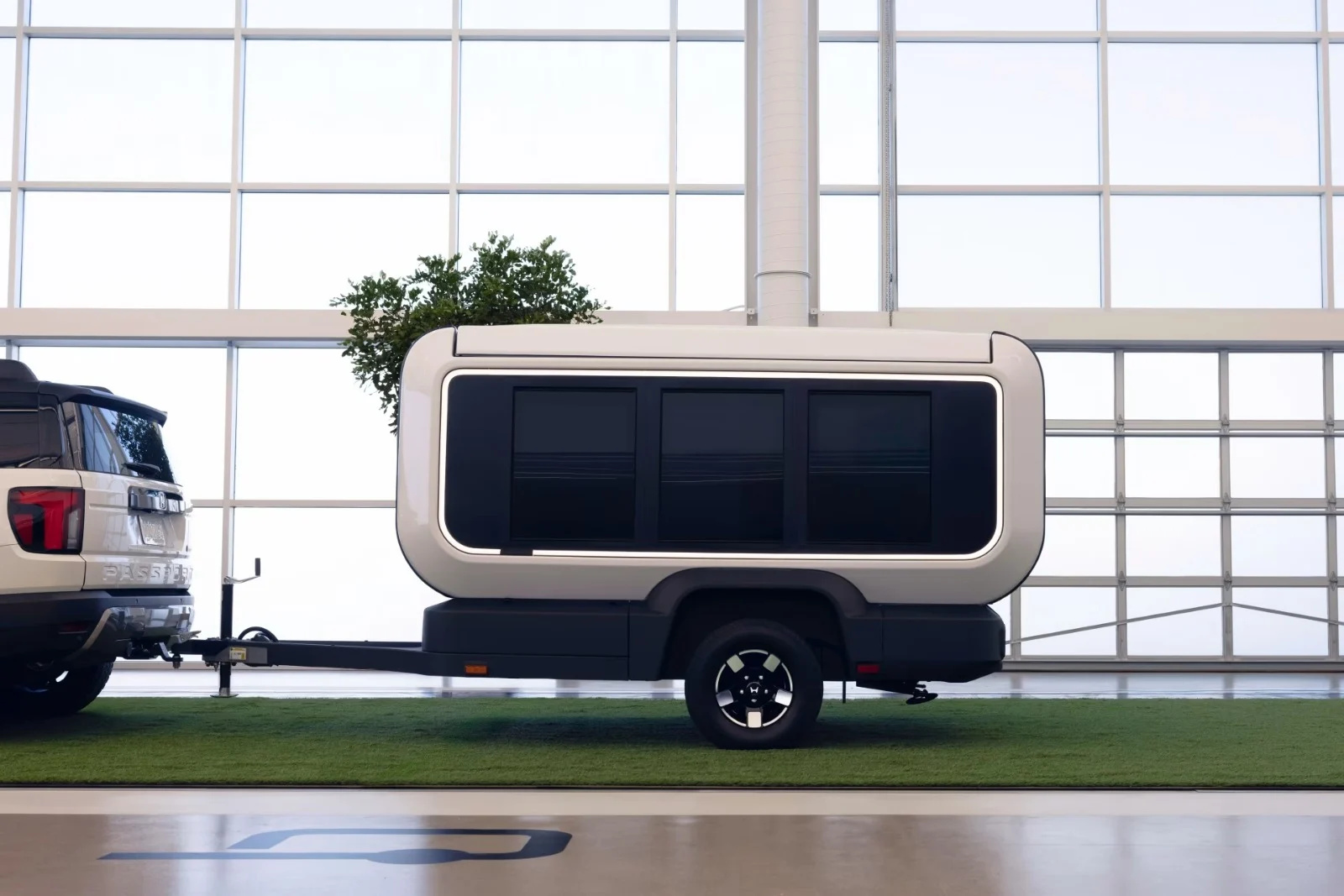
Honda’s Base Station Trailer Uses Solar Panels, Modular Kitchen, and Weighs Less Than 680 kg, Allowing Off-Grid Camping with Passenger Cars.
Honda decided to tackle a real problem in modern camping: a good portion of trailers require large, fuel-consuming, and expensive vehicles to tow. In the United States, this means full-size pickups and mid-size SUVs, which limits access to mobile tourism and discourages drivers of sedans, compact cars, or electric vehicles. To change this scenario, the brand introduced the Base Station, a modular trailer developed by Honda’s Research and Development Department in California, aimed at an audience looking for mobility, comfort, and energy autonomy without needing a truck to pull it.
Although still a prototype, the concept caught attention for its engineering logic: reducing weight and maximizing efficiency to allow common cars — like a Honda Civic, an HR-V, or even compact electrics — to tow the structure. It is a movement that aligns with recent trends in the U.S., where the interest in short trips, remote work, and “off-grid” experiences in natural areas is growing, without giving up basic comforts.
Less Than 680 kg: Weight as a Technological Key
The Base Station weighs less than 680 kg, a crucial figure for understanding the project. In the U.S., lightweight trailers fall into simpler licensing categories, do not require special licenses, and drastically reduce the towing vehicle’s fuel consumption.
-
Less than a Tera TSI, up to 710 km of range and charging in 9 minutes: the new BYD Song Ultra expands the Chinese brand’s bet on increasingly faster, more technological, and competitively priced electric SUVs.

-
With a 1.0 engine producing 75 hp and costing less than R$ 70,000, Fiat’s car returns to the podium as the cheapest in the country; a temporary promotion for the 2026 Like version reduces the price of the Fiat Mobi.
-
With a mild hybrid system of 48 V, 176 hp and a price of R$ 175,990 in the Sahara version, the new Jeep Renegade changes mostly on the inside, improves slightly in fuel consumption, and remains almost the same car.
-
With a 293.5 cm³ engine and a range of up to 400 km with a 14.1-liter tank, the Honda CB 300F Twister 2026 has up to 24.7 hp, an initial price of R$ 25,150, and already exceeds R$ 29,000 in the Fipe Table.

For electric vehicles, the impact is even more relevant: the heavier the trailer, the lower the range. With such a low mass, Honda’s concept preserves the range of EVs on long journeys and reduces stress on the battery.
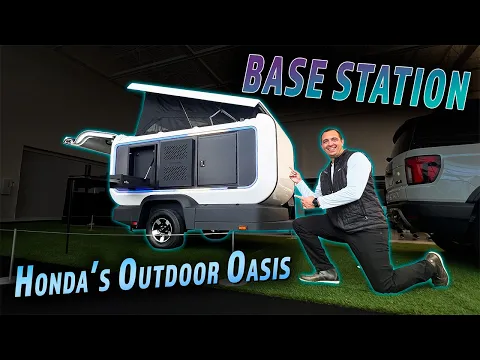

This point directly addresses what the project leader, Dillon Kane, defines as “the barrier to modern camping”: it is not just the cost of the trailer, but the cost of having the right vehicle to tow it. By allowing smaller cars to perform this function, Honda is targeting a market that is currently underserved.
Compact in the Garage, Expandable in the Field
Another challenge in the segment is urban logistics. Many trailers are too large for residential garages, requiring external parking, which increases costs or limits usage.
The Base Station solves this with compact dimensions in closed configuration, allowing it to fit in standard garage spaces in homes and condos.

Parked at the campsite, the trailer expands vertically. The roof rises and creates a ceiling height of 2.13 meters, a detail that completely changes internal comfort — those who have traveled in low trailers know the impact of being able to stand up without constantly bending down.
According to Honda, the space accommodates up to four people, with a queen-size futon and a twin bunk bed, something uncommon in models of this weight category.
Modular and Multifunctional Interior
Inside, the Base Station does not try to replicate a luxurious mini home; it bets on modularity. A rail system allows to remove or reposition furniture without complex tools.
This serves three main uses:
- Traditional bedroom for families on short trips.
- Mobile office, important in remote work times.
- Storage unit for sports equipment — Honda cited kayaks and motorcycles as examples.
This type of modulation is rare because traditional trailers are fixed, with permanent carpentry. The Japanese concept provides flexibility without adding weight or complexity.
Internal amenities include air conditioning, LED lighting, and a shower, but the most curious solution is on the outside: a kitchen that slides out from the body, optimizing food preparation in an open environment, reducing internal steam, and freeing up space.
Solar Power and Autonomy: 200 W + 4 kWh
Honda’s bet on autonomy is clear. The roof features 200 watts of solar panels connected to a 4 kWh LFP battery (lithium iron phosphate), a more stable and durable chemistry increasingly used in electric vehicles.
This set eliminates the dependency on combustion generators, common in American campgrounds, which are noisy and polluting.
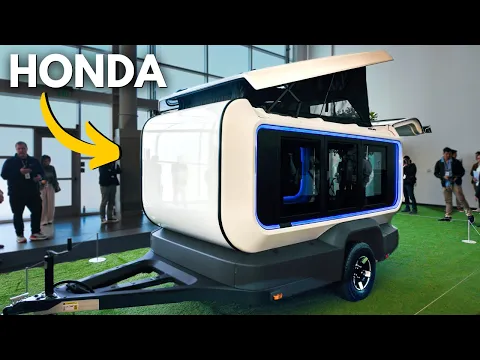
According to the engineering team, the battery powers lighting, ventilation, electrical equipment, and the small kitchen, ensuring a weekend “off-grid” without the need for external recharging. It is exactly the type of experience sought by those who camp in forests, deserts, or mountainous areas.
Furthermore, by reducing infrastructure needs, the trailer connects with trends in sustainable tourism and the growing market of electric mobility. For those driving an EV, every watt recovered or stored makes a difference.
A Trailer That Changes the Market or an Experiment?
For now, the Base Station is an experimental concept, presented to gauge public and commercial reaction. If approved, it could inaugurate a new category in the North American market: lightweight, urban, electric, and modular trailers aimed at an audience that does not want (or cannot) maintain a pickup truck.
It’s hard to ignore the context: pickups and traditional RVs still dominate camping in the U.S. but represent high investments and rising operational costs. A trailer that fits in the garage, does not require a truck, and generates its own energy responds to a real demand.
As Dillon Kane stated, the goal is “to remove the necessity of purchasing a larger vehicle just to tow a trailer,” something that could redefine the profile of those who practice mobile tourism in the country.
Whether this solution will hit the streets remains uncertain. But if Honda’s goal was to prove that there is another way to explore the idea of a trailer, the Base Station fulfills the mission: it is compact, lightweight, solar, modular, and, above all, towable by a Civic, a detail that says a lot about the future of tourism.








Seja o primeiro a reagir!