





 Portuguese
  English
  Spanish
  4 min of reading
  1 comment


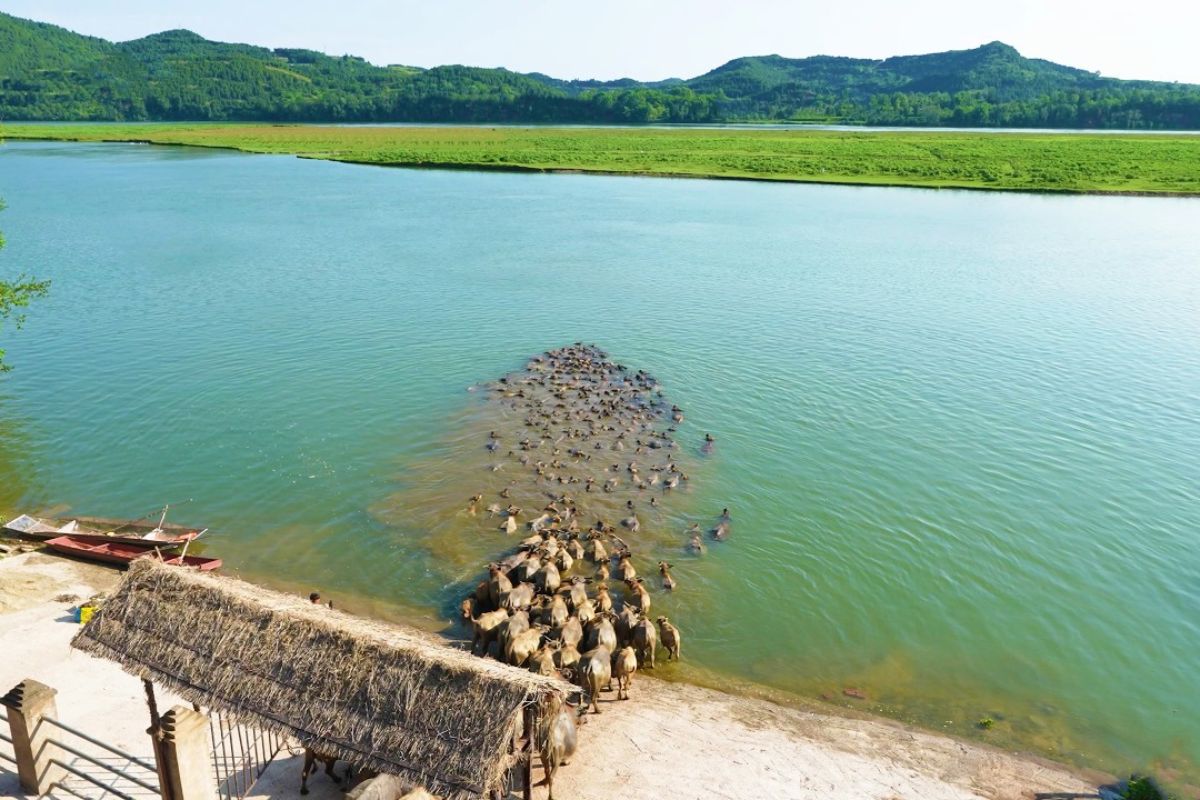


Daily Show of Buffaloes Crossing the Jialing River Transforms Interior of China into “Aquatic Migration”
Nearly 300 buffaloes crossing the Jialing River at dawn and dusk transform Peng’an County in Sichuan into a rare ecological “show,” with herds swimming to green islands in the middle of the river to graze. The sight of cattle lined up in the water has become a permanent attraction, earning the location the nickname of “Great Migration of Life” Chinese version.
In practice, what started as a forced adaptation to the floods of the Jialing River has turned into a daily phenomenon that blends animal instinct, traditional management, and human curiosity. Today, buffaloes crossing the Jialing River in unison, led by a dominant bull, are filmed, photographed, and followed by locals, tourists, and influencers in a mountainous region that was previously unnoticed on the map of China.
The Routine of Buffaloes Crossing the Jialing River
Every morning, still with the sun low, nearly 300 animals leave the pen in Peng’an, descend to the riverbank, and enter the water as a group.
-
Sprinkling dry baking soda directly on the carpet neutralizes odors from sweat and food without wetting the fibers, allowing you to forget about the vacuum cleaner for weeks using a product that costs less than five reais.

-
A bottle thrown into the sea by two Australian soldiers in 1916 on their way to the trenches of World War I was buried in the sand for over 100 years, and the letters inside it were still legible when they were found.
-
China invests over R$ 4.2 trillion, builds the largest water network in the world with 95,000 reservoirs and 1 trillion m³, expands piped water access to 96% of rural areas, attracts R$ 565 billion in foreign investments, and advances with the “longevity gene” in rice.
-
Heineken’s factory in Brazil surprises the world by reducing water consumption for beer production from nearly 10 liters to just 2.2 liters per liter produced, achieving a 23% decrease with real-time technology.

This is the beginning of the scene that made the image of buffaloes crossing the Jialing River famous, as if they were in an aquatic version of the great African migrations.
Led by a “king bull,” adults and calves form a compact column, moving upstream until they reach two small islands, referred to by locals as Sun Island and Moon Island.
There, in fenced grazing areas divided into strips, the herd spends the day feeding, resting, and interacting.
At the end of the afternoon, the movement reverses: the same orderly flow of buffaloes crossing the Jialing River returns to the main bank, reinforcing the impression of a natural choreography repeated day after day.
How a Hydroelectric Plant Created an “Aquatic Migration” in Peng’an
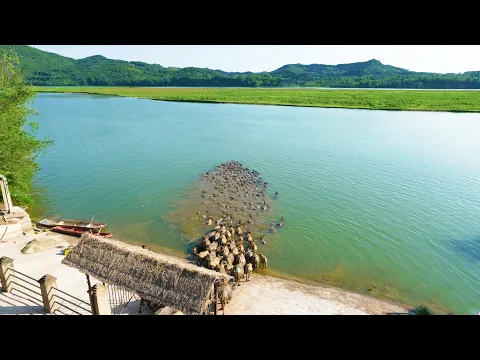

The phenomenon did not arise from tourism planning, but from a concrete environmental change.
In 1994, the filling of the Mahui Hydroelectric Power Plant reservoir raised the water level of the Jialing River and altered the local geography, flooding former pasture areas and highlighting islets with taller and more resilient vegetation.
To avoid food loss, ranchers began leading the animals to this new area, and the herds developed a daily habit of crossing the river.
Over time, this routine of buffaloes crossing the Jialing River to access more abundant grass became established as a conditioned behavior and, at the same time, a survival strategy in case of floods.
The mass crossing reduces the risk of the cattle being isolated when the water level suddenly rises.
Ecological Management and Herd Behavior
On the island, management follows a simple and efficient logic. Fences divide the pasture into sectors, allowing each area to rest while another is used, which helps maintain vegetative cover.
The cattle alternate consumption sections, ensuring that the grass has time to recover and preventing rapid soil degradation.
Another detail observed in the field reinforces the image of ecological management: animals tend to avoid defecating in the flatter and more vibrant grazing areas.
Instead, they concentrate their waste in depressions and specific points, keeping the green carpet clean and more pleasant for the herd itself.
The result is a landscape that combines mountains, clean water, and buffaloes crossing the Jialing River in an almost theatrical setting, yet supported by practices that enhance pasture quality.
Tourism, Local Culture, and the Spectacle of the “Hundred Heads of Cattle”
With the popularization of videos, the site has started to attract more and more visitors interested in recording the crossing.
Farmers, domestic tourists, and content creators share space in improvised viewpoints on the bank, while ferries operated by locals take part of the audience to the island to see the animals up close after their arrival.
The scene of buffaloes crossing the Jialing River in unison between the bank and the islands has become a regional postcard and is regarded by locals as a cultural heritage associated with Peng’an County.
The crossing, repeated daily from April to October, has solidified as a symbol of coexistence between rural production, adaptation to river changes, and appreciation of the natural landscape.
A “Sanctuary” Among Mountains, Water, and Silence
Surrounded by mountains, with the Jialing River at its center and islands covered in vegetation, the scenery in Peng’an resembles an isolated valley with its own dynamics.
The combination of topography, water, herd, and routine transforms the space into an “ecological stage” that renews itself every day, without relying on artificial structures.
For those observing from outside, the impression is of a rare balance between rural work and natural spectacle: the ranchers ensure food and income, while the public witnesses a scene that seems to come straight out of a documentary.
Amidst all this, the central idea remains of a place where mountains, river, and buffaloes crossing the Jialing River synthesize, in a few minutes, the meeting of tradition and landscape.
In your place, would you face the mountain road and the boat just to see up close this “aquatic migration” of Peng’an, or does the scene of hundreds of buffaloes in the water still seem too incredible for you to believe without being there?







Fantastic video. But horns/antler of buffalos have very wide curve so not attractive. Buffalos in Pakistan are much prettier because of having very closely box horns and lucrative with plenty of milk