





 Portuguese
  English
  Spanish
  9 min of reading
  1 comment


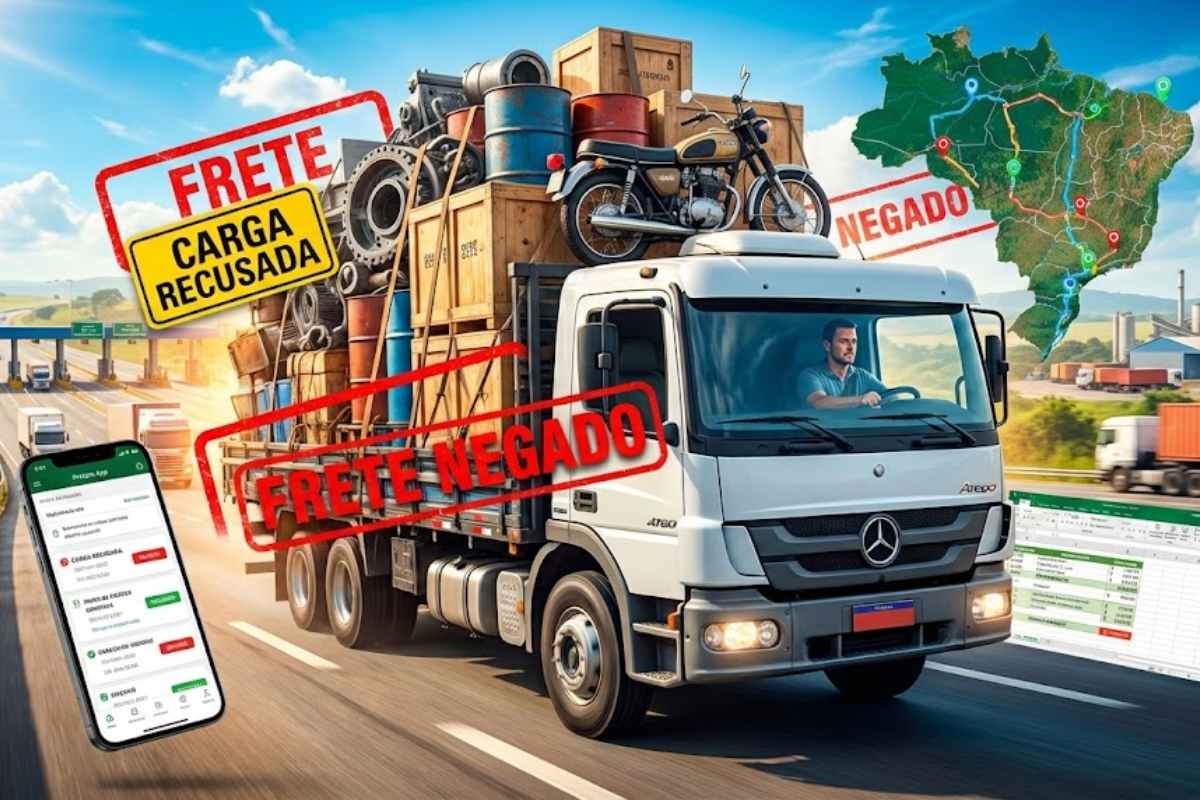


Between Denied Registration, Distrustful Freight Agency, Rare Additional Charge, and Over 5 Tons Load Rejected, the 3/4 Truck Driver Opens the Notebook, Details Negotiations, Shows Values per Route, and Reveals How Much Actually Remains in His Pocket After Driving for an Entire Week, Without Hiding the Hardships, Risks, Rejections, and Difficult Decisions
A 3/4 truck driver who lives off his freight intuition, a regular week on the road, several deals on the table, and many opportunities that seem good but end up in losses if he doesn’t do the cold calculations. The routine that appears in a few minutes of video is, in practice, a board of decisions all day long, where each call, each registration, and each additional charge can either save or ruin the revenue.
Throughout seven days, this 3/4 truck driver crosses states, loses freight due to denied registration, rejects loads too heavy for the equipment, drives kilometers almost empty just to avoid pushing the truck too hard, and in the end, reveals the numbers. The result shows a gross amount close to R$ 10,000 for the week, but it also exposes the side that many people ignore: wear and tear, risk, downtime, and bureaucracy deciding whether the invoice will cover the diesel costs or not.
The Beginning of the Week: Denied Freight, Stalled Registration, and a Game of Patience

The week for the 3/4 truck driver begins in Cascavel, on a Wednesday, with three important freight opportunities in front of him.
-
Masterpiece in Spain, under construction since 1882, receives 4.8 million visits in a year and impresses with its gigantism and architecture.

-
Attracting around 250,000 people a year, a lighthouse 200 meters from the sea, on a 60-meter high cliff, on the North Sea coast in Denmark, becomes one of the most impressive examples of how nature can threaten historical buildings.

-
The narrowest house in the world is only 63 centimeters wide, but inside it can accommodate a bathroom, kitchen, bedroom, office, and even two staircases.

-
In the middle of the sea, these enormous concrete and steel structures, built by the British Navy to protect strategic maritime routes, look like they came straight out of a Star Wars movie.


The first, to Campo Novo do Parecis in Mato Grosso, comes with a value below what he considers fair.
He asks for R$ 8,500, closes at R$ 7,500, sends all the details, and hears the cold water bucket: registration denied by the insurer, with no clear explanation.
Right after, another freight appears, shorter, around 500 kilometers in total, partially empty, partially loaded.
It was a bulky load of 1,500 kilos, which could only fit in a 3/4 truck with a box. It would pay R$ 3 per kilometer, a good rate for the route.
He sends the details again and hears the same “no”, this time with a justification: an old criminal case appears in São Paulo, related only to his name, not to the CPF or complete details.
To avoid being stuck in this shadow, he contacts a lawyer, seeks a certificate of good conduct, and devises a strategy: to prove that the issue is a name similarity, not a history that actually belongs to him.
The legal solution still takes time, so the immediate exit is simple and pragmatic. He continues to drive but becomes even more dependent on freight apps, especially Frete BR, where his registration is clean and validated.
When the 3/4 Truck Driver Hits the Freight that Holds the Week

At the end of the day, the freight that changes the mood of the week comes in. In Cascavel, a load of around 2,700 kilos, five pallets, for Jardinópolis, deep in São Paulo, emerges.
Closed value: R$ 3,500 for freight. The 3/4 truck driver seizes the opportunity, rushes, manages to load on the same day, and turns what would have been a lost Wednesday into the first pillar of revenue for the week.
After unloading in the São Paulo countryside, he does what every experienced 3/4 truck driver does: he doesn’t wait for “the perfect freight” to fall into his lap.
He searches for a regional load to avoid driving empty. A route of about 200 kilometers appears, something around 2 tons, for R$ 400 for freight.
It’s little in absolute value, but significant in strategy.
This additional charge covers diesel, food, and keeps the truck moving in the right area, close to the major logistical corridors of the Southeast.
Average Freight, Paid Toll, and the Choice Between Driving or Staying Still

Next, with the truck in São Paulo, a freight of 860 kilometers to Chapecó comes up.
The load is light, and the package comes with R$ 2,600 for freight plus paid toll. It’s not the “dream freight”, as he admits, but it’s Saturday, the truck is empty, and time is against him.
Here enters the typical math of a self-employed 3/4 truck driver:
Driving on weekends with average freight is better than staying two days parked waiting for something better.
If he refuses, he might get the same amount on Monday, but with the waiting costs of food, shower, parking, and lost time adding up.
He accepts, heads towards Chapecó, and on the way begins the most important game of the week: looking for freight back even before reaching the destination.
It’s the kind of discipline that separates those who just drive from those who truly manage their own business on wheels.
App Open All the Time and the Logic of the Right Additional Charge
With the truck unloaded in Chapecó, the 3/4 truck driver finds himself in one of the most delicate scenarios of the profession: an area with freight, but nothing fits well in weight, route, or deadline.
A proposal for an additional charge of 2 tons for R$ 2,000 comes up, and another for 800 kilos for R$ 1,000, forming a total of about R$ 3,000.
He talks, tries to improve, but not everything works in practice.
In parallel, a suspicious load appears in an empty company with a closed warehouse, and he does what an experienced professional needs to do: he prefers to lose a freight than to enter into a shady operation, even with the money tempting him.
At another moment, he faces an auction, a complicated yard, a cheap plate request defined by the contractor, and opts out.
Amid this chess game, he finds a simpler option leaving Londrina: freight of R$ 700 for about 1,300 kilometers, with half a load occupied.
It’s not a spectacular deal, but it counts as an intermediary piece, helping to bring the truck closer to the desired route and keeping the box occupied on the way.
The Load Too Heavy and the No That Protects the Truck
Back in his home region, the 3/4 truck driver receives a proposal that, on paper, looks good: a load to Tocantins, announced value of R$ 7,000, with room to negotiate up to R$ 7,800, an interesting route for those looking to go up.{
He has loaded for the same company before; the relationship exists.
However, when it’s time to load, reality sets in: 204 barrels of 25 kilos, totaling 5,100 kilos.
With the additional 200 kilos he had already taken in Chapecó, the total exceeds 5,300 kilos, too heavy for the truck setup and the initial proposal.
He declines, even with the shipper offering an extra R$ 1,000 to close the deal.
This “no” is a central point of the week. If he accepts, he exceeds the technical limit of the truck, strains the brakes, suspension, tires, increases the risk of an accident, and compromises the business in the long term.
By refusing, he loses a good immediate value but preserves equipment, reputation, and the potential to continue working without mechanical or legal headaches.
The Golden Additional Charge and the Stop at Home Midway
The turnaround comes again from Chapecó. The 3/4 truck driver finds a load of only 200 kilos, on a pallet, to Pirajuba, in the interior of Minas Gerais, for R$ 2,800 for freight, with a route that practically goes by his home.
The weight cost is insignificant, the price per kilo is extremely high, and the route is smart.
He takes the opportunity to do what few self-employed can fit in during the rush: stops at home in the middle of the trip, arrives at dawn, sleeps a few hours, changes the engine oil, keeps the maintenance up to date, and gets back on the road with everything in order.
This combination of small maintenance, rest, and well-paid freight shows the managerial side of the 3/4 truck driver, who doesn’t just think about the day but about the health of the truck throughout the year.
Next, he still fits another leg of R$ 700 from Londrina to the interior of São Paulo, keeping the box occupied and avoiding long periods of driving completely empty until the final delivery in Pirajuba.
Each segment is smaller individually, but at the end of the week, it’s the sum of several medium and small freights that sustains the revenue.
How Much the 3/4 Truck Driver Really Earned in the Week
As the video approaches the end, he prepares to “open the game” and show the weekly summary.
Based on the values narrated and actually loaded, it’s possible to organize the gross revenue as follows, only with what was shown on camera:
Cascavel → Jardinópolis: R$ 3,500
Regional leg of about 200 km: R$ 400
Interior of São Paulo → Chapecó: R$ 2,600 plus paid toll
Londrina → interior of São Paulo: R$ 700
Chapecó → Pirajuba, via home: R$ 2,800
By adding only these confirmed freights, the 3/4 truck driver finishes the week with around R$ 10,000 in gross revenue, not including tolls that the client reimbursed and not factoring in freight he refused due to risks, excess weight, or confusing bureaucracy.
On the other side of the bill, diesel, food, maintenance, tires, oil, taxes, apps, insurance, and any days off need to be accounted for, which don’t show up on the price tag but eat a significant portion of that amount.
Even so, the week shows that a 3/4 truck driver who is attentive to additional charges, routes, and risks can build a consistent revenue, even when losing good freights due to registration, name similarities, and equipment limits.
The Logic Behind Choosing the 3/4 Truck
Throughout the narrative, the driver himself reinforces why he chose to be a 3/4 truck driver instead of working with a van or a larger truck.
The 3/4 occupies an intermediate space: it carries refrigerators, cabinets, heavy motors, bulky pallets, and goods that won’t fit in a utility vehicle, but it can still enter tight docks in big cities and secondary roads in the countryside.
He recalls that a van is an “express” vehicle, ideal for quick, well-paid deliveries, but these almost never appear on large freight apps.
On the other hand, a heavy truck competes in a different market, with higher capital requirements, greater risk, and elevated costs.
The 3/4 truck driver occupies the middle ground: gaining in weight and cubing compared to the van and has more opportunities for fractional freight than larger vehicles, especially when he knows how to scout apps, agencies, and direct customer contacts.
At the same time, he shows that the equipment requires care: avoids loads above 5 tons, steers clear of excess that could break axles or overload the suspension, invests in cabin improvements, considers building drawers for clothes, wrapping the interior, and refurbishing the seat.
All of this reinforces that the 3/4, in the hands of someone who knows how to use it, becomes a small business on wheels that needs to be treated as such.
Flexibility, Quick Math, and Keeping an Eye on Freight
At the end of the week, the portrait that remains is of a 3/4 truck driver who doesn’t rely on luck, but rather on route reading, firm negotiation, and the courage to say no.
He declines good freight on paper to avoid damaging the truck, avoids suspicious operations even with a closed warehouse and cash on the table, endures denied registrations due to name similarities without ceasing to look for loads, and keeps the app open even at the unloading time.
More than the final number, the story shows that the income of a 3/4 truck driver comes from the sum of dozens of small daily decisions, often made alone, in a truck stop yard, with the phone in hand and the truck running while waiting for the next destination.
Those who only see the gross amount for the week overlook all the denied freights, kilometers driven almost empty, risks avoided, and the mental calculations made between one call and another.
And you, if you were to live like a 3/4 truck driver in this routine of freights, refusals, and tight budgets, would you accept a heavier load paying more or would you follow his example and say no to protect the truck and your wallet?









Por isso que carga fechada 5.000kg sai como “complemento” só ladeira abaixo,não falou o principal o gasto, porque a máxima persiste ” o principal não é o quanto ganha é o quanto gasta” só uma dica de quem está no mercado a 20 anos, frete de 3/4 tem que ser cobrado a ida e a volta e é frete÷3=custoposto/custocaminhao/sobra do caminhoneiro e faz o salário desse último de outro jeito é só bagunça e esperar a falência.