






 Portuguese
  Spanish


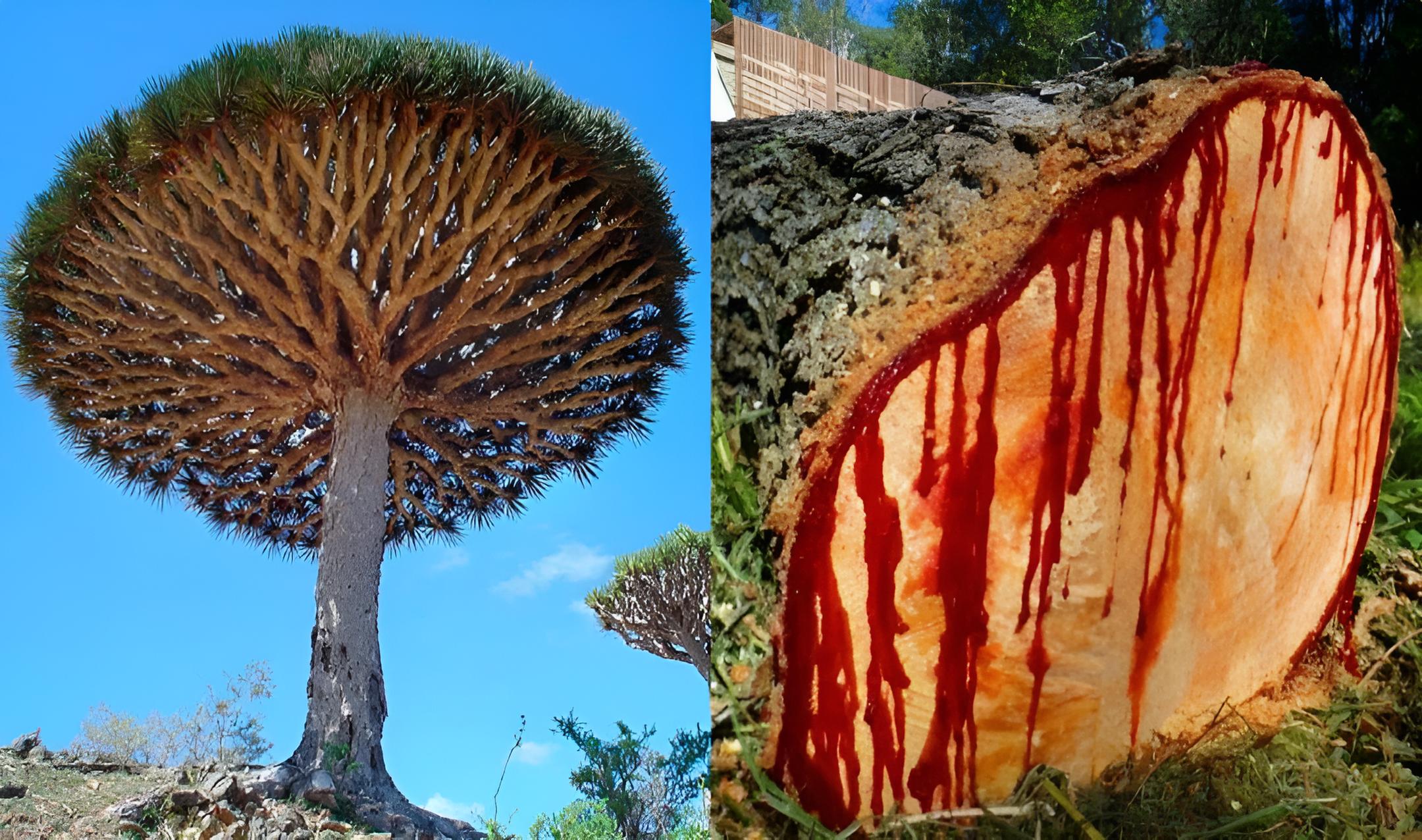


The Tree That Bleeds Red Resin Rich in 80 Bioactive Compounds and Originating from 20 Million Years Intrigues Scientists and Has Become One of the Most Enigmatic Organisms in the World.
In a world where tropical forests, savannahs, and deserts follow relatively predictable biological patterns, there exists a tree that defies classifications and seems to have emerged from its own universe. With a massive trunk, an inverted umbrella-shaped canopy, and an interior capable of releasing a bright red liquid similar to blood, the Dracaena cinnabari, known as the “dragon’s blood tree,” is one of the most intriguing species ever documented by modern botany. Its strange appearance, unique biology, and resin with medicinal properties documented for millennia have made it one of the most studied organisms by herbalists, archaeologists, and specialists in arid biodiversity.
The tree not only impresses with its appearance. It produces a red resin whose chemical composition includes over 80 bioactive compounds, including complex flavonoids, proanthocyanidins, plant alkaloids, and high-purity tannins, substances that vary according to the plant’s age and environmental conditions. There are reports that extraction can yield up to 1 or 2 liters of resin over several incisions — a process that needs to be controlled, as the plant grows slowly and takes decades to reach maturity.
A Tree That “Bleeds” Shaped by Isolation and Extreme Climate
Dragon’s blood trees are mainly concentrated in environments of medium altitudes, where sea mists reach cliffs and plateaus.
-
Ferrari, BMW, Tesla, and Chinese Automakers Shift from Copper to Aluminum Wiring to Reduce Weight and Costs in Electric Vehicles

-
Understanding Plastic Codes: Numbers 1 to 7 on Packaging Aid Efficient Recycling and Boost Circular Economy

-
400 km² of Greenhouses in Almería, Spain, Astonish American Visitor by Producing Millions of Tons of Produce for Cold-Weather Markets
-
Antarctic Volcano Emits Microscopic Gold Particles That Travel Up to 1,000 Kilometers Across the Continent




The structure of the umbrella-shaped canopy is not an aesthetic detail: it has been shaped by evolutionary pressures that required maximum moisture capture in regions where rain has become increasingly rare.


Studies conducted by researchers from Aden University and expeditions funded by UNESCO show that the canopy acts as a natural collector: the leaves channel water from nighttime mists to the trunk, allowing the tree itself to “create” its source of irrigation.
This adaptation explains why the species can survive in regions that, climatically and geologically, would be inhospitable to almost any other large plant.
The dense and highly fibrous wood, combined with thick sap, provides resistance against strong winds, erosion, and long periods of drought. The tree grows slowly, very slowly. Botanical estimates indicate that an adult specimen can be between 200 and 400 years, although some records point to millennial individuals.
The Red Resin: A Unique Biochemical Compound
Commonly referred to as “dragon’s blood,” the red liquid released by cuts in the bark has always sparked fascination. In chemical analyses conducted by the Royal Botanic Gardens, Kew, the following were isolated:
- uncommon flavonoids,
- polymerized plant resins,
- antioxidant proanthocyanidins,
- phenolic compounds with healing properties,
- natural pigments with unusual structures.
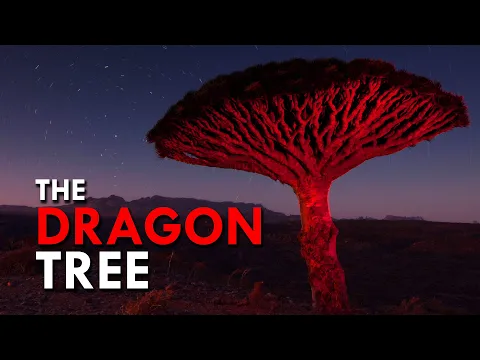
The resin was used as medicine in Mesopotamia, Ancient Egypt, Greece, China, and later in medieval Europe, appearing in papyri, clay tablets, and pharmacological treatises. It was applied as:
- healing agent,
- anti-inflammatory,
- ink and varnish,
- ingredient in religious rituals,
- natural preservative,
- aristocratic pigment in manuscripts.
Today, part of this tradition continues, and the resin is still being studied in pharmaceutical laboratories investigating the antiviral, hemostatic, and antioxidant properties of isolated compounds.
A Botanical Structure That Challenges Architects and Ecologists
The architecture of the tree is so peculiar that biomimetic architects have studied its structure to apply similar principles in water capture projects, urban shading, and structural resistance without visible central supports.
The branches branch out in almost mathematical geometric patterns, forming a network that expands horizontally and, when viewed from above, resembles fractals. This shape evenly distributes weight during sporadic storms and prevents branches from yielding under strong winds — an essential adaptation in regions with shallow, rocky soils.
From an ecological standpoint, the tree plays a critical role:
- provides shade for smaller species,
- houses endemic birds and insects,
- stabilizes vulnerable soils,
- influences local microclimates.
Thus, its loss — accelerated by desertification, uncontrolled grazing, and climate change — poses a real risk to entire ecosystems.
Science Tries to Save a Species That Ages Without Replacement
In recent years, reports from the Socotra Conservation Fund and studies published in the journal Biological Conservation have alerted to a serious problem: the natural regeneration of the species is extremely compromised.
The majority of young trees cannot survive the current climatic conditions, which are much drier than they were centuries ago, and the pressure from grazing prevents seedlings from reaching adulthood.
Climate models project that, without human intervention, up to 45% of the current distribution of the species could disappear by the end of the century. Therefore, reforestation programs, controlled seed collection, fencing of regeneration areas, and international genetic banks are being set up to ensure that the species does not go extinct.
The Enigma That Continues to Intrigue Science
Despite decades of studies, the tree continues to hold mysteries. Researchers are still trying to understand:
- why its resin contains so many rare bioactive compounds;
- how ancient genetic variants have remained almost intact;
- how the tree survived extreme climatic cycles;
- how its canopy structure evolved to capture water so efficiently.
Each scientific expedition returns with more questions than answers, which is why the dragon’s blood tree is treated as a “living laboratory” of evolution, natural chemistry, and biological resilience.
Its iconic image — a trunk that seems petrified and a “blood” red that escapes at the slightest cut — continues to fascinate specialists, travelers, and photographers around the world. And, while ecologists try to preserve the last remnants, the tree persists as a silent witness to a planet that has changed drastically since its origin millions of years ago.








É necessário manter a natureza viva e no seu devido lugar! A natureza é uma fonte de vida para todos, sem ela não teríamos oxigênio na terra.