





 Portuguese
  English
  Spanish
  3 min of reading
  0 comments


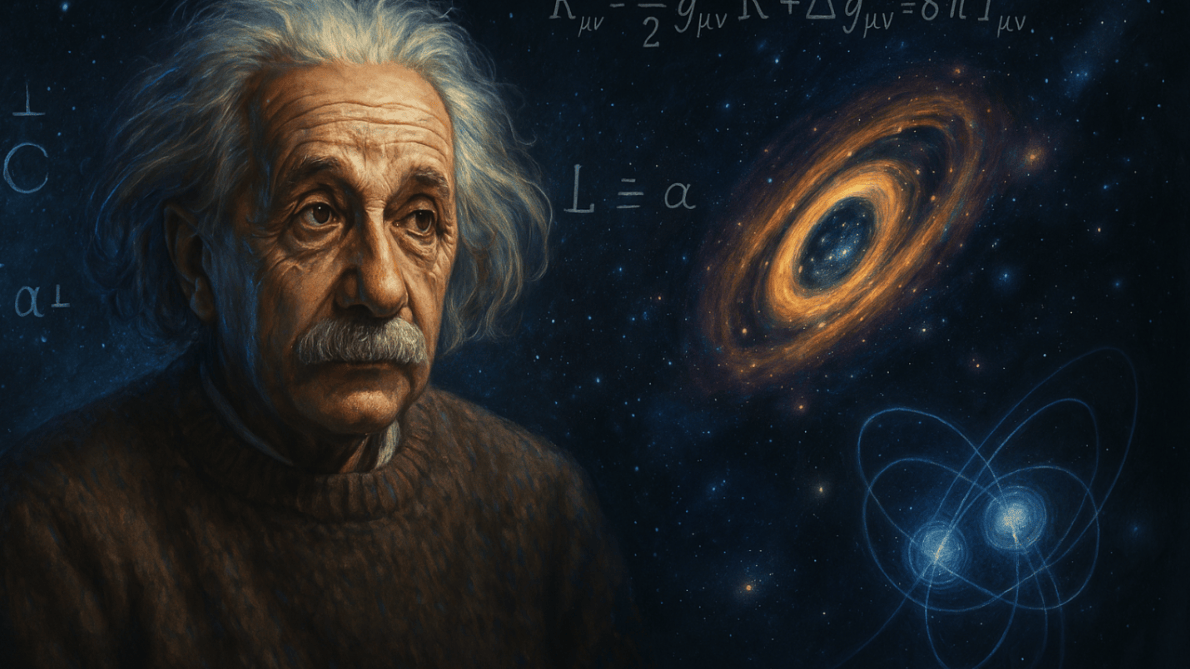
Discover How Three Mistakes by Albert Einstein Contributed to Important Discoveries in Modern Physics, Revealing the Impact of His Theories on Current Science.
In a scenario where even geniuses make mistakes, the errors of Albert Einstein prove fundamental for the advancement of physics and the refinement of theories that transformed our understanding of the Universe.
The renowned physicist, responsible for the famous theory of relativity, also faced moments of doubt and made slips that over time revealed new pathways for science.
The Dilemma of the Cosmological Constant
During the development of his revolutionary general theory of relativity, Einstein encountered an unusual challenge: calculations demonstrated that gravity could cause both the contraction and expansion of the Universe. At the time, the accepted view among scientists was of a static cosmos.
-
A new technology attached to the helmet can detect motorcycle accidents in seconds, assess the severity, and send the location to emergency services; meet Quin, a small smart device.

-
The bizarre train that uses Cold War jet fighter engines to blast air at over 1,000 km/h, melting ice walls and freeing frozen tracks in minutes where ordinary machines would take hours.

-
Japan is transforming dirty diapers from babies and the elderly into an ambitious and surprising project that could forever change the way the world deals with one of the most difficult types of waste to dispose of.

-
Hidden marks on the walls of the site associated with the Last Supper of Jesus for centuries have been deciphered in Jerusalem, revealing medieval inscriptions left by pilgrims, European nobles, and travelers from the Middle East.


To reconcile his calculations with scientific orthodoxy, the physicist introduced the so-called “cosmological constant” in his equations, neutralizing the gravitational effect.
Although this intervention was considered a mistake by many for decades, more recent studies suggest that this modification may have surprisingly anticipated the discovery of the accelerated expansion of the Universe.
Today, with evidence of dark energy, some scientists believe that Einstein’s cosmological constant may play a crucial role in explaining this phenomenon, demonstrating that sometimes what seems to be a flaw can reveal a valuable insight for physics.
The Discovery of Gravitational Lenses
Another significant episode occurred when the general theory of relativity predicted that the massive presence of an object, such as a star or a galaxy cluster, could bend the light from objects situated behind it, acting as a natural lens.
Initially, Albert Einstein believed that this effect was virtually imperceptible and even hesitated to publish his calculations.
However, a convincing argument from a Czech engineer caused him to reconsider his position.
With the publication of his studies on gravitational lenses, a new chapter in astronomy opened, allowing for the observation of distant galaxies in more detail through instruments like the Hubble Telescope.
Thus, even what was initially considered a mistake transformed into an essential tool for expanding our knowledge of the cosmos.
The Challenge to Quantum Mechanics
The third episode pertains to Einstein’s view on the foundations of quantum mechanics.
While his pioneering work outlined the contours of modern physics, the physicist always expressed skepticism regarding the probabilistic interpretation and the inherent uncertainty of subatomic particle behavior.
On several occasions, he expressed his belief that “God does not play dice,” summarizing his resistance to the idea that reality could exist in multiple simultaneous states until observation.
Even having significantly contributed to the theoretical foundation that would support quantum mechanics, this critical view led Einstein to develop thought experiments with colleagues, such as the famous paradox involving quantum entanglement.
This debate, which lasted decades, ultimately drove new discussions and developments in quantum theory, demonstrating how opposition to certain interpretations can surprisingly enrich the field of physics.
Albert Einstein’s “mistakes,” far from mere failures, represent important turning points that propelled the evolution of physics.
Each slip or doubt opened doors to debates that culminated in significant advancements, both in the theory of relativity and in quantum physics.
Today, looking back, we see that critical thinking and the willingness to question established knowledge are, in fact, essential pillars for scientific progress.
Thus, Einstein’s trajectory reinforces the idea that even the greatest human geniuses possess an imperfection that can transform into a revolutionary engine for science.








-

2 pessoas reagiram a isso.