





 Portuguese
  English
  Spanish
  4 min of reading
  0 comments


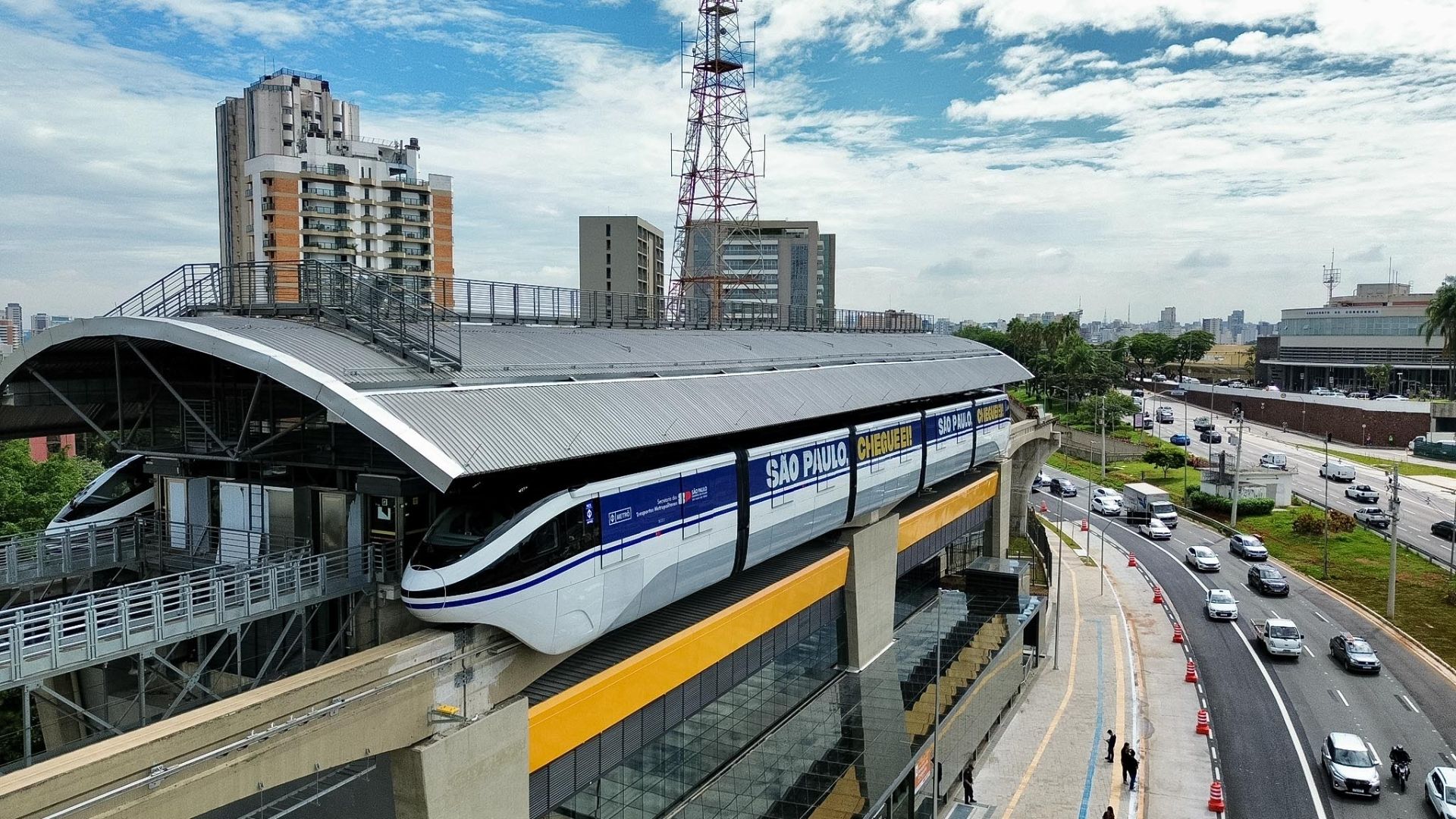
After years of waiting, the capital of São Paulo finally integrates the airport into the metro-rail system with monorail technology and promises to transform urban mobility
Congonhas Airport, one of the busiest in Brazil, now has a direct connection to São Paulo’s metro-rail system. The information was disclosed by “Government of SP,” which confirmed the inauguration of the Congonhas Airport station, integrated into Line 17-Gold, marking a historic advancement in urban mobility for the capital.
The new structure represents a milestone not only for the city but for the entire country. After all, it is the first Brazilian airport to have a subway station physically connected to the passenger terminal. This way, passengers, workers, and users now have a faster, more efficient, and safer alternative to access the airport.
Additionally, the station was built on the lower level of the terminal and connected via a tunnel under Washington Luiz Avenue. This makes access smoother and safer, eliminating the need for external travel and significantly reducing travel time.
-
Goodbye, concrete: a new trend in civil construction reduces the weight of the structure by up to 30%, accelerates projects by up to 40%, cuts costs on steel and labor, and improves thermal insulation with EPS.
-
Russian engineers create an innovative propeller blade for aircraft that could completely change the way airplanes and helicopters operate.

-
Couple finishes building PVC chalet on the beach on the last day, with air conditioning and curtains, but discovers the bathroom drain is inverted: water escapes from the drain, risking breaking the floor, and the rush continues before the trip.

-
Niterói surprises with a mega project of R$ 34 million and advances in the new Caramujo Bus Terminal, promising to revolutionize urban mobility by 2027.

Line 17-Gold: billion-dollar investment and promise to transport 100,000 passengers per day

On the other hand, the project goes far beyond a simple station. Line 17-Gold, which operates via monorail, has a length of 6.7 kilometers and includes eight stations along its route. This system directly connects the airport to Lines 5-Purple and 9-Emerald, enhancing integration with the entire public transport network of the city.
The total investment in the project reached R$ 5.97 billion, highlighting the magnitude of the work and its strategic importance. According to the Government of the State of São Paulo, the expectation is that the system will transport about 100,000 passengers per day when it reaches full operation, expected in October.
However, it is important to highlight that the delivery of the project has faced a long history of delays. Initially scheduled for before the 2014 FIFA World Cup, construction encountered various obstacles over the years, being resumed only in September 2023. Thus, the inauguration represents not only a delivery but also the conclusion of one of the most awaited infrastructure projects in São Paulo.
During the inauguration ceremony, Governor Tarcísio de Freitas highlighted the next steps of the project and reinforced the commitment to expanding urban mobility.
“We completed the work to take further steps, with firmness and responsibility. Today we authorized the extension project for more kilometers of Line 17, which takes the subway to Paraisópolis and connects to Line 4-Yellow,” he stated.
Expansion, assisted operation, and impact on urban mobility in São Paulo

In addition to the current delivery, the project already anticipates expansion. In this sense, the extension of Line 17-Gold by an additional 4.6 kilometers has been authorized, including four new stations: Américo Maurano, Vila Paulista, Panamby, and Paraisópolis. This extension will allow connection with Line 4-Yellow, further expanding the integration network.
At this initial stage, the operation occurs in an assisted manner. That is, the operation is limited to Monday through Friday, from 10 AM to 3 PM, with intervals ranging from seven to 14 minutes. Initially, two trains operate in a shuttle model between the Congonhas Airport and Morumbi stations, always under the supervision of staff on board.
The route includes seven of the eight planned stations: Morumbi, Chucri Zaidan, Vila Cordeiro, Campo Belo, Vereador José Diniz, Brooklin Paulista, and Congonhas Airport. This initial model allows for technical adjustments and continuous evaluations, ensuring greater reliability before expanding to full hours, expected between 4:40 AM and midnight.
Another relevant point is that all stations were designed with a focus on accessibility and urban integration. Thus, they feature elevators, escalators, tactile flooring, adapted restrooms, and appropriate signage. Additionally, there are platform doors, bike racks, bike parking connected to bike lanes, and specific areas for vehicle pick-up and drop-off.
Finally, the access walkways and the tunnel connecting the airport remain open to the general public, including pedestrians who do not use the monorail. This initiative also improves local mobility, facilitating the crossing of the area and contributing to the reduction of traffic around Congonhas.
In your opinion, will this new connection to the subway really reduce traffic at Congonhas, or will the impact be less than expected?









Seja o primeiro a reagir!