Portuguese
  Spanish


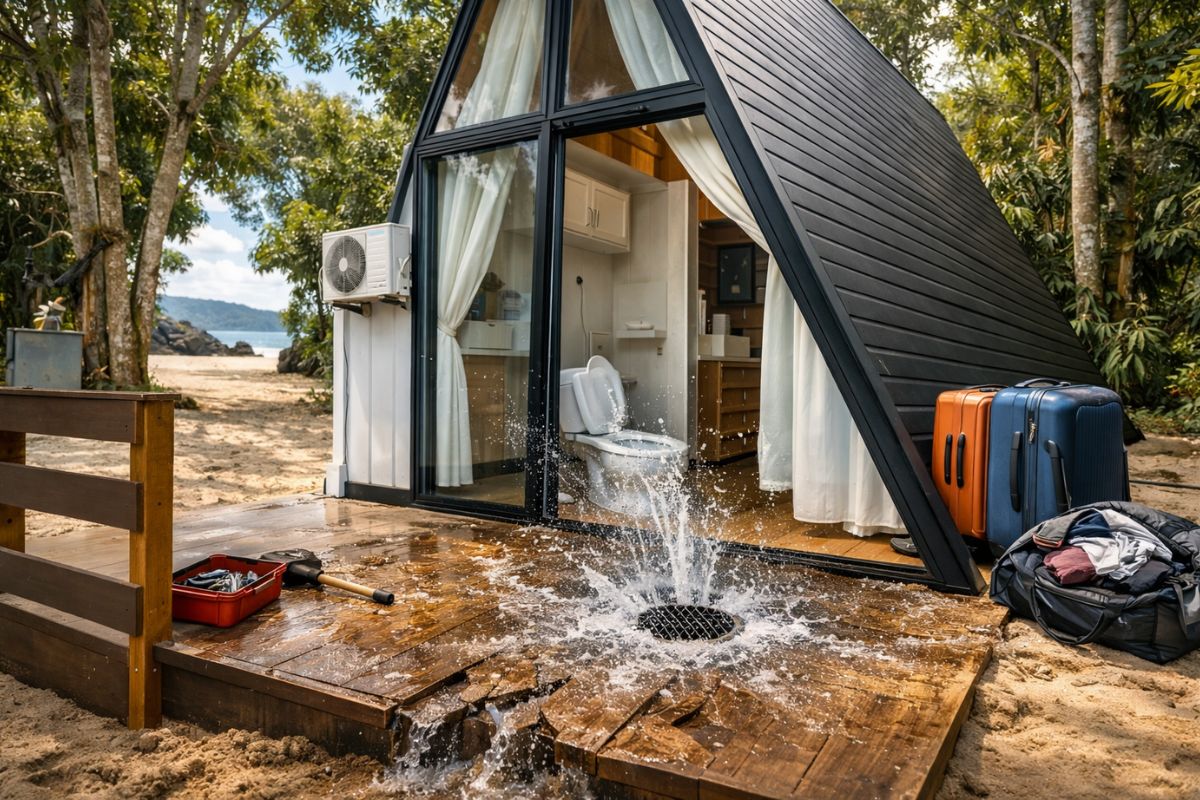

The couple celebrates the cozy and ready chalet, but discovers that the bathroom floor has the wrong slope, the water does not go to the drain, and the solution may require breaking part of the floor
The couple arrives on the last day of construction with the feeling that they will finally see the chalet “turn into a chalet.” After months of building everything with their own hands, the space already has items that change the comfort game, such as installed air conditioning and curtains in place, making the interior cozier and more like a lodging.
However, just when it seemed that the most difficult phase had passed, the couple encounters a serious problem in the bathroom: the floor is in the wrong position and does not direct the water to the drain. What was supposed to be a finishing day turns into tension, because fixing this at the end could mean dust, dirt, and the risk of messing with a finished area, all on the eve of their trip.
The last day begins with haste and a list of pending tasks
From the start of the day, the couple makes it clear that it is not a peaceful closure. There is still a list of tasks to finalize the chalet the way they envision: painting, cleaning, organizing the mezzanine, safety adjustments, and advancing the furniture. It is no longer rough construction; it is the stage where small details become big problems.
-
Couple Sold Their Home to Live in a Trailer While Converting a Granite Tower into an Award-Winning 11-Meter Residence in Cornwall

-
Sustainable Building Solutions Enhance Durability, Long-Term Savings, and Comfort in Home Construction and Renovation

-
Brazilian Fishing Couple Spends 4 Years Building Solar-Powered Floating Home on the Paraguay River, Now a Navy-Approved Vessel with Leisure Area and Tour Demand

-
While the World Opens New Airports and High-Speed Trains, Brazil Rushes to Complete Projects Stalled for 40 Years




With the trip approaching, the couple needs to fit everything into a few hours. The strategy is simple: resolve what is urgent, finish what can be finished, and make the chalet presentable for the “before and after” they want to show.
Air and curtains change the chalet’s atmosphere instantly
Among the good news of the day, the couple highlights two things that transform the feeling of the space: the air conditioning and the curtains. The air conditioning makes the chalet more comfortable to work in and, later, to use, while the curtains provide privacy and that ready-to-use look, not a construction site.
This type of detail often serves as a turning point in such projects. The place may be technically built, but it only seems “ready” when the comfort elements come in. For the couple, it is the moment when the chalet begins to have an identity.
The organization of the mezzanine and the weight of the final stretch
The mezzanine becomes an important part of this transformation. The couple works to keep the upper part organized, clean, and functional, because it is there that the chalet gains a more “complete” look. This stage includes moving heavy items, adjusting space, and understanding how the area will be used in practice.
The final stretch has this effect: what seemed simple becomes difficult because everything is already assembled. Any adjustment requires double care to avoid ruining the finish, scratching, dirtying, and creating a new problem.
Stairs, finishing, and the concern for safety
The couple also faces a delicate point: finishing and safety on the stairs. In a compact chalet with circulation, a poorly resolved edge can become a risk, especially for visitors.
Therefore, the couple thinks of quick and practical solutions to reduce exposed edges and make the path safer.
It is the type of correction that almost no one imagines when they start building, but that always appears when the space begins to be used for real.
The bathroom seemed to be on track until the worst mistake appeared
The bathroom, at first glance, seems to be advanced. The couple is already talking about installed items, the space looking “well on track,” and the desire to have everything ready before leaving. However, in the midst of this evolution, the problem that changes the tone arises: the slope of the floor was made to the wrong side.
In practice, this means that the water, instead of naturally going to the drain, tends to flow to another point. And a bathroom without proper drainage is not a detail: it is a daily use problem.
When the water escapes from the drain, the risk becomes real
The critical point is simple to understand: if the water does not go to the drain, it accumulates, flows where it shouldn’t, and can even leave the shower area. The couple realizes that this is not a small adjustment but a type of failure that can ruin the chalet experience and generate constant maintenance.
Besides the inconvenience, there is the risk of repair. Correcting the slope of the floor usually requires breaking part of the finish, redoing the slope, and reconstructing the section, which generates dust and dirt. And doing this with the chalet ready and in a hurry is the scenario the couple wanted to avoid.
The difficult decision: correct now or after the trip
Faced with the problem, the couple enters “crisis management” mode. The priority is to understand the extent of the correction and how it can be done without destroying what is already finished.
The possibility of calling a professional to evaluate arises, and the idea that the definitive correction can wait until after the trip, to avoid total chaos now.
This choice is typical of real construction: it is not always possible to resolve everything in the ideal time, so the couple needs to balance what is urgent with what is possible.
Even with the problem, the couple rushes to finish the chalet inside
While the bathroom becomes a concern, the couple continues to handle the rest of the finishing touches. The phase of furnishing, positioning items, and adjusting what is missing to give the chalet a lodging standard begins.
The goal is clear: even if the floor repair does not happen immediately, the rest of the environment needs to be ready, functional, and beautiful.
This parallel effort is what defines the final stretch: resolve what can be resolved, so as not to hold everything up for a single problem.
What this situation shows about construction in practice
The story of the couple leaves a direct lesson: construction ends when it ends, but it also ends when time runs out. You can do everything right for months, and still, an execution error can appear at the end and steal energy, time, and budget.
At the same time, it also shows resilience. Even with frustration, the couple keeps the focus on completing the chalet, organizing the space, and preserving the project, without giving up on the greater goal.
If you were this couple, would you break the floor and fix the bathroom before traveling or leave it to resolve later to avoid dust, dirt, and more rush?