





 Portuguese
  English
  Spanish
  3 min of reading
  0 comments


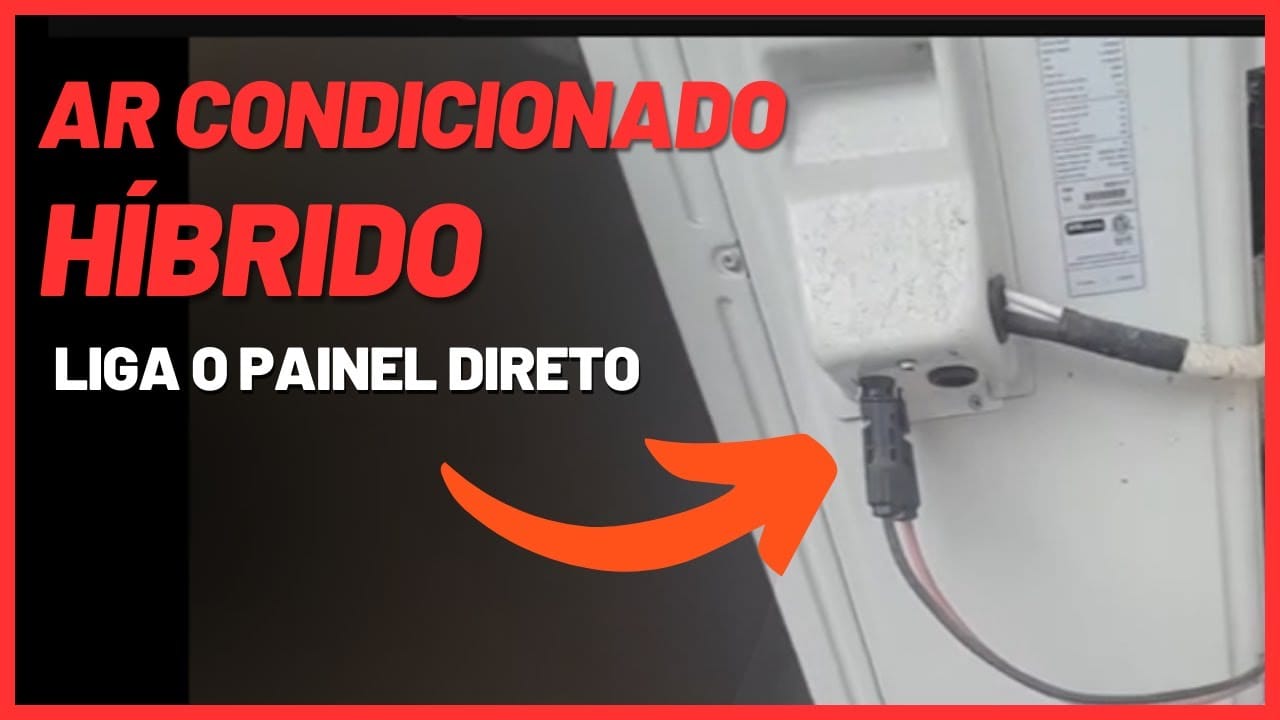
Check Out All The Details Of The Deye Hybrid Solar Air Conditioner That Can Operate With Just 6 Solar Panels.
Deye recently launched a solar air conditioner that promises to significantly reduce electricity bills. The Deye hybrid solar air conditioner operates with both the 220V power grid and directly with the panels connected to it, making it an exceptional solution for off-grid use and pointing to a future trend.
Initially, the solar air conditioner is not available for sale in Brazil, being marketed only in other markets, such as China. With just six modules, the Deye hybrid solar air conditioner can operate efficiently. On cloudy days, when solar panels may not have enough capacity to power the unit, due to its hybrid technology, the air conditioner will use grid energy to compensate.


The Deye hybrid solar air conditioner can also be 100% off-grid, powered by a DC 48V battery and features low voltage battery protection, with high efficiency powered by DC. Additionally, it operates over a wide temperature range (-10 °C to 58 °C).
-
5,000-year-old bacteria found frozen in a cave in Romania already shows resistance to modern antibiotics and raises a global scientific alert about the future of infections.
-
Scientists thaw microbes trapped in Alaska for 40,000 years, discovering that they reorganize, become active again, and start releasing greenhouse gases in a troubling climate alert.

-
China is erecting a mega project in Tibet worth $167 billion and 60 GW that could become the largest individual source of energy in the world and, at the same time, one of the biggest geopolitical bombs in Asia.
-
Alone in space, a wandering planet without a star is consuming 6 billion tons per second, setting a record that challenges astronomy and reignites the debate on how planets and stars actually form.

Due to the intelligent monitoring platform, the complete series of Deye inverter products support remote shutdown immediately when an accident occurs. Set configuration parameters and update the FW remotely, simplifying the O&M of the photovoltaic plant.
The operation of the solar-powered air conditioner depends, of course, on a solar power kit. The idea is to harness sunlight to generate electric energy and then convert it to power the unit, which operates from a clean and renewable source.
Advantages Of The Solar Air Conditioner DEYE
The combination reduces household electricity bills and also minimizes environmental impact, as it relies on a sustainable system, less dependent on fossil fuels. In this scenario, any excess energy generated should be sent back to the grid, generating additional energy credits, further reducing expenses and aiding in environmental preservation, with significantly lower CO2 emissions.
It is evident that the use of solar energy connected to the electrical grid or autonomous systems can vary based on resource availability and desired investment. However, both technologies serve as solutions to reduce the impact of air conditioning consumption on electricity bills.
Like the Deye hybrid solar air conditioner, several companies sell a photovoltaic kit for air conditioning, which consists of solar panels, inverter, cables, and connectors. As mentioned earlier, kits can be connected to the electrical grid and autonomous systems, with the difference being in the generation and storage of this energy. Adding batteries, inverters, and charge controllers will likely increase its price.
How Many Panels Are Needed To Power A Solar Air Conditioner?
This calculation of the number of solar panels required will depend on the consumption of the device needed to cool the environments.
The estimate made is as follows: 6 panels for an air conditioner that consumes 241.64 kWh/month. It is worth mentioning that currently, the use of solar energy for air conditioning is viable; however, the return on investment can be long if the total energy consumption of the residence is not taken into account.
The recommendation for the installation of solar panels for electricity generation is to respect, first and foremost, the geographical location and the slope of the building structure – rooftop, if that is the available location. This is considering how to capture sunlight in greater amounts.







Seja o primeiro a reagir!