





 Portuguese
  English
  Spanish
  6 min of reading
  0 comments


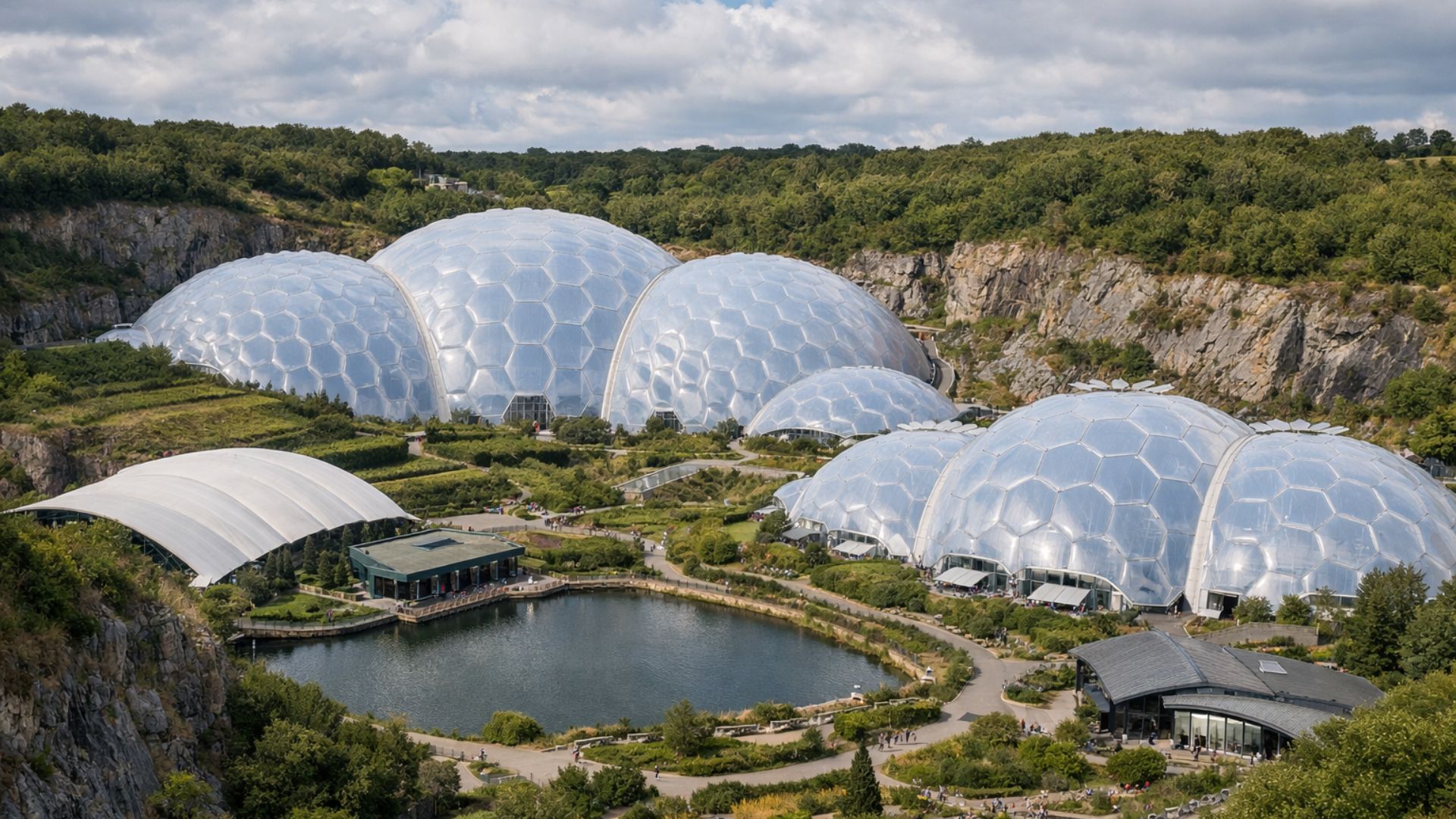
Project Built Giant Greenhouses Inside a Mining Pit in Cornwall and Had to Face Flooding, Drainage, and Slope Instability to Operate Below the Water Table, Transforming an Industrial Void into a Visitor Destination.
Built inside an old clay extraction pit in the Bodelva region of Cornwall, the Eden Project established a type of construction that begins where most projects end: at the bottom of an industrial void.
The complex opened to the public in 2001, occupying a site that was previously described as a barren mining area, with exposed slopes and a high propensity for flooding.
Instead of reshaping the terrain to “erase” the scar, the project embraced the hole as a base and arranged the structure around it, combining landscape recovery with a set of large greenhouses known as “biomes”.
-
A woman went out for a regular walk and ended up finding a treasure buried for over 900 years, with more than 2,000 medieval silver coins compared by archaeologists to a lottery prize and considered one of the most significant finds in recent years in the country.

-
Scientists revealed 11 signs that very intelligent people exhibit in their daily lives, and most people have no idea that some of these common behaviors are directly linked to an above-average brain.

-
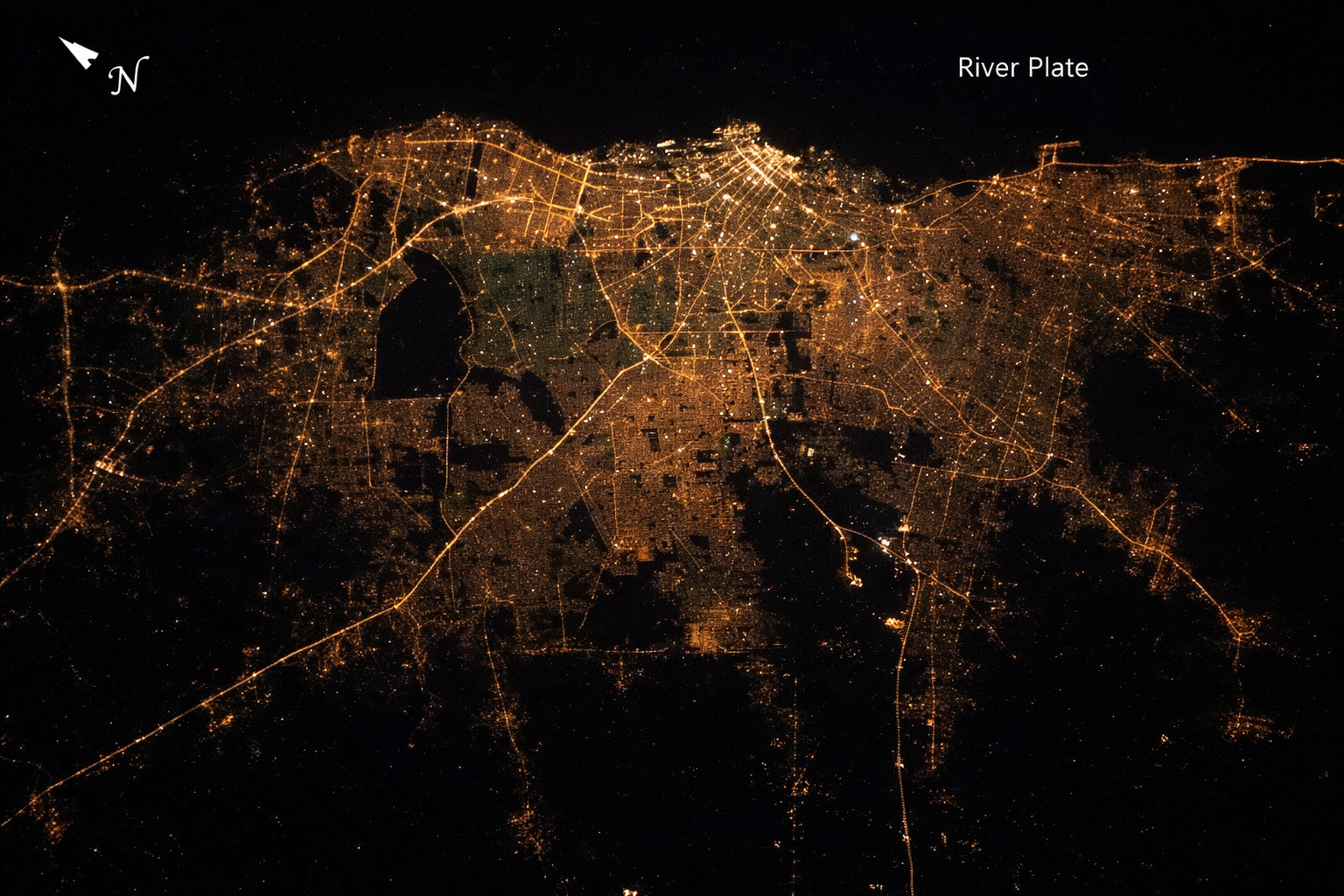
From space, Buenos Aires appears as a colossal spot of light surrounded by kilometers of darkness, revealing at a single glance the exact boundary between the metropolis and the countryside, seen from 400 km altitude.
-
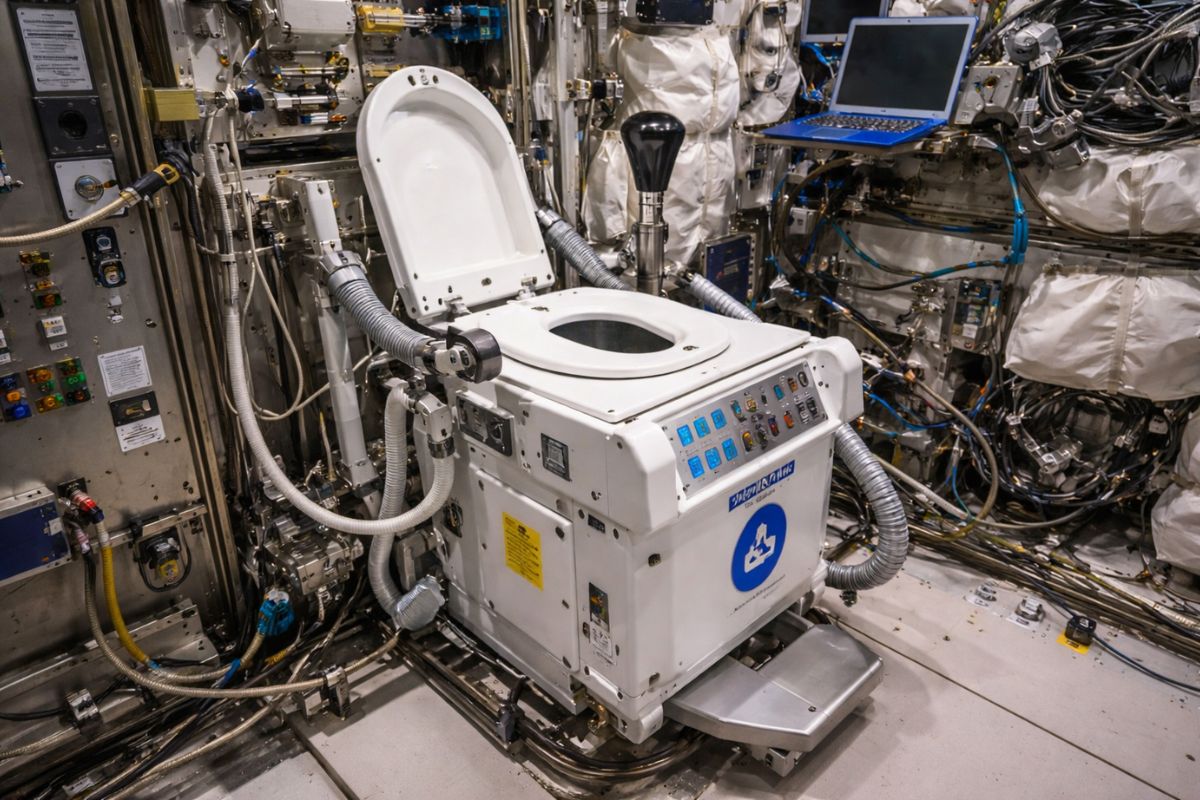
NASA spent over 118 million reais to build a single bathroom that works in zero gravity, and it has just gone to space on the first crewed mission to the Moon in more than 50 years.
Depth of 60 Meters and the Challenge of the Water Table
The pit chosen for the project had already been mined for decades and exhibited typical limitations of a mining environment: little to no usable topsoil, unstable areas, and a historical tendency for rapid water ingress during rain periods.
A technical report published in the construction and lifting sector described the site as a clay pit approximately 60 meters deep with a constant challenge of water control, particularly due to the relationship between the pit floor and the groundwater level.
It is at this point that the “hook” of the Eden Project imposes itself.

The Institution of Civil Engineers in the UK (ICE) recorded that, in the initial months, the weather became an engineering obstacle: 43 million liters of rain fell in 90 days, necessitating the design of a specific drainage system.
The same source indicates that the site was about 15 meters below the water table, which increases the pressure for water to find entry points into the pit and complicates any earthworks and foundation work without rigorous hydraulic control.
Flooding During Construction and Industrial-Scale Drainage
Other technical descriptions from the period point to similar but not identical figures regarding this relationship with the water table, indicating that measurements and cuttings from the site may vary depending on the point considered.
In the sector text that recounts the flooding episode during construction, the bottom is mentioned to be around 20 meters below the water table, while also noting the need for containment drains and large retention areas to enable the initial earth movement and the continuation of work.
When discussing the Eden Project, there is public record that the pit was situated in a range of tens of meters below the groundwater level, with technical references placing the bottom between 15 and 20 meters below the water table.
Water did not appear merely as a “potential risk” but as a concrete event.
A scientific disclosure material describing the operation of the site indicates that, after two months of intense rain, approximately 43 million gallons — almost 163 million liters — drained and accumulated at the bottom of the pit.
From this scenario, the text describes that it was necessary to channel the water to prevent soil erosion and create a stable base, with integrated capture and pumping systems essential to the functioning of the complex.
This volume helps to illustrate what the title suggests by speaking of “draining millions of liters”: even before the tourist experience, the project had to deal with water masses comparable to localized floods concentrated in a low point of the terrain.
Giant Biomes and Lightweight Structure with ETFE
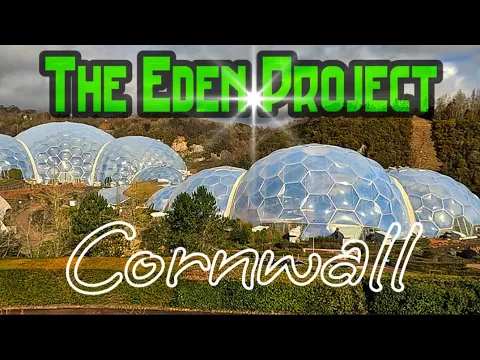
The architectural and structural design was conceived to adapt to the irregular shape of the pit, rather than impose rigid geometry on a “tamed” terrain.
The ICE reports that architect Nicholas Grimshaw sought a solution that followed the surfaces and unevenness of the old pit, drawing on the concept of “soap bubbles” as a reference for volumes capable of accommodating the available space.
In practice, this translated into large domes formed by transparent modules in a metal structure, with hexagonal panels that trap air between layers of ETFE, a plastic material described by ICE itself as lightweight and durable, allowing for reduced weight and, consequently, some of the load requirements on a terrain already complex by nature.
In this context, the “biomes” are not just an aesthetic choice.
They function as large controlled environments for plant collections and visitation, and their constructive logic connects to the challenge of building within a pit: reducing materials, reducing weight, increasing structural efficiency, and maintaining transparency for light entry.
The same ICE text associates the “honeycomb” shape of the modules with gains in strength using less material, and notes that the structures were designed as a warm environment for plants, equipped with closing technology that also plays a role in internal climate control.
Recovery of Degraded Area and New Habitat
In addition to the domes, the Eden Project is presented by its stakeholders as a case of rehabilitation of a degraded area.
In the institutional material of the Grimshaw office, the site is described as an old “china clay pit” that was still being excavated during the design phase and was transformed into a new habitat, now situated in a landscaped area of 15 hectares.
This change of status — from an almost uninhabitable industrial area to a space for visitation, education, and cultural programming — appears as a central part of the project’s purpose.
The recovery of the “floor” also required practical solutions that did not exist in the original mining scenario.
The HowStuffWorks text describes that, to sustain the vegetation of the biomes, a large volume of revitalized soil was produced by mixing clay waste with green waste composting, creating a substrate capable of supporting cultivation within the structures.

The publication mentions 85,000 tons of revitalized soil produced for the project, a figure that helps explain why the transformation of the industrial hole did not merely involve raising domes but also required restoring basic conditions for supporting plant life in an environment previously dominated by exposed rock and sterile material.
Water Capture and Continuous Operation of the Complex
The use of water was also integrated into daily operations.
In the same material, the captured water is described as part of a system that collects, filters, and pumps for internal uses, such as irrigation and part of the hydraulic infrastructure of the complex.
Although this type of description is for publicity and not a construction report, the public record reinforces that the management of rainwater and the water table was not confined to the construction phase: water was treated as an operational component, with capture and routing designed to reduce the impact of runoff and maintain base stability.
Building Downwards and Operating a Compromised Terrain
What stands out, from an urban and engineering perspective, is that the Eden Project did not need to “hide” the pit to function.
It relies on the pit itself to create the microenvironment, organize circulation, orient volumes, and facilitate a landscape that did not exist there before.
The project’s official website identifies the Eden Project as an attraction in Cornwall and maintains a public record of its opening in an old clay pit, basing its institutional narrative on the transformation of what was once an industrial void.
In this context, “building downwards” is not limited to digging; it involves operating, for years, on a terrain that was already compromised by mining and that has come to require water control, containment, soil restoration, and lightweight structures on a large scale.





-

-

4 pessoas reagiram a isso.