





 Portuguese
  English
  Spanish
  5 min of reading
  0 comments


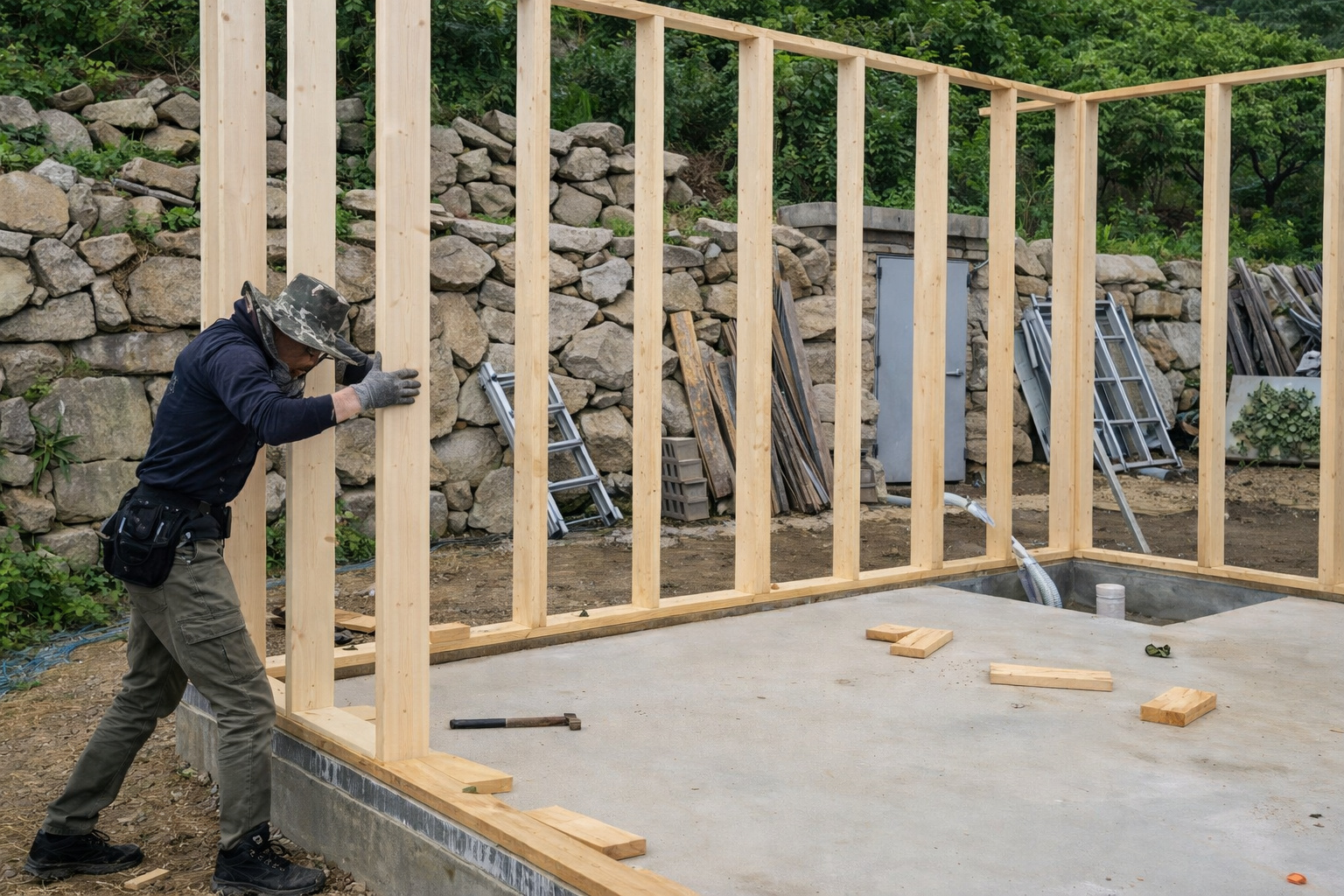
Workers Assemble a Traditional Korean House on Extreme Land in Duamchodang, Mountain Region of South Korea, Using Solid Wood Beams and Columns Fitted into a Rigid Structural System That Challenges Modern Construction Logic
A traditional house begins to emerge directly on the edge of a cliff in the mountain region of Duamchodang, South Korea. The setting is steep, with irregular terrain and natural rock walls surrounding it. Even so, workers position solid wood beams and columns that begin to form the skeleton of the construction.
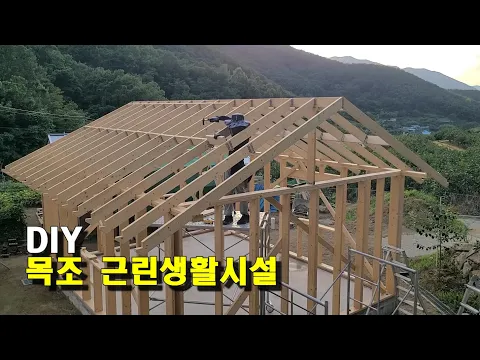

The structure grows piece by piece. Vertical columns rest on firm points of the base and receive horizontal beams that lock the whole together. The pieces are fitted precisely and reinforced by metal brackets and rigid connections, creating a structural frame that supports the weight of the house.
What stands out is the logic of the assembly. Instead of heavy concrete or steel structures, the construction relies on solid wood fitted manually. The method shows how traditional techniques can still tackle difficult terrains without depending on complex machinery.
-
The village where two rivers run side by side without mixing in Santarém and Alter do Chão reveals some of the most beautiful freshwater beaches on the planet.

-
Brazil’s nuclear submarine with a speed 5 times greater than normal advances after nearly 50 years and R$ 40 billion spent.

-
A Brazilian island charges R$ 0.50 to receive visitors and prohibits any new residents.

-
Why was the Great Wall of China built? The truth that many are unaware of!


The Structural Challenge of Building a House on a Cliff in the Mountainous Region of Duamchodang
Building on a cliff requires meticulous organization of the work space. The sloped terrain limits movement and requires that each piece be positioned carefully. In Duamchodang, the rocky edge becomes the base where the structure begins to take shape.
The workers start the process with vertical columns made of solid wood. Each column receives horizontal beams that form rigid frames. The connections appear reinforced by metal brackets and structural screws, which lock the fitting of the pieces.
As the assembly grows, the construction gains stability. The structure begins to distribute weight among the columns and main beams. The result is a wooden skeleton capable of supporting the house even on irregular terrain.
The work routine reveals the physical effort involved. The beams are lifted manually, adjusted into place, and secured in sequence, repeating a process that requires precision and a steady rhythm.
The Technical Secret Behind Traditional Korean Houses Made of Solid Wood
Traditional Korean houses are known for their structure based on wooden columns and beams. Instead of structural walls, the weight of the building is supported by a set of vertical columns and horizontal beams.
This system creates a kind of rigid skeleton. Each beam fits into specific points of the columns, forming a structural mesh that distributes the weight of the roof and walls. Metal brackets reinforce some of these connections.
The result is a structure that can be assembled in stages. First, the columns appear, then the upper beams, and finally, the roof elements. The house gradually takes shape.
The assembly reveals an important detail. Even with ancient techniques, the precision of the fitting between wood and metal creates a stable structure capable of withstanding wind, slope, and the weight of the roof.
Assembly of the Inclined Roof Completely Changes the Appearance of the Structure
Once the wooden skeleton is complete, the inclined beams that form the roof are added. These pieces rest on the upper beams of the walls and create the characteristic shape of the covering.
Each beam is positioned in sequence and secured at the support points. The alignment defines the angle of the roof and determines the drainage of water over the roof. The whole creates an inclined line that stands out at the top of the construction.
The visual change is immediate. What was once just a set of columns and beams now looks like a complete house. The roof begins to dominate the silhouette of the construction.
During the assembly, the work occurs at height. The beams are lifted, supported, and secured while the rest of the structure bears the increasing weight of the covering.
Panels, Sheets, and Boards Close the Walls and Transform the Skeleton into a Habitable Traditional House
With the roof assembled, the closing of the walls begins. Between the columns, sheets and panels appear to fill the gaps in the structure. Each element has fitting and securing directly to the wooden beams.
The boards form continuous surfaces that cover the internal structure. Screws secure each panel at the support points of the wood. The interior begins to gain clear boundaries.

This stage completely changes the internal environment. The open space between the columns begins to form an enclosed volume. The walls cease to be just structure and start to define the rooms of the house.
The sequence of installation reveals a repetitive rhythm. Panel by panel, the workers close the gaps until the wooden skeleton disappears behind the mounted surfaces.
Construction in Duamchodang Shows How Traditional Techniques Still Challenge Modern Engineering
The traditional house built on the cliff in the mountainous region of Duamchodang shows that ancient methods can still tackle complex structural challenges. Instead of relying on concrete or heavy steel, the project uses fitted solid wood to form a rigid structure.
The logic of the construction reveals an engineering based on balance and weight distribution. Columns, beams, and brackets work together to support the house on terrain that, at first glance, seems unsuitable for any construction.

At the end of the process, the cliff ceases to be just a geographical obstacle. It becomes part of the foundation of the construction, demonstrating how traditional techniques can adapt to extreme environments.
This type of construction arouses curiosity precisely because it combines tradition and practical engineering. In a terrain where many modern projects would face difficulties, a fitted wooden structure shows that ancient knowledge still has much to teach.
Want to see more stories of curious engineering, extreme constructions, and technologies that challenge industry logic? Leave your opinion in the comments and tell us what you think of this cliff construction.








-

Uma pessoa reagiu a isso.