





 Portuguese
  English
  Spanish
  4 min of reading
  8 comments


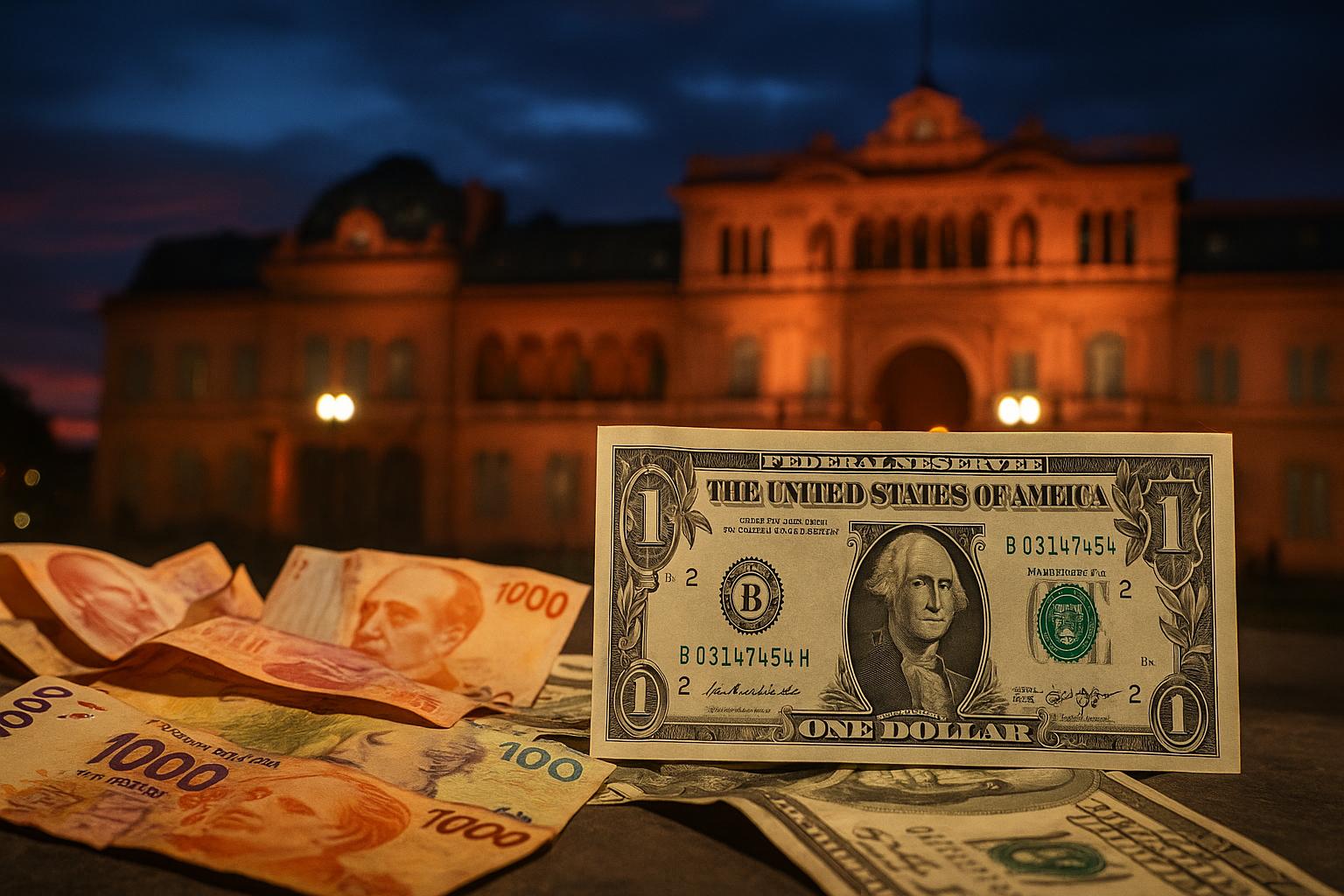


With The Dollar At 1,400 Pesos, Argentina Faces Currency Crisis And The Milei Government Announces Intervention In The Exchange Rate To Contain The Severe Devaluation Of The Currency.
When the dollar reaches 1,400 Argentine pesos, it is not just another exchange rate number — it is a red alert. The local currency is in a rapid decline, reflecting uncontrolled inflation, capital flight, and a loss of market confidence. The population sees their salaries evaporate, while imported products become unaffordable. It is in this scenario that the Javier Milei government abandoned its promise not to intervene in the exchange rate, announcing emergency measures on the morning of September 2, 2025, to try to halt the peso’s collapse.
Promise Vs Reality: The Non-Intervention That Lasted Briefly
At the beginning of his term, Milei promised to drastically liberalize the Argentine economy, reduce state interference, and allow the exchange rate to be free — that is, without direct interventions from the government or the Central Bank.
The goal was to regain external credibility, encourage investments, and stabilize inflation through the market.
-
India announces a plan of $3.06 billion to bring aviation to forgotten regions: 100 new airports, $1.07 billion in subsidies, and regional routes guaranteed for 10 years, from 2026 to 2036, away from the centers.

-
Brazil blocked a proposal from the United States at the WTO that would make the exemption from tariffs on digital products like streaming and ebooks permanent, favoring American tech giants at the expense of developing countries.

-
IPTU exemption for seniors in 2026: see how to secure the benefit.

-
The institute that trained the greatest aerospace engineers in Brazil has just opened its first campus outside São Paulo after 75 years: ITA Ceará will have R$ 445 million, new courses in energy and systems, and classes are expected to start in 2027.




But the peso’s volatility, combined with political pressure and the social impact of inflation, caused this promise to be abandoned.
The government now acknowledges that total non-intervention is becoming impractical. The necessity to act arises almost as a failure of the purist exchange rate policy that had been touted as its trademark.
The Announced Intervention Measures
The Argentine government recently announced a series of measures to try to curb the peso’s devaluation and restore some exchange rate stability. Among them:
- Operations of buying and selling dollars by the state, to secure the supply of the American currency in the national market.
- Regulatory and fiscal measures that influence the exchange market, including limitations or adjustments to barriers for external transactions.
- Attempts to contain price inflation through the control of public tariffs and subsidies in sensitive sectors, to avoid passing the high exchange rate directly to the population.
Immediate Economic and Social Impacts
The currency crisis and the significant devaluation of the Argentine peso have profound effects:
Inflation rises at an accelerated pace — imported products, such as fuels, medicines, and processed foods, become much more expensive.
The purchasing power of the population decreases drastically, especially for those earning fixed pesos or little-adjusted salaries.
Companies that rely on international inputs face high costs, hampering production, investments, and their ability to compete in exports or imports.
The risk of political instability increases: voters press for emergency measures, protests may arise, and external market confidence suffers from exchange rate uncertainty.
Limits Of Intervention And Risks For Milei
Intervening is not a simple task, and the risks are significant:
- If the government buys too many dollars with limited reserves, it could lose a substantial part of its foreign exchange capital, further weakening the state.
- Interventions could generate political noise: the electoral base and liberal investors, who supported the promise of exchange rate openness, may feel betrayed.
- Without structural reforms (inflation control, fiscal adjustment, institutional confidence), intervention may only have a temporary effect — holding the peso for a few days but failing to prevent the next drop.
Experts Evaluate The Currency Turning Point
For specialized economists, this movement marks a turning point:
- Reaching 1,400 pesos per dollar highlights that the Argentine currency is no longer responding solely to sectoral or perception factors: it is a macroeconomic crisis of confidence.
- It is also considered a credibility test: if the government intervenes, it will need to combine exchange measures with strict monetary policy, clear communication, and inflation control.
- Emergency measures cannot replace a sustainable exchange policy — if the state does not regain inflationary control, the social effects will intensify.
Intervention As A Necessity, Not A Choice
Argentina is in a delicate moment: the peso melts before the dollar, and free market measures have not been enough to contain the crisis. The announced intervention is not a result of a change in ideology, but of urgency.
What is at stake is much more than the exchange rate — it is institutional credibility, the ability to protect the population from the effects of inflation, and to avoid a cycle of economic deterioration.
When the dollar reaches 1,400 pesos, intervention ceases to be an alternative: it becomes, for the government, a matter of monetary and political survival.










Esse milei é uma piada não entende de economia e nem de governo tá perdido kkk
Parabéns Milei…vai ganhar o prêmio Nobel de Química 👏🏼👏🏼👏🏼👏🏼👏🏼
Milei talvez aprenda – se tiver capacidade para isso – que mercados não se autorregulam.
O que ele precisa é seguir o exemplo da Inglaterra: conquistar militarmente ao menos uma dúzia de colônias para explorar economicamente. Ou então, lidar com a realidade, como muitos outros fazem, o Estado precisa intervir, e muito.