





 Portuguese
  English
  Spanish
  4 min of reading
  0 comments


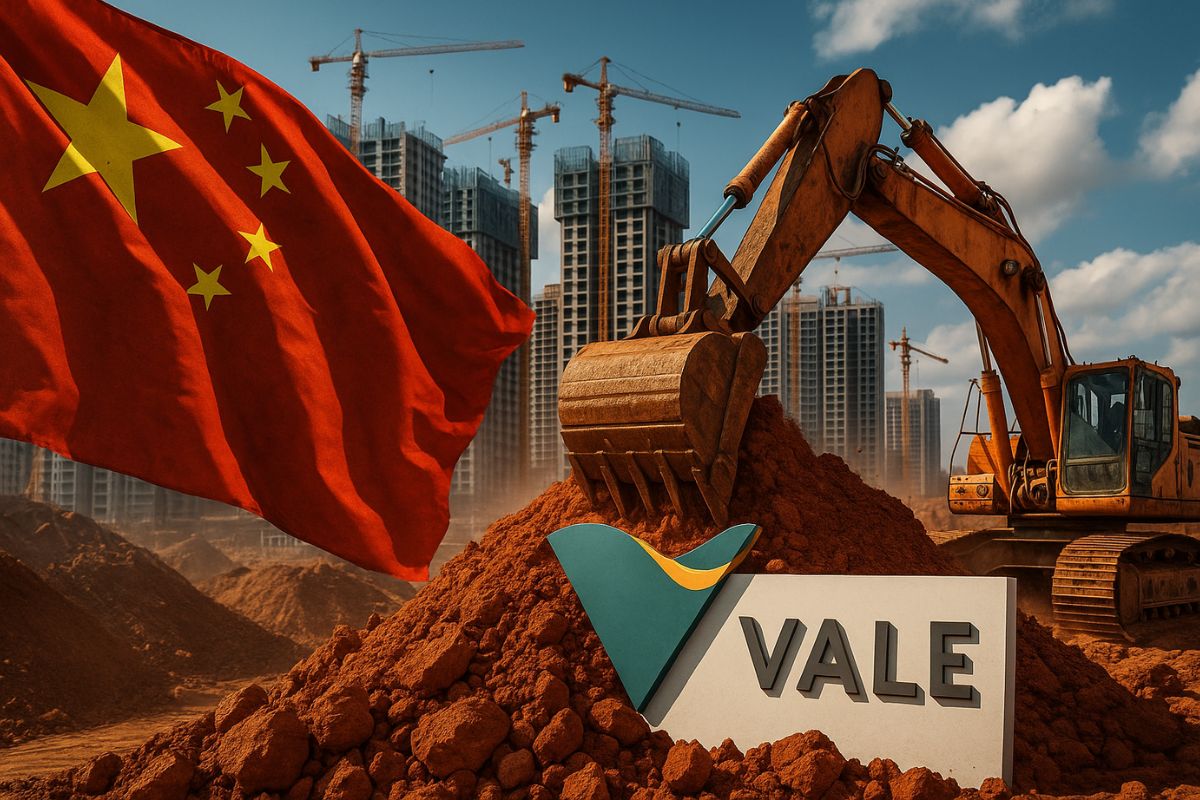
The Real Estate Crisis in China, Marked by the Decline in Construction and the Collapse of Major Developers, Drastically Reduced Iron Ore Consumption and Hit Vale Hard, Which Relies on the Chinese Market for More Than Half of Its Exports.
The slowdown in China’s real estate sector triggered one of the largest declines in global iron ore demand in recent years, directly impacting the results of Vale, one of the largest mining companies in the world. With the end of the construction “boom” and the crisis of giants like Evergrande, the price of a ton of ore fell below US$ 100, ending a high cycle that supported part of the Brazilian economy over the past decade.
China, which once consumed about 70% of the ore exported by Vale, is facing a structural crisis after the imposition of the so-called “three red lines”, which limited the indebtedness of builders and exposed debts exceeding US$ 300 billion. The result is a chain of impact that affects builders, steelmakers, and exporters, including the main Brazilian miner.
The Collapse of the Chinese Real Estate Market
The real estate crisis in China began to intensify in 2021 when the government started imposing strict credit restrictions to curb the unchecked expansion of developers.
-
Labor shortages are prompting Portugal, Spain, Germany, and Canada to open up opportunities for foreigners in 2026, with salaries ranging from 920 euros in Portugal to 50,700 euros per year in Germany.

-
The government is considering a temporary subsidy for cooking gas following the spike in oil prices due to the war in Iran and warns about the impact of 20% of imports on the prices paid by families.

-
The lack of truck drivers in the country is already halting shipments and threatening deadlines: 88% of transport companies are unable to hire, with an average of eight trucks idle, and the port complex of Itajaí is now feeling the impact.
-
Petrobras is about to transform a forgotten city in the far north of Brazil into the capital of oil: Oiapoque is already feeling the effects even before the first drop of oil comes out from the seabed.

Companies like Evergrande, Country Garden, and Sunac had amassed billion-dollar debts based on pre-sales and short-term financing.
In January 2024, the bankruptcy liquidation of Evergrande marked a turning point. Property sales fell to the lowest level in 18 years, and the number of new developments plummeted 58% compared to 2019.
The sector, which accounted for about 25% of China’s GDP, collapsed, dragging along the demand for steel and, consequently, for iron ore.
Decline in Steel Production and Direct Impact on Iron Ore
The reduction in the pace of construction had an immediate effect on Chinese steelmaking.
Raw steel production fell to 1.005 billion tons in 2024, the lowest level in five years.
Since iron ore is the main input for the steel industry, demand fell and pressured international prices.
The ore, which rose above US$ 150 per ton in 2021, started fluctuating below US$ 100 in 2024, reflecting oversupply and a slowdown in industrial consumption.
For Vale, this represented a 22% reduction in proforma EBITDA, which fell to about US$ 15.4 billion, according to recent financial statements.
Experts indicate that the super-demand cycle driven by Chinese urbanization has come to an end and that the country is now trying to rebalance its economy, focusing on less steel- and ore-intensive sectors such as technology and clean energy.
Vale and the Challenge of Adapting to the New Economic Cycle
Vale is one of the companies most exposed to the Chinese crisis, as more than 50% of its exports are destined for the Asian country.
With the weakening of the real estate market and the increase in inventories at steel mills, the Brazilian miner faces pressures on margins, average price, and sales volume.
The scenario has also affected the company’s stock performance.
The shares VALE3 have accumulated significant declines since the beginning of 2024, following the retreat of metal commodities.
The company is trying to respond with diversification measures, betting on critical minerals for the energy transition, such as nickel and copper, in addition to reinforcing its sustainability and governance (ESG) goals.
Still, analysts believe that structural dependence on the Chinese market remains the main long-term risk.
Without a solid recovery in the construction sector in China, the demand for iron ore is likely to remain constrained in the coming years.
A New Global Equilibrium in the Commodities Market
The crisis in China represents more than just a temporary problem; it is a structural change in the global commodities cycle.
The era of large projects and accelerated urbanization, which sustained the growth of ore and steel for two decades, is giving way to a phase of adjustments and slower expansion.
Meanwhile, new consumer hubs are beginning to emerge, especially in India and Southeast Asia, but not yet on a large enough scale to replace China’s role.
The transition, therefore, will be slow and will require miners to adopt innovation and diversification strategies.
Do you believe that the Chinese economy will be able to reinvent itself after the real estate collapse? Or do you think that the dependence of companies like Vale on China puts Brazil in a vulnerable position? Share your opinion in the comments; we want to hear from those who are following the impact of this crisis on the real economy.








-

-

-

-

-

-

42 pessoas reagiram a isso.