





 Portuguese
  English
  Spanish
  10 min of reading
  29 comments


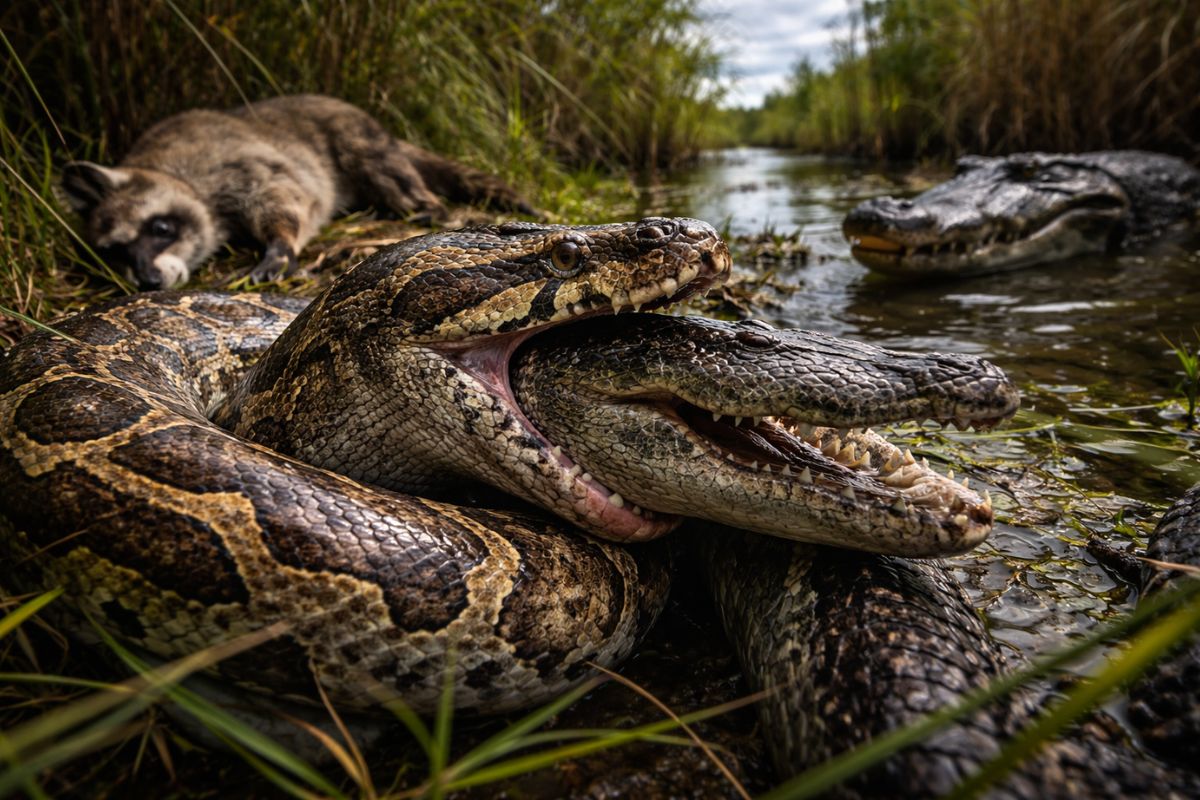


Crocodiles Disappear In Florida With Advancement Of Invasive Giant Pythons, Mammal Collapse In The Everglades, Brutal Change In The Food Chain, Increasing Risk To People, And Deep Ecological Imbalance.
As crocodiles and other animals vanish in parts of Florida, scientists relate the crisis to the advance of invasive pythons, with giant snakes appearing near Miami and mammals plummeting to near extinction in areas of the Everglades, altering water, reproduction, hunting, and the structure of the subtropical ecosystem.
In the swamps of South Florida, crocodiles are disappearing along with other animals, and the situation has been linked to the presence and expansion of invasive giant pythons. The change is not just visual; it’s ecological: by drastically reducing mammals and reorganizing the food chain, these snakes push the ecosystem into a new balance, much poorer in species and far more unstable.
West of Miami, a small area, just 2.6 kilometers long, has become a constant cause for alarm. Trail cameras have recorded unusual activity, with population growth faster than expected and snakes measuring 7 to 10 meters appearing at an alarming density. They are described as huge, aggressive and capable of consuming more food than alligators. The practical result is an environment where prey disappears, native predators lose territory, and, in some encounters, even well-known threatening snakes retreat.
-
With nearly 6,000 square meters and an investment of $100 million, the building that seems to move in Las Vegas has a reflective stainless steel façade, creates optical illusions, and has become a symbol of creativity worldwide.

-
From Florianópolis to Antarctica non-stop at 60 years old: 1st Brazilian woman to sail solo makes history by facing one of the most dangerous routes on the planet.

-
A Brazilian recounted how a sudden malaise triggered the entire hospital machinery in the United States, with emergency protocols, tests to rule out a heart attack, and a bill that could reach $40,000.

-
Discovered just 4 meters deep, a 5,000-year-old submerged city with streets, tombs, and trade signs with Crete reveals how one of the oldest civilizations in the world lived before disappearing beneath the sea.

Where The Crisis Begins And Why Crocodiles Are In The Line Of Fire

The subtropical swamps of South Florida are a system where water, vegetation, and fauna balance through cycles. When an invasive species reaches the top of the food chain, it does not just cause “one more predator.” It alters the hunting rhythm, the behavior of prey, and the survival of natural competitors.
With the advance of pythons, the impact hits first at the food base. Fewer mammals mean fewer prey for everyone, and this directly affects the daily lives of large predators. Crocodiles depend on a functional environment, with food availability and stable locations to maintain hunting and reproduction behavior. When fauna disappears and the dynamics of the swamps change, pressure does not remain confined to one species; it spreads.
The Area Of 2.6 Km West Of Miami Has Become An Alert Point

The alarming detail is how such a small area can concentrate so much change. In just 2.6 kilometers, ecologists have started to observe a pattern of accelerated population growth, documented by images from trail cameras. The problem is not just the size of the snakes; it’s the density. Snakes of 7 to 10 meters appearing frequently suggest effective territory occupation, rather than just isolated sightings.
And there is an even more serious factor: proximity to the Everglades. The distance to the large wetland system is about 200 to 500 meters, comparable to the length of two football fields. This means that, in simple conditions, such as a rainy night and a quick crossing through open areas, the species can advance and establish itself in much larger regions.
Where Do These Pythons Come From And How Did They Get To The USA

The story involves humans and the exotic animal trade. Giant pythons were brought to the United States as exotic pets, considered easy to buy and, in many cases, inexpensive. For more than a decade, over 20,000 individuals have been imported from Africa for this trade.
The pattern repeats itself: when small, a 1-meter python may seem harmless. But when it reaches 3 meters, then 4 meters, the control shifts. The constriction force can exceed 70 to 100 kilograms of pressure, and at this point, many owners become unable to handle the animal. The described consequence is the release into the natural environment.
There is also an important milestone. In 1992, Hurricane Andrew hit Miami and damaged an exotic animal breeding facility, tearing off the roof and allowing approximately 300 to 500 pythons, including Burmese pythons and African rock pythons, to escape. From a small number of escapees, in about two decades, the population multiplied into the tens of thousands.
Giant Pythons As Predators: Size, Aggressiveness, And Attack Behavior
What makes certain pythons even more concerning is not just their size, but their behavior. There is a noted difference between species: while Burmese pythons tend to retreat when disturbed, African rock pythons can turn and attack, even in situations where humans do not intimidate them.
This creates a scenario of risk and fear. The alert is clear: if not a trained professional and you encounter one of these snakes, the guidance is to run as far away as possible, because they may chase and constrict when they feel their territory has been invaded. Florida authorities have mobilized a large contingent of highly trained agents and professional hunting teams, but the efforts have only slowed the advance.
Reported Cases And Perception Of Danger

The material describes incidents in various places involving African rock pythons and fast, silent attacks with little chance of reaction. There is a highlighted case in August 2013, in Campbell, Canada, involving two brothers, Noah and Connor Barthe, while they were sleeping in the living room of a family friend’s house. The owner kept an African rock python over 4 meters long. The snake is said to have crossed a damaged vent and attacked. The central idea is the speed and silence of the attack, with victims having almost no chance to react.
There is also mention of a 2017 episode in the Eastern Cape Province, South Africa, involving an elderly man who disappeared, and the subsequent discovery of a python with a swollen midsection, leading to an official conclusion of the worst-case scenario. Other reports include ambush situations, injured people, and descriptions of extreme force.
Even without entering graphic details, the sum of these reports reinforces the point: it’s not just a large species, but a species that can attack and dominate encounters.
Why Florida Is A “Paradise” For Invasives And Where Crocodiles Lose Space
Florida is described as a critical point for invasive species, with hundreds of non-native species established, from fish to reptiles. In the case of pythons, the combination is explosive:
Average annual temperature close to 24 degrees Celsius
High humidity
Everglades wetland system covering 6,150 square kilometers
Shorter winters than in the past
Fewer days below 10 degrees Celsius, with a nearly 40 percent reduction in about 10 years, lowering the thermal barrier
In 2018, thermal cameras recorded an African rock python surviving an unusual cold of 8.3 degrees Celsius without interrupting feeding behavior, suggesting greater cold tolerance than expected.
This set is crucial for understanding crocodiles. When the cold barrier drops, expansion ceases to be a “maybe” and becomes a “when”. With more snakes, fewer mammals, and tougher competition, the environment becomes less favorable for native predators to maintain their ecological routines.
Documented Population Growth And Proximity Of The Everglades
One point that stands out is the temporal sequence: researchers identified the first population of African rock pythons in the western suburbs of Miami, in an area so dense that drones could not see the ground. Between 2019 and 2024, the observed number went from three confirmations to more than 400 confirmed individuals, not counting those who went unnoticed.
This detail is crucial because it shows two things simultaneously:
The environment allows efficient hiding
Human detection sees only a fraction of the total real
Differences Between Burmese Pythons And African Rock Pythons

The comparison between the two species in the material makes clear why ecologists are so concerned:
Annual egg-laying
Burmese pythons: 12 to 36 eggs per year
African rock pythons: 40 to 80 eggs
Sexual maturity
Burmese: 3 to 4 years
African: 2 to 3 years
Behavior towards humans
Burmese: avoid humans, more likely to attack when cornered
African: more prone to attack on contact, with bite or strike rates upon being touched reaching about 57 percent, approximately double that of many other large pythons
Constriction force
The material points out numbers that reinforce greater strength and competitive advantage in encounters and prey capture.
And there is a field piece of information: in a 2021 experiment, African rock pythons completed a large prey capture simulation, with a mass of 25 kilograms, 0.3 seconds faster than Burmese pythons. In the predator world, fractions of seconds can separate capture from escape.
Additionally, there is the ability for prolonged fasting. African rock pythons can go without eating for up to 12 months and still maintain energy to attack, something that the material describes as very difficult for Burmese pythons to replicate at the same level.
What Has Happened To Mammals And Why It Changes Everything For Crocodiles
The most striking part is the portrait of the Everglades after the proliferation of Burmese pythons, even before considering the advance of the African species.
Surveys compared mammal data before and after the confirmation of established pythons. Sporadic sightings occurred for 20 years, and pythons were recognized as established in the Everglades in 2000.
With expansion, numbers plummeted:
- Raccoons and opossums: decline around 99 percent
- White-tailed deer: decline of 94.1 percent
- Lynxes: decline of 87.5 percent
- Rabbits and foxes: disappeared from the most recent surveys, despite being common in earlier periods
There is also the warning from a researcher that, in any population of snakes, you see only a small fraction of the real number of individuals. This means that the effects could be even greater than what field records are able to capture.
This mammal collapse causes broad effects: without prey, predators change behavior, and the ecosystem loses pieces that kept the swamp functioning. The described consequence includes declines in raptors, changes in alligator nesting sites, and alterations in water movement due to the loss of burrowing species.
All this connects with crocodiles in an indirect, yet powerful way: fewer prey, a less stable ecosystem, competition for resources, and a reorganization of the environment where they live.
The Size Of The Territory And The Real Difficulty Of Containment
The Everglades are compared to a vast system, covering 6,150 square kilometers with immense environmental complexity. Containment is difficult because the area is enormous and full of hiding places:
More than 700,000 hectares of vegetation
Thousands of kilometers of shallow channels, with depths of 20 to 40 centimeters
Countless mud flats where a 5 to 6-meter python can disappear in seconds
Even with technology, detection does not equate to elimination.
Why Hunting And Technology Fail So Much
The material describes specific limitations:
Infrared drones increased detection of Burmese pythons, but for African pythons, the rate dropped by almost half because they hide deeper and remain in layers of wet mud, where the soil temperature approaches their bodily temperature, making thermal differentiation difficult.
Artificial intelligence systems that identify by shape and color struggle because the fragmented and mottled patterns of African pythons blend with shadows and tree bark. In initial tests, accuracy rates were around 60 to 70 percent for Burmese and only 20 to 30 percent for Africans.
Trained dogs achieved detection of up to 70 percent for Burmese pythons and around 30 to 35 percent for African pythons, compounded by weaker pheromones and an environment full of mud, feces, and leaf odors.
Experienced hunters report specific discomfort because the African species does not retreat; it advances when illuminated.
The combination shows why Florida can slow down but not stop.
New Strategies: Environmental DNA, Pheromones, And Robots
In light of the difficulties, more precise tools have emerged:
Environmental DNA in water, with 250 ml samples collected from canals and waterways, allowing identification if a python has passed through the region in the last 24 to 48 hours. This shortens the search from entire areas to a few hundred meters, saving time and reducing risk.
Pheromone traps based on male scent glands, attracting females during the breeding season. Initial tests in early 2024 showed an almost threefold increase in the appearance of females near these traps. Capturing a single female carrying a clutch of 40 to 80 eggs can reduce the population growth the following year.
Snakebot, a robot shaped like a snake, 1.5 to 2 meters long, equipped with cameras and thermal sensors, capable of entering root cavities, underground channels, and narrow crevices where pythons hide.
Even with this, the conclusion is realistic: the goal is reduction, not elimination, because the high reproductive rate, the ability to remain hidden, and the vastness of the wetlands make control an ongoing task.
The Risk Of Hybrids And The Possibility Of An Even Greater Crisis
There is an additional fear: the emergence of hybrids when different species meet in the same environment. In 2018, DNA analyses of 400 pythons collected in the Everglades identified 13 individuals with genetic markers of hybridization between Burmese pythons and African rock pythons. Samples were found in areas separated by 60 to 70 kilometers, suggesting that it was not an isolated event.
The risk is direct: if high reproduction and adaptation traits combine, population growth may surpass human control capacity. Researchers prioritize genetic sampling when encountering individuals with unusual coloration or body proportions.
What Changes In The Daily Life Of Florida When Top Predators Establish Themselves
With pythons established, the impact is not confined to the park. The surrounding landscape has domestic animals, livestock, and wildlife that become potential targets. Dogs, goats, chickens, ducks, deer, wild pigs, and waterfowl form a “banquet” scenario for large predators.
At the same time, the absence of natural counterweights that exist in the pythons’ original environment, such as significant competitors and predators, creates the perfect condition for expansion.
In this type of context, crocodiles become part of a larger problem: they do not disappear due to a single isolated factor, but due to accumulated pressure. Fewer prey, more competition, altered ecosystem, and the presence of an invasive species capable of dominating encounters and remaining hidden.
An Entire Ecosystem Being Pushed To The Limit
The restoration of the Everglades has long been a controversial topic, and historical drainage for human use has reduced the original system. The national park covers 25 percent of the original southern Everglades, and even this fraction faces continuous pressure from invasives.
The presence of pythons in the territory has expanded over thousands of square kilometers. The amount removed reached nearly 400 in 2009 and has been increasing year by year, with a slight drop in 2010 due to a cold wave. The problem is that removing hundreds does not mean being close to a resolution: you may only be seeing a fraction of the total.
When the numbers of mammals drop to the point of nearly disappearing, it is not just one species that vanishes, it is the “engine” of the swamp that fails. And when the engine fails, crocodiles and all native fauna enter a zone of uncertainty.
Do you think Florida can still turn this tide and prevent giant pythons from pushing crocodiles and other species into a definitive disappearance?









Grande mentira, o que mais tem é crocodilo e cobra jibóia pra comer ser humano tem que acabar com essa animais perigosos
WOW!!! It sounds like everyone is worried about it but you don’t see any real strong pushes to eliminate the problem. If it’s that worrisome then take the hard stand, man up and shoot them on sight, you would probably get a few hundred thousand volunteers to buy a license a d go hunting. What is so wrong with shooting them oh I forgot tree huggers don’t like that it’s inhumane, yet to let these invaisive pests wipe out your entire ecosystems is humane, wow you’ve really gone the wrong direction. Put on your big boy pants and do something about it.
They already do those things. Pay attention. They DO go hunt & shoot them. The DNR pays for dead pythons, they pay by the foot. Read the article. It’s extremely difficult to find these snakes. The article goes into detail, read it. “Put on your big boy pants”? Already done for several years now. DUH
If the extreme manifestation of this problem is in an area west of Miami just 2.6 kilometres long then why cant your conservation department focus on getting rid of these pests? After all if some are 7 m long they must be fairly visible. It seems to me that there is no great urgency being displayed by your conservation department. Basically the same slackness that was shown at the outset of this problem.
Clearly you haven’t spent much time there. One that size could be two feet away and you never see it.
Fairly visible? Did you even READ the article? Our schools have failed us, people who didn’t bother (or can’t read?) to read the article keep commenting. Your comment proves you did not read the article, or your comprehension is non-existant.