





 Portuguese
  English
  Spanish
  5 min of reading
  0 comments



From the Advancement in the Amazon in the 1970s and 1980s to the Pressure for Sustainability, The King of Cattle Became a Reference in Scale, Efficiency, and in Defending Individual Herd Control
The King of Cattle became known for a hard-to-ignore mark: surpassing 200,000 head and building a livestock empire in the middle of the Amazon, at a time when the region was isolated, with poor infrastructure and little state presence.
The question that runs through history is straightforward: how is the King of Cattle today and why has he returned to the center of the debate by advocating for total traceability, with electronic identification and a focus on efficiency in already opened areas?
The Bet on the Unknown in Southern Pará
To understand the King of Cattle in the present, one must go back to the beginning. Roque Quagliato was 33 years old when he decided to leave Ourinhos, in the interior of São Paulo, where the family operated in the sugar-alcohol sector, and bet on southern Pará.
-
The water that almost everyone throws away after cooking potatoes carries nutrients released during the preparation and can be reused to help in the development of plants when used correctly at the base of gardens and pots, at no additional cost and without changing the routine.

-
The sea water temperature rose from 28 to 34 degrees in Santa Catarina and killed up to 90% of the oysters: producers who planted over 1 million seeds lost practically everything and say that if it happens again, production is doomed to end.

-
An Indian tree that grows in the Brazilian Northeast produces an oil capable of acting against more than 200 species of pests and interrupting the insect cycle, gaining ground as a natural alternative in soybean, cotton, and vegetable crops.

-
The rise in oil prices in the Middle East is already affecting Brazilian sugar: mills in the Central-South are seeing their margins shrink just as ethanol gains strength.


The destination was the Sapucaia region, near Xinguara, about 600 km from Belém. It was the kind of decision that many people called madness, but the price of land in Pará was described as much lower than in states like Goiás, Minas Gerais, and Mato Grosso, which was important for those wanting to grow at scale.
Cheap Land, Large Area, and a Project for Decades
The King of Cattle entered a context where the formation of pastures and productive occupation of the Amazon were encouraged.
He even reported that he traveled up the Araguaia River by boat to see land for sale and then bought extensive areas to start transforming the property.
Over roughly three decades, Roque and his brothers Fernando, Francisco, and Luiz structured the family group. The herd surpassed 200,000 head, with around 150,000 concentrated on farms in southern Pará, and the properties in the Amazon region totaled around 85,000 hectares.
Scale didn’t come just from “having land”; it came from sustaining a large operation for many years, in an environment where almost everything had to be created from scratch.
A Farm That Functioned Like a City
The size of the project required internal infrastructure. On the farms, accommodations, outpatient clinics, dental offices, workshops, carpentry shops, and even an elementary school for the children of employees were built.
This detail helps to understand why the King of Cattle became a symbol of an era: it wasn’t just cattle in the pasture; it was a complete structure to support people, services, and production routines within the property.
Efficiency, Genetics, and Numbers That Caught Attention
Aside from scale, the King of Cattle invested in genetic improvement and management. The story mentions adherence to bull selection programs, use of artificial insemination, and strict control of zootechnical data.
In this model, performance metrics emerged that reinforced the group’s reputation: the herd’s birth rate was close to 90%, above a traditional average mentioned at around 60%.
There is also a comparison about slaughter precocity: while in many farms cattle were slaughtered at 4 years and around 16 arrobas, in the group’s system, the animal reached close to 19 arrobas at around 3 years old.
Efficiency here means producing more in the same time with better control, something that connects directly to the most recent discourse about technology and traceability.
Amazon, Critics, and the Change in Tone
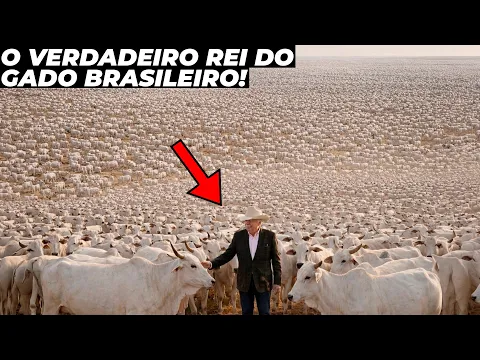

With growth and visibility, the King of Cattle has also been mentioned in discussions about historical deforestation, at a time when international pressure on the Amazon increased.
In more recent interviews, he defended that the previous context was different, with government incentives and environmental legislation of another era, and stated that today reality has changed, with accountability for those who deforest illegally.
The central point of this turn is to recognize that the rules of the game have changed, and that market and reputation now carry as much weight as production.
Total Traceability: The Cattle with Chip and the New Logic
The most recent phase of the story centers on what the King of Cattle came to advocate: total traceability of the herd. He appears as one of the first large cattle ranchers in Pará to implement individual electronic identification, with a chip per animal, allowing tracking of origin, movement, and health history.
The idea meets the demands of markets that require proof of origin and pressure for meat associated with more transparent supply chains.
This brings a shift of focus that the text itself emphasizes: instead of expanding by opening new areas, the path is to intensify production in already opened areas, raising efficiency through management, soil correction, and technology.
The reference mentioned is that, in low productivity pastures, it would be possible to quadruple the number of heads per hectare with proper management.
The Family Remains in the Game and the Brand Remains Strong
Even at an advanced age, the King of Cattle is described as active in strategic decisions, discreet in style, and very dedicated to work, closely monitoring property management.
Meanwhile, the new generation also appears to be expanding businesses. The text mentions Kiko Gualato, linked to the brand 20@, with large purchases at auctions, and a group with seven farms in northern Goiás, totaling owned and leased areas, in addition to a herd of around 40,000 heads in a breeding and fattening system, combining pasture and confinement.
The message is clear: the surname remains relevant in cattle ranching, even though the sector today has more business groups and corporate structures.
What It Means to Be King of Cattle Today
When the question resurfaces, “is he still the largest cattle rancher in Brazil?”, the answer becomes less straightforward than in the past. The sector has professionalized, holdings and investors with significant volumes have emerged, and comparing pure size has become a more difficult exercise.
Still, the King of Cattle remains a reference when it comes to individual trajectory, pioneering in southern Pará, and historical impact on Brazilian cattle ranching.
He has navigated very different phases of agriculture, from the incentivized occupation of the Amazon to the era of digital traceability and international pressure for sustainability.
And for you: is the King of Cattle reinventing himself with total traceability and chip, or has this phase changed the game to the point that no one commands alone?





-

-

3 pessoas reagiram a isso.