





 Portuguese
  English
  Spanish
  4 min of reading
  60 comments


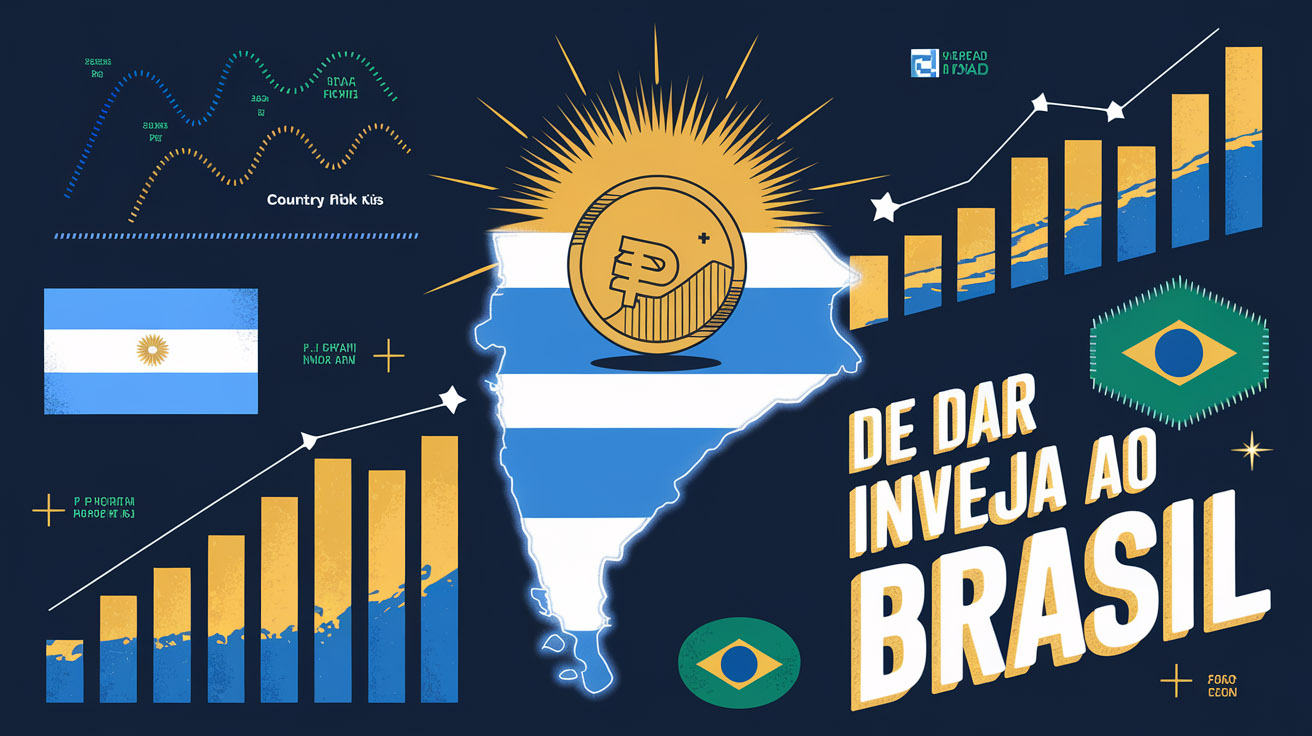


An Impressive Economic Achievement: Argentina Recorded the Lowest Country Risk in Years and Saw the Argentine Peso Shine in the Global Market. Will This Be the Beginning of a New Era for the Neighboring Country’s Economy? Meanwhile, Brazilians Are Wondering How Argentina’s Recovery Could Impact Brazil.
While many countries struggle to stabilize their economies, a South American neighbor caught attention by achieving a surprising economic feat.
This unprecedented achievement reignited hopes and sparked discussions across the continent. But what is the secret behind this impressive turnaround?
On Monday, January 6th, Argentina recorded a historic milestone: the country risk, measured by the American bank J.P. Morgan, fell to below 600 points.
-
“No one will make us change the Pix,” says Lula after the US report.

-
Lula responds directly to Trump and says that Pix is from Brazil and will not change under pressure from anyone, after a report from the United States pointed out the Brazilian payment system as an American trade barrier.

-
Amazon has just announced a new fee on all deliveries, and your online purchases will become more expensive starting April 17, including for those buying from the United States here in Brazil.

-
He sold his share for R$ 4 thousand, saw the company become a giant worth R$ 19 trillion, and missed the opportunity of a lifetime.


This was the first time the index reached such a low level since 2018, when the country was still under the leadership of former President Mauricio Macri.
The index reflects investors’ perception of the country’s ability to honor its debts, and the drop signals an increase in confidence in the Argentine financial market.
Argentine Peso: The Best Currency in the World in 2024
Another impressive piece of data came in December 2024, when the consultancy GMA Capital classified the Argentine peso as the “best currency in the world.”
The currency appreciated by 44% in real terms over the year, consolidating itself as a symbol of economic recovery in a turbulent global scenario.
This performance put Argentina on the radar of international investors who had, until recently, avoided the country due to recurring crises.
Although the advances are undeniable, many experts warn that the context is not that simple.
The Argentine economy still faces significant challenges, such as high inflation and difficulties in controlling public spending.
However, positive signs show that well-directed policies can yield substantial results, even in times of crisis.
The Impact of Country Risk
The decline in country risk is significant because it directly affects the cost of international loans.
With a lower index, Argentina can secure financing at lower interest rates, which is essential for a country looking to balance its public accounts and stimulate economic growth.
Additionally, this reduction attracts external investors interested in exploring the opportunities of a market that shows signs of recovery.
Still, the advancement in country risk and the appreciation of the peso represent signals that economic policies can indeed reverse severe crises.
For investors, the decrease in country risk is seen as an indicator of greater safety for investing in the country.
However, long-term success will depend on the continued implementation of consistent economic measures.
The Role of Economic Policies
Experts believe that the success of the peso and the decline in country risk may be linked to stricter policies adopted by the Argentine government, which sought greater control over public accounts and implemented measures aimed at increasing the confidence of international investors.
Even with a challenging internal scenario, the government managed to attract positive attention from the global financial market.
Additionally, the influence of strategic sectors such as agribusiness and commodity exports helped strengthen the economy in critical moments.
This combination of factors contributed to the current perception of improvement in economic stability.
A Milestone Since 2018
The last time Argentine country risk was this low was during Mauricio Macri’s administration in 2018.
Since then, the country faced a series of economic crises that raised the index to concerning levels.
Therefore, the drop to below 600 points is indeed a milestone that puts the Argentine economy back on the radar of international investors.
This achievement, however, comes with challenges.
The high demand for credit, the external debt, and inflation control are still issues that could hinder the sustainability of these advances.
Reflections in Latin America
The economic recovery of Argentina is not just good news for the country but also for Latin America as a whole.
If the Argentine economy continues to strengthen, neighboring countries could benefit from increased exports and trade partnerships.
For Brazil, Argentina’s main trading partner, the economic stability of its neighbor is crucial to ensure a healthy flow of bilateral business.
Argentina: An Example of Overcoming?
Recent results show that, even amid a long history of instability, significant progress can be made.
However, analysts emphasize that it is necessary to closely monitor the evolution of economic policies to ensure that the progress is not just temporary.
What Do You Think?
Will Argentina be able to sustain this economic recovery in the coming years? Or could internal and external challenges reverse the positive scenario? Share your thoughts in the comments!








Parabéns a todos os argentinos, presidente e a liderança desejo que o povo argentino se recupere e seja um exemplo para o Brasil !
Já temos bastante miseráveis aqui. Sem inveja da Argentina!!!!!
Se é verdade, uma maravilha como escreveu, Invista todo seu dinheiro lá. Compre bastante pesos e guarde, que você vai enriquecer. É brincadeira alguém se dispor a escrever isto!