





 Portuguese
  English
  Spanish
  9 min of reading
  0 comments


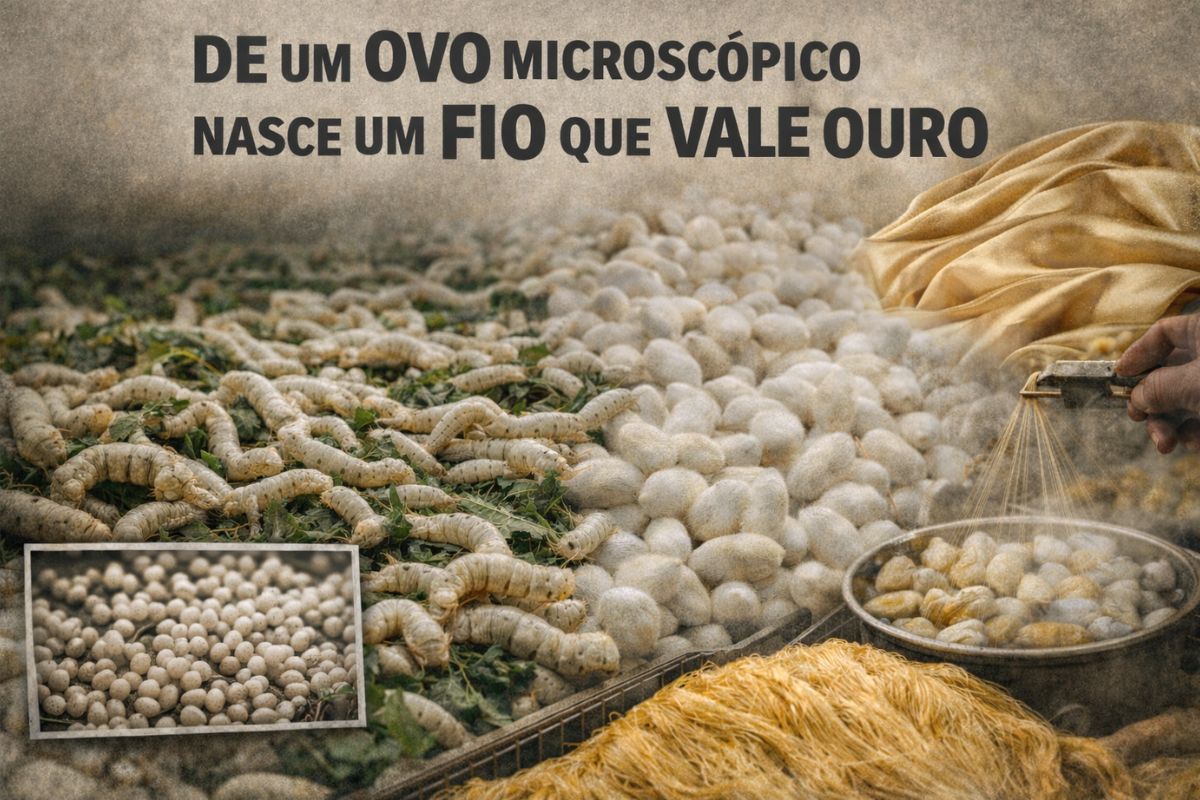
From The Invisible Egg to The Silk Production That Fuels An Ancient Industry, A Thread Worth Gold Sustains Jobs, Tradition, and The Most Desired Luxury on The Planet.
From the silence of an incubation room to the shine of the windows of Paris, a thread worth gold is born from an almost invisible egg, passes through perfect cocoons, and ends up in luxurious fabrics that span generations. Behind each meter of silk is a meticulous chain of care, patience, and technology that even today the modern industry has not been able to replace.
For weeks, the silk worm lives solely to eat, grow, and build its own transformation capsule. Inside, hidden in a delicate cocoon, is a thread worth gold capable of totaling hundreds or even thousands of continuous meters. From this silk thread, specialized factories create some of the planet’s most coveted luxury fabrics, maintained by a silk production that blends ancient tradition and extreme industrial control.
From The Microscopic Egg to The First Thread of Life

Everything begins with a silk worm egg that is so small it is smaller than the head of a pin. They are kept in cool places, resting, until the exact moment when spring arrives and production needs to restart.
-
Elon Musk focused on Brazil and lowered the price of Starlink, his internet service, but the question remains: is it worth it? An expert provides a detailed analysis of the internet that promises to connect any part of Brazil.

-
Workers were performing maintenance on the sewage system when they found a 3.2-meter beam that may be part of a 1,300-year-old Viking ship buried under the pipes since the medieval period in Europe.
-
Scientists caught a water vapor explosion on Mars exactly when it shouldn’t have happened: an unexpected dust storm launched the water to an altitude of 80 kilometers and accelerated the escape of hydrogen into space by 2.5 times.

-
The Brazilian Navy launched the NPa Mangaratiba (P-73) on April 27: a 54.2 m Macaé-class patrol vessel, with 43 crew members, 6 days of autonomy, and a range of 4,000 km to monitor the entire Blue Amazon.


At this initial phase, technicians transfer the eggs to heated incubation chambers, where the temperature is rigidly controlled at around 25º.
After about 10 days, the shell breaks and the first larvae emerge, dark threads 2 to 3 mm long. They are fragile, tiny, and still do not resemble a thread worth gold, but there lies the starting point of the entire silk production.
The newly hatched larvae are placed in special trays lined with clean paper. In front of them, workers place fresh mulberry leaves, the only food that the silk worm can digest.
As soon as they smell the leaves, the caterpillars rush towards the green with such eagerness that the sound of chewing resembles soft rain falling on the paper.
The Starving Childhood of The Silk Worm
In the first few days, the caterpillars do little else but eat. They grow at an impressive speed, doubling in size day after day, while teams maintain the environment in almost surgical cleanliness. Any infection can destroy an entire batch in just a few hours.
Every four hours, fresh mulberry leaves are brought in from nearby farms. By the end of the first week, the larvae are visibly larger, heavier, and with an even more aggressive appetite. It is then that the first molt occurs.
The caterpillars stop feeding, their skin becomes dull, and they remain still. The old skin splits along their backs and a renewed body emerges, ready to resume the feast.
This cycle repeats several times.
After the second molt, the larvae reach about 2 cm, with a pearlescent glow under the light. After the third, they begin to eat nearly 24 hours a day.
In the fourth and final molt, they reach about 7 to 8 cm, with a milky white body and a small horn-shaped bump.
This is the sign that the growth phase has reached its limit and that the next step in silk production is about to begin.
The Moment of Transformation: When The Cocoon Holds A Thread Worth Gold
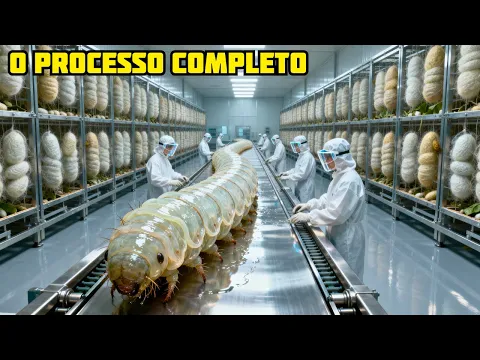

As hunger diminishes, the caterpillars become restless. They start walking around the trays, lifting their heads, looking for the ideal place to attach themselves.
At this moment, workers position structures of branches or straw over the trays, creating a maze of supports for the future cocoons.
The caterpillars hide in the spaces between the branches and begin a continuous and silent work. From special glands located under their lower lip, a thin and transparent thread emerges, which begins to be wrapped around their own bodies.
First, they build a loose structure, then they begin to rotate in figure-eight movements, layer upon layer, without rest.
In just three days, each silk worm is capable of producing between 800 and 1500 meters of continuous silk thread. It is within this perfect cocoon that a thread worth gold hides, constructed millimeter by millimeter.
The walls become thicker and more opaque, varying between white and yellow, until the caterpillar transforms into a pupa, immobile, hidden inside this natural fiber vault.
For those observing from the outside, the room fills with small oval lanterns hanging from the supports. It is a sort of vertical planting of cocoons, where each unit holds enormous potential in luxury fabrics still invisible.
Cocoon Selection and The Beginning of Silk Production
Five to six days after the caterpillar begins to spin, the cocoons mature and can be harvested. Workers carefully remove them from the structures, placing everything into baskets for the first sorting. It is at this stage that silk production decides the fate of each group.
Cocoons are sorted by color, size, and integrity.
The best ones are divided into two paths:
- A portion will be used to form butterflies and ensure the next generation of eggs
- The majority will be sent to the processing area, where the goal now is to protect a thread worth gold and prepare everything for industrial unwinding
Before the pupa transforms into a butterfly and breaks the cocoon, it is necessary to interrupt the cycle. Therefore, the cocoons go into ovens or drying chambers at about 70º. In a few minutes, the chrysalis dies.
This procedure, called vaporization or mortification, is not merely a formality. Without it, the silk thread would be cut into pieces and cease to be a continuous line of extremely high value.
From The Cocoon To The Perfect Line: When A Thread Worth Gold Meets Hot Water

After the thermal treatment, the cocoons go for a controlled bath. They are submerged in large tanks of water at about 90º.
In these industrial tubs, the natural glue of silk, called sericin, gradually softens, preparing the cocoon for the most delicate stage.
Workers brush the surfaces of the cocoons to find the tip of the silk thread. Once they locate this almost invisible starting point, they carefully pull it and attach the threads to a spinning drum.
Five to eight cocoons have their threads joined together, forming a single flow with the thickness and resistance suitable for industrial use.
When the drum starts spinning, what happens there is a choreography of precision. The silk thread, with a thickness of just 10 to 20 micrometers, unwinds from the cocoons, passes through rings, rollers, and successive baths, always on the edge between resistance and breakage.
When one cocoon runs out, the operator immediately joins the thread of another cocoon, maintaining the continuity of the flow.
It is in this continuity that the industry sees a thread worth gold. The longer, more uniform, and cleaner this thread is, the greater the value of the lot and the greater the potential to be transformed into luxury fabrics.
After passing through warm water, the thread loses excess sericin, becoming softer and more elastic. Then it passes through small ceramic holes that remove excess water and align the direction of the flow.
Finally, the thread is wound onto large spools, forming strands with hundreds of meters, which are hung on supports for drying in a controlled environment.
Boiling, Shine, and Classification: The Polishing of The Silk Thread
Even after drying, raw silk still retains some sericin. This makes the thread stiffer, opaque, and slightly yellowed.
To achieve the texture and shine associated with luxury fabrics, one more deep treatment is required: degumming, or boiling in an alkaline solution.
The threads are placed in large cauldrons with water, soap, and alkaline compounds. For hours, the thread is stirred, engulfed by the solution, releasing the natural glue that covers each fiber.
When the sericin detaches, the silk thread completely transforms: it gains a pearlescent shine, feels softer to the touch, and becomes lighter, losing up to a quarter of its original weight.
After boiling, the silk is repeatedly washed in clean water until no traces of soap remain. The threads are then squeezed, hung, and left to dry slowly in well-ventilated areas, always under temperature and humidity surveillance.
Then comes the moment of classification. Experienced masters analyze:
- shine
- strength
- uniformity of thickness
- presence or absence of knots and defects
The best lots go to the extra category, reserved for the most sophisticated luxury fabrics. In this fraction of the production lies the purest form of a thread worth gold, because it combines continuity, shine, and regularity that few natural processes can deliver.
Dyeing and Twisting: Preparing A Thread Worth Gold To Become Fabric

A portion of the silk goes directly to dyeing. Before entering the dye tanks, the silk thread is once again immersed in warm water with substances that help fix the color. Then, it enters large baths where the colored solution circulates slowly, penetrating each fiber.
For deep and intense colors, the process can be repeated several times, with intermediate rinses and application of fixatives.
Afterwards, the threads are dried in environments protected from direct light, preventing the sun from fading the tones even before the fabric exists.
In the twisting stage, two or more threads are intertwined in specific machines. Depending on the direction of the twist and the combination of threads, variations in texture emerge that will determine whether the result will be suitable for satin, crepe, chiffon, velvet, or other luxury fabrics.
It is here that a thread worth gold ceases to be just a continuous line and becomes a high-performance component, prepared to withstand the tension of the loom, the wear and tear of use, and the visual demands of fashion and interior design.
From Looms To Runways: The Final Path Of A Thread Worth Gold
With the thread classified, boiled, dyed, and twisted, the stage that most resembles what the public sees begins: weaving.
Specialized factories receive the spools and feed automated looms capable of crossing thousands of threads per minute.
From these looms, fabrics like satin, organza, silk crepe, chiffon, and velvet emerge. These surfaces reflect light in a unique way, drape elegantly over the body, and help justify the fame that silk is indeed a thread worth gold when transformed into a final product.
From there, the path diverges:
- parts of the fabric go to fashion houses in cities like Paris, Milan, Tokyo, and New York
- others go to manufacturers of bed linens, curtains, ties, scarves, and fine rugs
Every wedding dress, each exclusive tie, and every high-end curtain carries, hidden in its weave, the complete cycle of the silk worm.
From that microscopic egg to the final roll of ready fabric, silk production ties together weeks of work, climate control, cocoon selection, and laboratory tests to ensure that this silk thread behaves exactly as the luxury fabric market demands.
Why Technology Has Yet To Surpass The Silk Worm
The modern industry has already attempted to imitate natural silk with synthetic fibers, but none have managed to reproduce all the aspects that make silk a thread worth gold.
The combination of shine, touch, strength, thermal comfort, and hypoallergenicity is a direct result of the extremely fine structure built by the silk worm over millions of years of evolution.
Automatic equipment speeds up processes, helps with quality control, and reduces failures. Even so, the heart of silk production remains tied to biology: without eggs, larvae, cocoons, and pupae, there is no natural thread. The factory may be modern, but the “original loom” is inside each caterpillar’s body.
An Infinite Cycle of Luxury and Nature
Year after year, the cycle repeats. Eggs, larvae, cocoons, threads, fabrics. While the world discusses sustainable materials and new processes, silk remains a material that spans empires, fashions, and crises without losing relevance.
When someone wears a piece of natural silk, they are not just wearing a beautiful fabric. They are wearing the complete history of a thread worth gold, woven by nature and polished by the industry.
With each new generation of silk worms, a new batch of silk thread enters the factory, and a new set of luxury fabrics begins to take shape.
What changes are the machines, controls, and final destinations, but the principle remains almost identical to what Chinese masters have mastered for millennia.
After learning about the entire journey of the silk worm until it becomes a thread worth gold, would you pay more for a piece of natural silk or would you still prefer other types of fabric in your daily life?






-

-

-

-

-

20 pessoas reagiram a isso.