





 Portuguese
  English
  Spanish
  5 min of reading
  0 comments


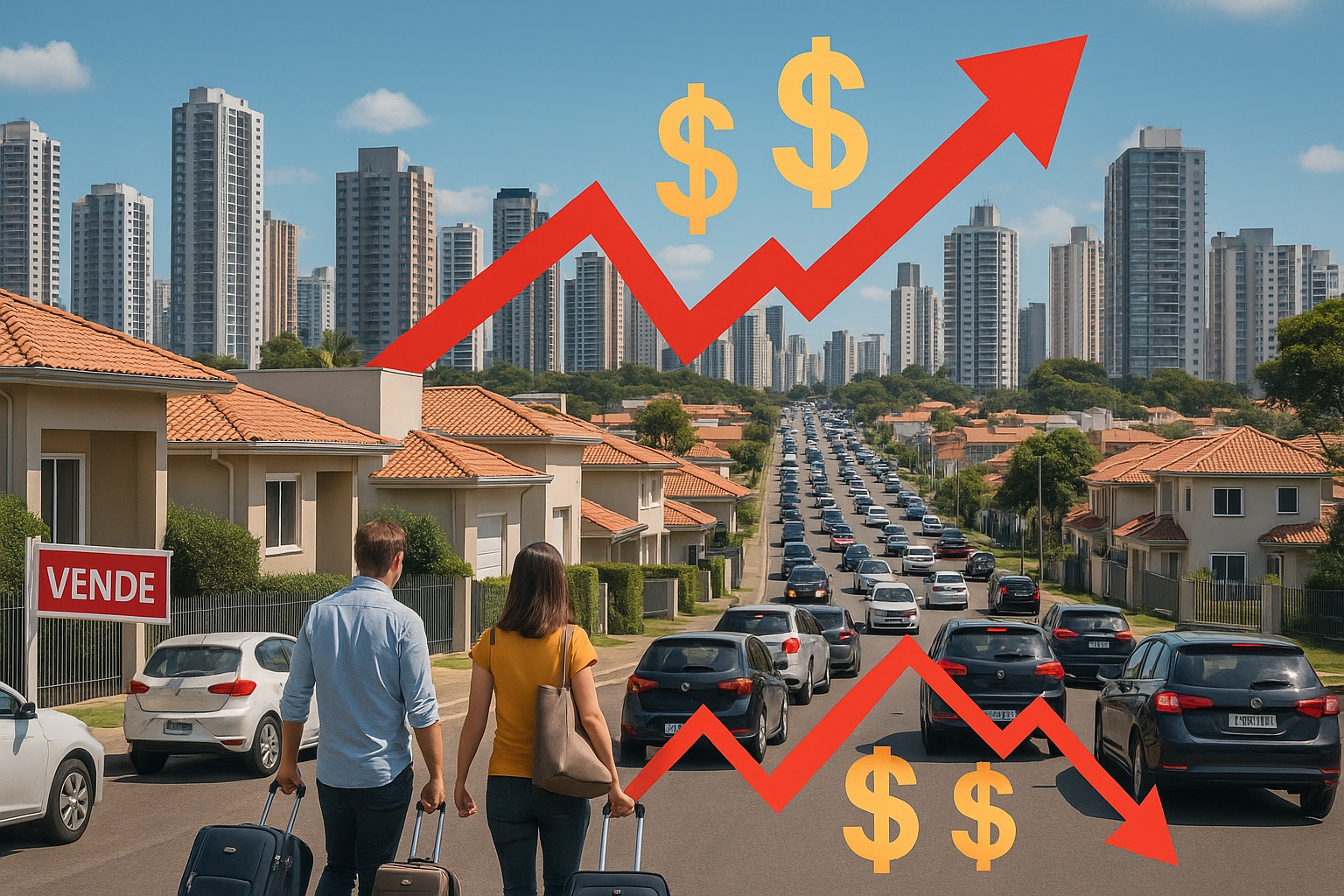
Demographic Explosion in the Paulista Interior: Campinas and Sorocaba Receive Elite Migrating from the Capital in 2025 and Already Face Soaring Prices and Urban Crisis.
The year 2025 solidified a silent yet profound transformation in the urban map of São Paulo: the Paulista elite is migrating en masse to the interior. Cities like Campinas, Sorocaba, São José dos Campos, and Ribeirão Preto have become hubs for high-income families that were previously concentrated in the capital. This movement, accelerated by the pandemic, the popularization of remote work, and the search for quality of life, is now also driven by the exhaustion of the metropolis, marked by chaotic traffic, pollution, and a growing sense of insecurity.
Data from the Seade Foundation show that, just in 2024, Campinas and Sorocaba together welcomed more than 40,000 new residents from the capital. In 2025, the trend intensified: high-end developments and gated communities are multiplying in these cities, and property value appreciation is already being compared to upscale neighborhoods in the capital.
Soaring Prices and a Heated Market
The demographic explosion in the interior has a direct reflection on the real estate market. In Campinas, the average price per square meter for residential properties exceeded R$ 9,000 in 2025, an increase of nearly 20% compared to the previous year. In Sorocaba, planned neighborhoods near the industrial area and along the Castelo Branco and Raposo Tavares highways are already seeing land valued at up to 70% since 2020.
-
“No one will make us change the Pix,” says Lula after the US report.

-
Lula responds directly to Trump and says that Pix is from Brazil and will not change under pressure from anyone, after a report from the United States pointed out the Brazilian payment system as an American trade barrier.

-
Amazon has just announced a new fee on all deliveries, and your online purchases will become more expensive starting April 17, including for those buying from the United States here in Brazil.

-
He sold his share for R$ 4 thousand, saw the company become a giant worth R$ 19 trillion, and missed the opportunity of a lifetime.

Developments like Alphaville Campinas, Fazenda Boa Vista (in Porto Feliz, near Sorocaba), and new planned neighborhoods in Jaguariúna and Valinhos have established themselves as preferred destinations for the elite, combining security, leisure, and proximity to major road corridors. Real estate companies are betting on the concept of private cities within the city, with complete infrastructure of schools, commerce, clubs, and even medical clinics.
The Engine of Migration: Security and Quality of Life
The promise of security and quality of life is the main engine driving this exodus of the elite to the interior. Unlike the capital, where urban violence and chronic congestion dictate daily life, cities like Sorocaba and Campinas offer the image of quieter streets, less suffocating traffic, and greater contact with green areas.
Furthermore, the expansion of remote work and distance learning has increased flexibility for the upper middle class and executives, allowing families to settle dozens or even hundreds of kilometers away from the capital without losing professional connectivity.
Multinational companies and startups located in technological hubs like the Techno Park of Campinas and the Technological Park of Sorocaba reinforce the appeal, as they offer high-value jobs outside the capital.
Urban Exclusion and Rising Inequality
However, the real estate boom also brings its contradictions. The mass arrival of high-income residents generates a surge in prices that displaces traditional families from the interior cities to peripheral areas.
In Campinas, the average rent rose by 22% just in the first half of 2025, putting pressure on workers in commerce and services who cannot keep up with property valuations. In Sorocaba, neighborhoods near the new luxury condominiums are facing skyrocketing living costs, while public infrastructure—health, transportation, and schools—has yet to keep pace with the speed of expansion.
Urban planners warn of the risk of creating privileged enclaves surrounded by areas of exclusion, repeating the fragmented model of the capital paulista in the interior.
Mobility: The Bottleneck of the Future
The advancement of the elite to the interior exposes another challenge: mobility. Although Campinas and Sorocaba are connected by modern highways, the demographic explosion poses a risk of saturation in strategic corridors like the Anhanguera-Bandeirantes and Castelo Branco.
Regional public transportation is still insufficient. The São Paulo-Campinas intercity train project, promised for years, remains delayed. In the meantime, residents of luxury condominiums continue to depend on private cars, increasing congestion and emissions of pollutants.
Without a robust regional mobility plan, the promise of quality of life may quickly turn into a trap of long commutes and strained infrastructure.
The Domino Effect in Medium Cities
The appreciation of the interior is not limited to Campinas and Sorocaba. Cities like Indaiatuba, Jaguariúna, Valinhos, and Itu are already riding the wave of migration, with luxury developments spreading at an accelerated pace.
The presence of regional airports, universities, and benchmark hospitals enhances the attractiveness of these locations. In 2025, Indaiatuba was considered one of the cities with the highest quality of life in Brazil, according to a survey by Urban Systems consultancy, largely thanks to the influx of private investments tied to the demographic boom.
Regional Impacts and the New Urban Frontier
The phenomenon of 2025 can also be seen as a rearrangement of São Paulo’s economic geography. With the elite migrating to the interior, there is a redistribution of consumption, jobs, and investments. High-end shopping centers, international schools, and private hospitals are multiplying in Campinas and Sorocaba, attracting even more families from the capital.
At the same time, city governments face the challenge of planning growth sustainably. Without control, the risk is of uncontrolled expansion, pressure on natural resources, and increased social segregation.
The demographic explosion in the Paulista interior in 2025 indicates that Brazil is experiencing a new phase of urbanization. Campinas and Sorocaba are no longer just interior cities: they have become new hubs for the Paulista elite, with prices rivaling upscale neighborhoods in the capital and private infrastructure that creates true walled cities within the city.
This movement opens up opportunities for development but also imposes risks. Without urban planning and public investments in transportation, housing, and services, the promise of quality of life can turn into a model of exclusion and traffic congestion replicated outside the capital.
The future of São Paulo, therefore, will not be defined solely within the municipality that bears its name but also in the cities that orbit its influence and that, in 2025, have already become protagonists in the life of the Brazilian elite.









-

-

-

-

-

-

19 pessoas reagiram a isso.