





 Portuguese
  English
  Spanish
  4 min of reading
  229 comments


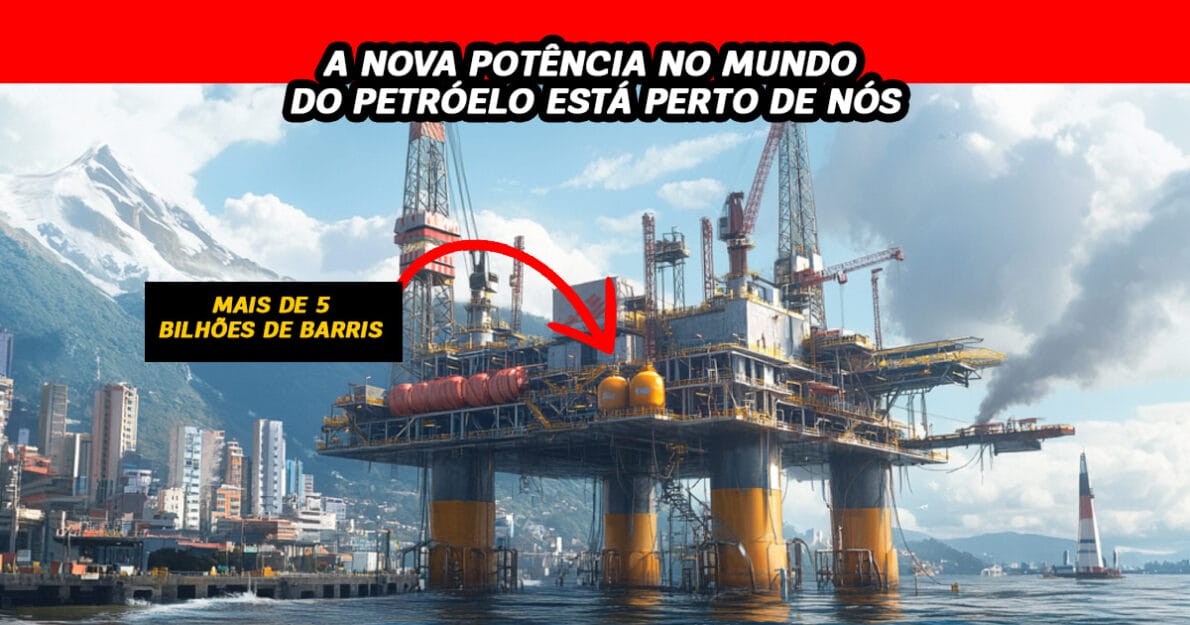

With Explosive Economic Growth and Accelerated Production, the Small South American Country Has the Potential to Become the New Oil Superpower of the Continent.
It seems that Petrobras, the Giant of the Brazilian Oil Sector, is about to face unexpected competition.
A small country in South America may be on its way to dethroning Brazil in the ranking of the world’s largest oil powers.
The discovery of an impressive field of more than 11 billion barrels of oil in 2015 put Guyana on the global map of fossil fuel exploration, and the consequences of this discovery could transform the global economy.
-
Petrobras evaluates suspension of sales to distributors and considers canceling the cooking gas auction following guidelines from the Federal Government.

-
Lula reveals a masterstroke by Petrobras to undo a deal made by Bolsonaro, which involves the return of an important refinery that currently produces less than half of what was expected and makes Brazil dependent on international diesel.
-
A study confirms that the natural gas sector will reduce greenhouse gas emissions in Brazil by 0.5% and accelerate the energy transition by 2026.

-
Petrobras implements a severe adjustment and confirms a 55% increase in the price of aviation kerosene with a proposal for installment payments for the companies.


An Emerging Power in the Oil Market
Since the discovery, Guyana, a country with just over 800,000 inhabitants, has been experiencing unprecedented economic growth.
In 2015, ExxonMobil revealed the existence of huge oil reserves in the region, radically changing the economic landscape of the nation.
It is estimated that Guyana has about 11 billion barrels of oil, a number that places it among the largest reserves on the planet.
Compared to Brazil, which is the largest producer in South America with a production capacity of around 3 million barrels per day, Guyana has the potential to become a true superpower in the sector.
Economic Impact of the Oil Discovery
The impact of this discovery on the Guyanese economy has been colossal.
According to the statistics portal Statista, based on data from the IMF and the World Bank, Guyana’s gross national income is expected to multiply from 4.62 billion euros in 2019 to an impressive 29.3 billion euros in 2029.
This extraordinary increase is directly linked to oil exploration, which promises to transform Guyana into one of the most dynamic economies in the world.
Labor Shortage and Return of the Diaspora
However, this accelerated growth has also brought significant challenges, particularly in terms of labor.
With so many infrastructure projects rapidly emerging, Guyana is facing a critical shortage of skilled workers.
Many young people, disillusioned by limited opportunities in the past, emigrated in search of a better life.
Yet, in light of this new economic reality, the Guyanese government has launched initiatives to attract back citizens who have moved away.
As mentioned by the portal Newsroom, since the first major oil discoveries, around 50,000 Guyanese have returned to the country, representing a significant boost to the local workforce.
In 2016, for the first time in many years, the number of immigrants returning to Guyana exceeded the number of those leaving, showing a clear shift in migration dynamics.
Managing the Return of Migrants Due to Oil
To deal with this mass return, the Guyanese government created the remigration program, which offers financial and logistical support to Guyanese wishing to return to the country.
This program seeks to reintegrate migrants into the labor market and ensure they can contribute to the nation’s development, especially in the oil sector.
According to the International Organization for Migration (IOM), in 2018, the country’s net migration reached 18,150 inhabitants, and since then, more than 30,000 people have returned to Guyana, a considerable number for such a small population.
Comparison with Brazil
As Guyana continues its rise in the global oil market, it is inevitable to draw a parallel with Brazil, which has dominated oil exploration in South America for years.
Petrobras, the Brazilian giant in the sector, has established itself as one of the leading global producers, but the discovery of large reserves in Guyana introduces a new competitor.
Despite Petrobras having robust and established production, Guyana may soon stand out for large-scale production, thanks to the rapid development of its infrastructure and international partnerships, such as that with ExxonMobil.
It is worth noting that the Brazilian pre-salt remains one of Brazil’s greatest assets, but Guyana, with its new discovery, is not far behind and has the potential to reshape the oil market in South America.
The Future of Oil in Guyana
If Guyana continues to develop its reserves at the same pace, the forecast is that the country will become one of the key global players in the oil sector in the coming decades.
With an estimated production that could exceed 1 million barrels per day by 2030, the small South American nation may even surpass Brazil in terms of oil exports.
This could completely shift the balance of power on the continent, where Brazil has always played a leading role in the energy sector.
The big question is: will Brazil be prepared to face this new competition?
As Guyana emerges as a new oil power, many questions arise about the future of oil exploration in South America.
Will this small nation, with its once-modest economy, really dethrone giants like Brazil in the global oil market? And how will this impact power dynamics in the region?
What do you think, does Guyana have a chance to dethrone Brazil and become the new oil power in South America?








O Brasil precisa resolver seu problema com instituições ambientais e iniciar a exploração do petróleo próximo da Guiana. Se a Guiana tem essa reserva gigante, com certeza Roraima e Amapá também tem. E a própria Amazônia que não permitem explorar. Podemos seguir sendo referência em exploração de petróleo e geração de energia. Mas cuidem do IBAMA e das ONGs antes.
Me parece sensacionalismo especulativo
Ok agora cade a refinaria q vai derivar o produto pra q tanto ouro nas maos se entrega nas maos erradas e compra 3 vezes a mais do valor