





 Portuguese
  English
  Spanish
  4 min of reading
  0 comments


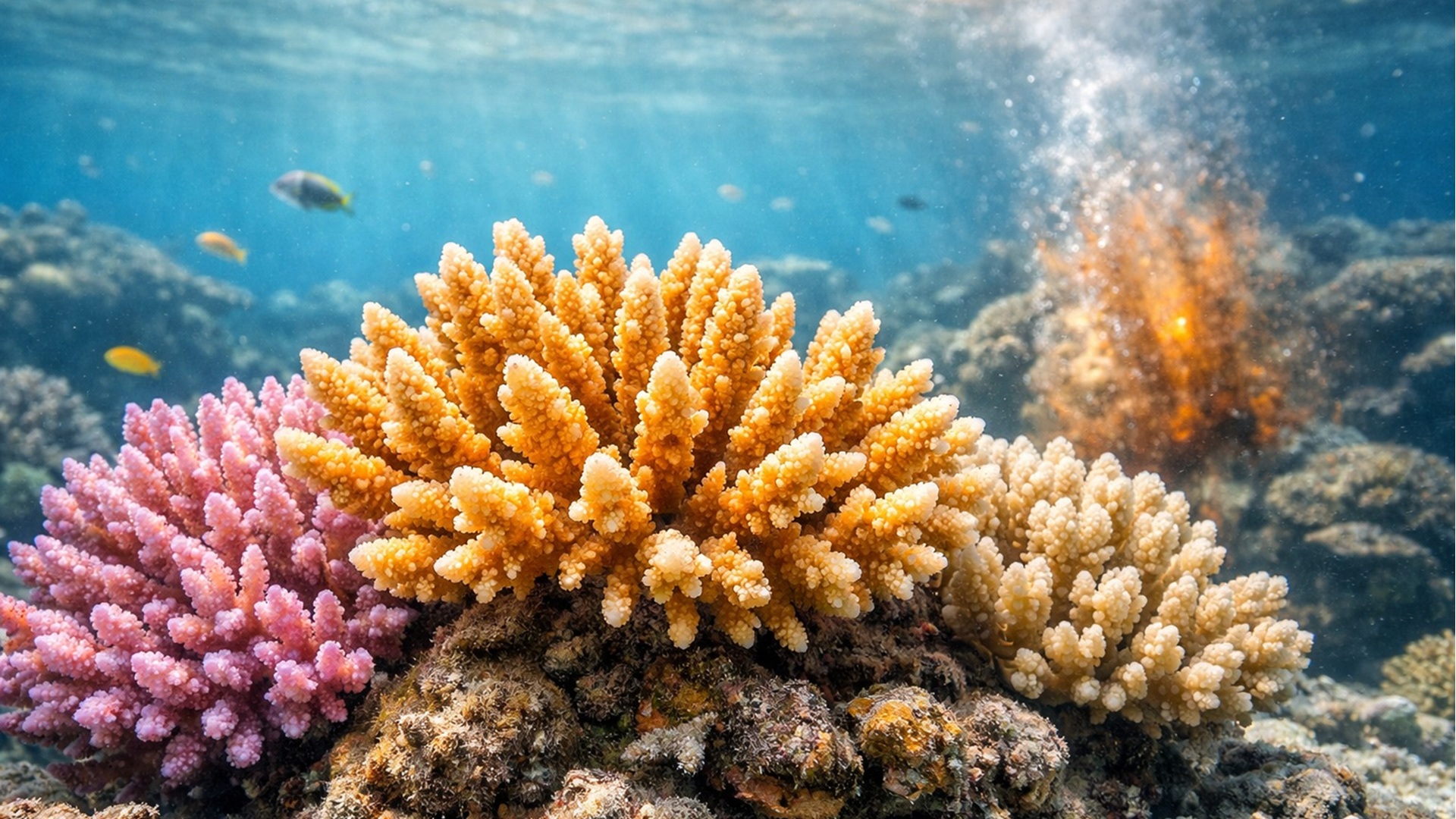
Researchers in Mauritius Lead an Innovative Project That Selects Heat-Resistant Corals, Achieving Survival Rates of 98% in 31°C Waters, Protecting Marine Biodiversity and the Local Economy Against the Devastating Effects of Climate Change and Securing the Future of Reefs.
Researchers in Mauritius, led by Dr. Nadeem Nazurally, achieved 98% survival in corals selected for thermal tolerance after a heatwave of 31°C last summer, validating a crucial strategy to protect biodiversity and the local economy.
Record-Breaking Survival Results Under Extreme Heat
When an intense marine heatwave hit the reefs of Mauritius last summer, the observed contrast was brutal. While wild corals in nearby areas showed bleaching rates of up to 80%, a specific group resisted.
A small group of colonies remained vibrant in color, with firm structure and life. These corals were cultivated under the supervision of Dr. Nadeem Nazurally. The program advocates for letting nature choose, but with strategic human intervention.
-
With a cost per shot close to zero, the DragonFire laser could change naval warfare in 2027 and provide British ships with nearly unlimited defense against drones.

-
A British startup creates tires that generate electricity in electric vehicles when passing over potholes, speed bumps, and cracks.

-
Scientists have created robots made with living cells that have their own nervous system, swim on their own, explore the environment, and self-organize without any genetic engineering, and now they want to do the same with human cells.

-
Students create a solar-powered ambulance that operates without a plug, without fuel, and still keeps medical equipment running in remote areas.


Nazurally and his team have been working for years on the premise that it is not enough to replant strong corals. It is necessary to cultivate corals capable of tolerating higher temperatures.
The last heatwave, with waters reaching nearly 31°C, was the toughest test yet. The selected colonies showed survival rates close to 98%.
This number begins to change the discussion about reef restoration in tropical regions. The scenario shows that ecological innovation can offer real solutions for increasingly warmer environments.
Accelerated Natural Selection Methodology and Reproduction
The developed approach aims to select corals based on their thermal tolerance. The criterion is not just appearance or rapid growth, but resistance to heat.
The science behind this leverages the synchronized reproduction of corals. This event occurs sometimes in a single night each year, for a few hours, when the reef releases eggs and sperm.
Predicting that exact moment requires the use of tide models, lunar phases, and sea temperature. The Odysseo team sets out by boat on specific nights to conduct the collection.
They collect gametes directly from the water and take them to protected marine nurseries. There, the larvae grow under controlled conditions to ensure their initial development.
Only the larvae that can withstand higher temperatures move on to the next stage. There is no genetic manipulation or futuristic laboratories involved in the process.
The method is, in essence, accelerated natural selection. This allows the fittest specimens for the new climate to thrive and repopulate degraded reefs.
Comparative Data and Adapted Cultivation Techniques
A study led by Nazurally and published last summer focused on the genus of hydrozoans Millepora. This is a close relative of hard corals and served as a basis for the analysis.
The results attracted attention beyond the Indian Ocean. The study recorded 99.8% survival during the last bleaching event in these specific colonies.
In comparison, the average survival rate in other genera was 88%. For colonies cultivated using traditional methods without thermal selection, the rate was only 10%.
The study also compared two distinct cultivation methods. It analyzed nurseries on the seafloor and floating platforms at intermediate depths.
In areas with tourist activity, boat traffic and coastal development stir up fine sediments. Under these conditions, the floating platforms provided a clear advantage.
Less suspended particles mean less stress for young corals. On the other hand, in more remote areas, the seafloor remains a good cultivation option.
Historical Context and Socioeconomic Impact in Mauritius
Mauritius, off the east coast of Africa, is home to nearly 250 species of corals and hydrozoans. Its reefs are more than landscapes; they sustain fishing and protect the coast from erosion.
These structures support a tourist industry on which thousands of families depend. It is estimated that a quarter of the country’s marine life finds refuge in these living structures.
When corals weaken, the entire ecosystem is shaken, generating a domino effect on the local economy. Since 1998, the archipelago has suffered at least four major bleaching events.
Classic cloning and replanting strategies have failed as ocean warming accelerated. What survived one year perished the next, demanding a new direction in research.
The support of the Mauritian government and international United Nations programs has been crucial. Institutions such as the Mauritius Oceanography Institute and the University of Mauritius coordinate these efforts.
The difference in Mauritius lies in the integration of science, public policy, and the local community. Fishermen monitor nurseries and tourist operators adjust routes to avoid damaging the reefs.
Healthy reefs dampen wave energy and reduce flood risk on low-lying islands. They also enhance fishing productivity by providing refuge for commercial species.
By reducing the need for repeated interventions, these methods decrease the environmental impact of restoration. There is less transport and energy spent on replanting than on what does not survive.







-

-

-

-

4 pessoas reagiram a isso.