





 Portuguese
  English
  Spanish
  3 min of reading
  0 comments




Brazil Reinforces Request To UN For Exclusive Control Over Submarine Region Rich In Minerals Essential To Global Energy Transition
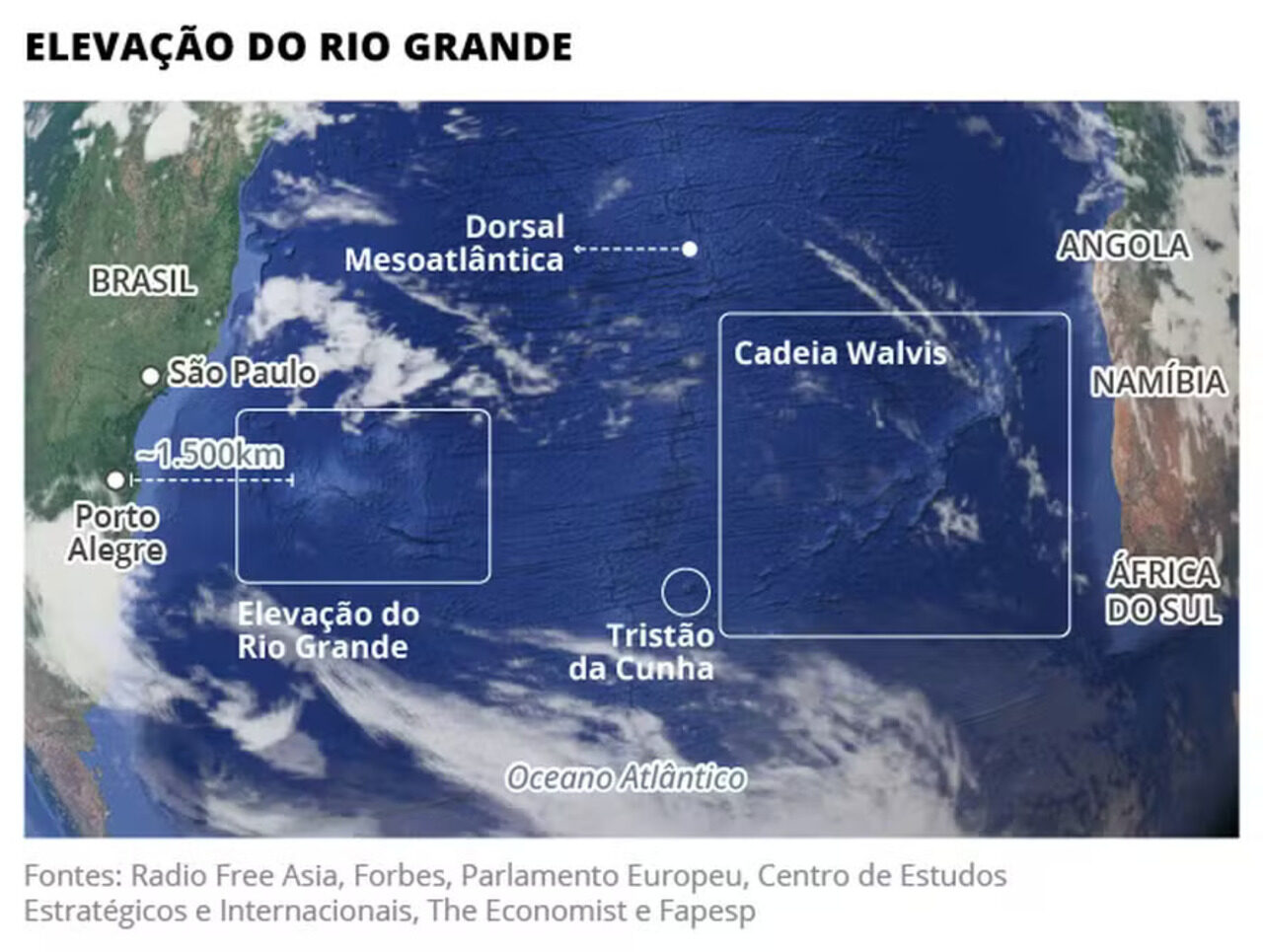
The Brazilian government updated a request made in 2018 to the UN to claim the Elevation of Rio Grande as part of the country’s continental shelf. The submarine structure is located in the South Atlantic, about 1,200 kilometers off the coast of Rio Grande do Sul. The region is rich in strategic minerals such as cobalt, manganese, nickel, tellurium, and rare earth elements.
These minerals are essential for the manufacturing of batteries, wind turbines, solar panels, and electronics.
Therefore, the area attracts considerable international interest. In a meeting with businesspeople, the representative of the American embassy in Brasília, Gabriel Escobar, stated that the Trump administration wanted to establish agreements for the purchase of rare earth elements.
-
China alone accounts for 70% of trade within the BRICS, while Brazil establishes itself as an essential supplier of food and minerals: understand how the group, which already represents nearly 40% of the world’s GDP, is changing the game.
-
Starting in May, those who do not have registered biometrics will not be able to apply for Bolsa Família, sickness benefits, or unemployment insurance: understand the new rule that changes access to benefits for millions of Brazilians.

-
A new law being voted on in Brazil proposes a minimum fare of R$ 10 per trip and R$ 2.50 per kilometer for Uber and 99 drivers, and promises to ensure they earn as well as taxi drivers did during the golden age of taxis in the country.

-
Bauer Group collapses after failed judicial recovery: 25 years, 800 vehicles, and a network of gas stations leave a debt of R$ 50 million and 100 layoffs, exposing costs, tight margins, and expensive credit in Brazil.

In response, President Lula declared that “no one lays a hand” on Brazil’s resources.
Elevation Of Rio Grande: Unique Structure On The Seabed
The Elevation of Rio Grande is considered one of the most complex geological formations in the South Atlantic.
Its base is located about 5,000 meters deep, with the top ranging between 700 and 2,000 meters below sea level. The structure features hills, plateaus, canyons, channels, and a large tectonic fissure.
Since 2015, researchers from the University of São Paulo (USP) have been studying the area in partnership with universities from Germany, Japan, and the United Kingdom.
The research is coordinated by professor Luigi Jovane, a specialist in marine geophysics and paleomagnetism.
He explains that the analysis of rocks and sediments indicates that the elevation is a fragment of the continental crust.
According to the professor, the formations in the region are between 540 million and 2 billion years old. This means they predate the separation between South America and Africa.
There is evidence that the structure was once above sea level, exhibiting characteristics of a tropical island.
Samples show volcanic rocks aged between 45 and 47 million years and sediments altered by exposure to air.
Elevation Of Rio Grande: Economic Potential And Environmental Risks
In addition to its economic value, the Elevation of Rio Grande has geopolitical and scientific importance. If Brazil’s request is accepted by the UN, the country will be able to exclusively explore the resources of the seabed. However, it will also assume environmental responsibility over the area.
Professor Jovane warns that little is still known about the environmental impacts of deep-sea mining.
The main concerns include changes in water chemistry, such as variations in pH and oxygen levels. There is also a risk of contamination from particles or pollutants released during extraction.
Another critical point is the potential impact on local fauna. Many organisms are attached to the mineral crusts and may be directly affected by human activity.
To address these challenges, USP is developing specific technologies to explore the ocean floor precisely.
Among the equipment are sensors and tools capable of operating in hard-to-reach areas. A new scientific cruise is expected to take place at the end of this year or early 2026.
The mission will be carried out in partnership with the Navy and other public institutions.
Advancement Based On International Rules
According to the United Nations Convention on the Law of the Sea, a country can claim the extension of its continental shelf beyond 200 nautical miles.
To do so, it must provide evidence of geological continuity with the national territory.
The rocks of the Elevation of Rio Grande have a composition similar to those found on solid ground in Brazil.
This reinforces the argument that the area is geologically linked to Brazilian territory. If the UN accepts the request, Brazil will have exclusive rights to the region’s resources.
Most importantly, this achievement also implies new duties. In addition to accessing rare earth minerals, the country will have to guarantee environmental protection of the area.
“This is a strategic area, with great economic potential, but it also requires a firm commitment to environmental preservation,” concludes Jovane.
With information from O Globo.





É impressionante como esse país tinha e tem tudo pra ser a maior potência do planeta, ele não depende de nada, é rico em tudo, agro, petróleo, gases, bases espaciais perto da linha equatorial, terras raras, água doce abundante e florestas infinitas, uma costa oceânica gigante etc. O que faltou aqui foi administração. Se não fosse a corrupção e má gestão dos próprios brasileiros seríamos a maior potência do planeta. Era só trazer a industrialização para os nossos recursos primários, como o refino de petróleo e terras raras para não dependermos mais de ninguém. Só pegar o exemplo da China que décadas atrás tinha seu PIB menor que o nosso e agora já está quase ultrapassando os EUA. Até a Índia já nos ultrapassou. Da pena e vergonha ver o caminho que nossa nação trilhou e vaga até hoje. Nem no futebol que eramos soberanos pode se confiar mais. Brasil, um país rico e um gigante adormecido fadado ao fracasso!