





 Portuguese
  English
  Spanish
  5 min of reading
  0 comments


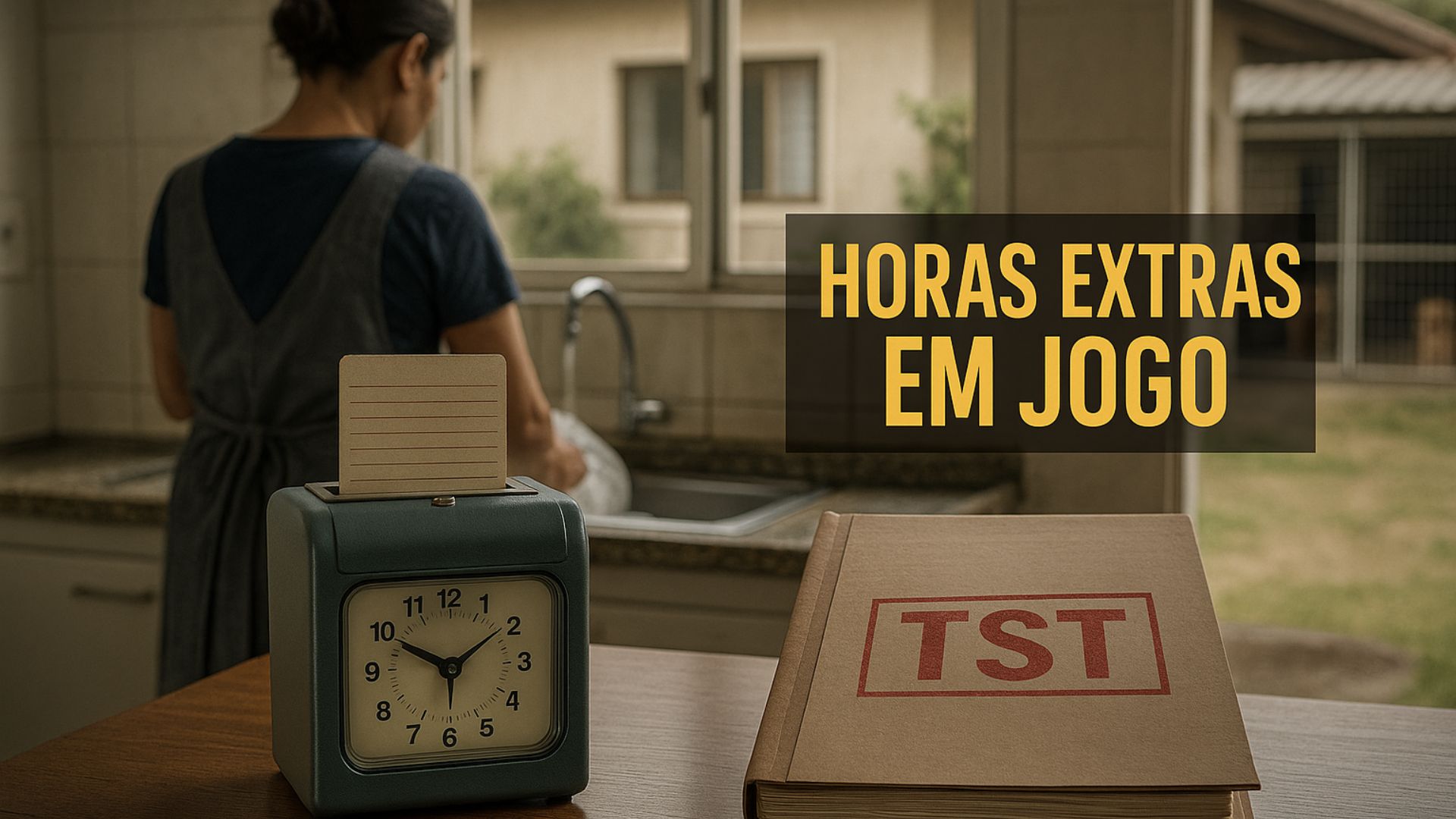
Domestic Worker from Natal Managed to Overturn TRT Decision and Ensure Payment of Overtime After TST Applied Rule of the Domestic Workers’ Law That Requires Employers to Register Work Hours.
The Sixth Panel of the Superior Labor Court (TST) decided, on September 24, 2025, that employers in Natal (RN) must pay overtime to a domestic worker hired after the Supplementary Law 150/2015.
The ruling was based on the lack of time registration, a legal obligation, which led to the presumption of correctness of the hours reported by the employee. The decision was unanimous.
Working Hours in Two Households and the Kennel
The worker started the job in June 2023 to assist two residences of a divorced couple.
-
In Spain, a law has created paid menstrual leave funded by the state, turning debilitating cramps into legal leave and placing the country among the most advanced in Europe in terms of women’s health rights.

-
Government enacts new law: paternity leave increases from 5 to 20 days with gradual increases until 2029, and Social Security pays the paternity salary; companies no longer bear the absence cost, estimated at R$ 5.4 billion.

-
End of the 1-hour lunch break in the CLT? Current labor law maintains the break, allows for negotiated reductions, and defines rules for working hours and home office in Brazil.

-
Employee Fired After Accumulating 114 Days of Medical Leave in One Year, Labor Court Upholds Company’s Decision

In addition to domestic duties, she cared for a commercial kennel maintained by one of the employers.
According to the claim, the working hours were from 7 AM to 5 PM. However, the employers denied the occurrence of overtime and maintained that there was no extra work.
Decision in First and Second Instances
In the first instance, the request was denied. The court understood that, due to the nature of domestic work, there was no legal requirement for timekeeping.
For this reason, it was up to the employee to prove any overtime.
The Regional Labor Court of the 21st Region (RN) upheld the ruling under the same terms, preserving the original distribution of the burden of proof.
Domestic Workers’ Law and the Duty to Register Hours
When judging the appeal, the rapporteur, Minister Augusto César, emphasized that with the enactment of the Domestic Workers’ Law (LC 150/2015), there was a significant change.
The domestic employer is now required to register the working hours, regardless of the number of employees.
In the absence of time cards or equivalent documentation, a relative presumption forms that the hours claimed by the worker correspond to reality, unless there are other elements in the records indicating otherwise.
Recognition of Overtime by the TST
Based on this understanding, the Sixth Panel overturned the regional judgment and recognized the right to payment of supplementary hours, with parameters to be determined in the liquidation phase.
It was noted that the lack of documentation of hours in contracts entered into after LC 150/2015 cannot result in prejudice to the party that depends on such records to demonstrate the extent of services rendered.
Particularities of the Employment Bond
The case presents a specific picture of the work organization.
The domestic worker attended to two households belonging to the same family unit and also performed tasks related to a commercial dog establishment.
For the TST, these particularities do not remove the regime provided by law when the bond is domestic and there is continuity in the provision of services.
The essence of the controversy was not the nature of the activities, but the absence of formal proof of hours.
Impact of LC 150/2015
Before LC 150/2015, there were frequent debates about the full applicability of work hour rules to domestic workers.
The supplementary legislation, however, began to ensure rights such as daily and weekly hour limits, breaks, and remuneration for overtime.
Within this framework, time registration became an essential tool for verifying compliance with these rights.
The Sixth Panel’s decision aligns with this logic, reinforcing that timekeeping is not ancillary, but a necessary component of the domestic employment relationship.
The Relative Presumption
Another point highlighted was the relative nature of the presumption.
This means that the hours reported by the employee prevail in the absence of employer records.
However, it can be overcome by other robust evidence indicating different hours.
Thus, the mechanism does not automatically convert any claim into judicial truth, but corrects a evidentiary imbalance created when the party that has the legal duty to document fails to do so.
Practical Implications for Employers and Employees
The decision also corrects the understanding adopted at the origin, which had placed the entire burden of proving overtime on the worker.
According to the TST, once the focus is inverted by the legislator — requiring the employer to control — the absence of employer evidence directly impacts the outcome of the case.
By recognizing this guideline, the Sixth Panel overturned the understanding of the TRT of the 21st Region and the first-instance court.
From a practical standpoint, the judgment indicates the need for formal procedures in the domestic context.
Employers must adopt a reliable method for recording hours, whether manual, mechanical, or electronic, maintaining regular storage of these records.
In turn, domestic workers have the backing to demand the organization of hours and appropriate payment when there is exceeding the contracted limit.
Hours Claimed by the Employee
In the specific case, the employee reported working from 7 AM to 5 PM.
Without timekeeping or another measurement mechanism presented by the employer, the hours indicated in the initial petition prevailed.
Respecting the possibility of adjustment in the calculation phase according to any intervals or peculiarities proven in the case.
The TST, therefore, did not address an automatic benefit, but a direct consequence of the failure to fulfill the duty of control.
Guidance for Future Labor Disputes
Even though each case has its specificities, the precedent reaffirms the jurisprudential standard that LC 150/2015 has concrete effects on the proof of working hours.
By employing clear language about the obligation of control and the presumption arising from its absence, the rapporteur’s vote aimed to provide legal security to employers and employees, reducing disputes based on irreconcilable versions unsupported by documentation.
For those maintaining domestic ties, the message is clear.
Documentation of working hours is essential from the start of employment, including in arrangements with more than one service location linked to the same employer.
Without this, disputes over overtime will tend to be resolved according to the hours reported by the employee, unless proven otherwise.
How will households employing domestic professionals adapt to record hours in a simple, safe, and continuous manner?









Seja o primeiro a reagir!