





 Portuguese
 Spanish


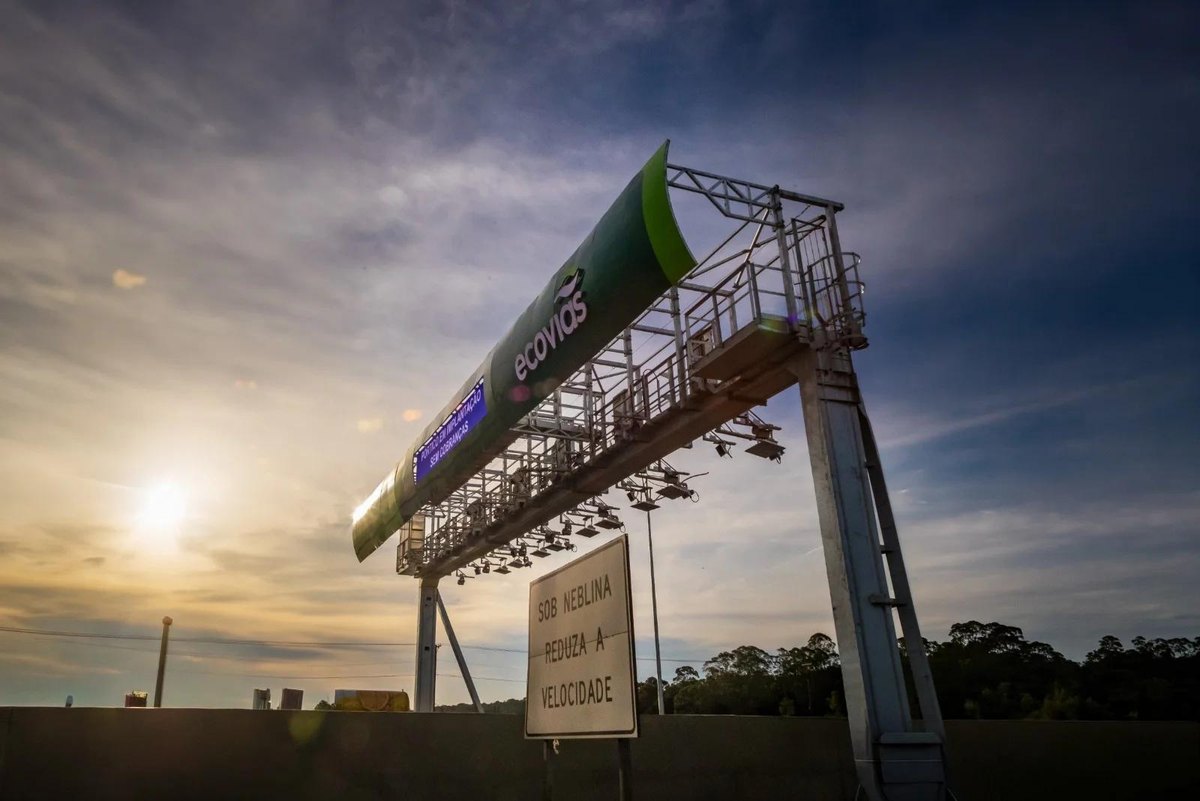
Starting Dec. 1, free-flow tolling is coming to the Anchieta-Imigrantes highway system, and drivers traveling up or down the mountain range will no longer stop at toll booths. The R$40.60 toll, currently charged only in the coastbound direction, will become R$20.30 each way, collected by electronic gantries.
Ecovias Imigrantes announced the start date for free-flow tolling on Tuesday (17), and the São Paulo state government confirmed the change through São Paulo State News that same day, outlining the tolls in each direction and payment rules for drivers without a transponder.
The round-trip toll for a passenger car will not change. It will remain R$40.60, but will now be split into two charges of R$20.30.
What changes is how drivers pay. Toll booths will stop collecting fares, and cameras, sensors and antennas will identify each vehicle by its license plate or transponder as it passes.
-
Brazil Lines Up R$160 Billion in Rail Projects to Restore 10,000 Kilometers of Track and Expand Freight Capacity

-
Braspress invests R$10 million to acquire 30 electric vehicles, expanding its sustainable fleet for nationwide transportation operations
-
Brazil Sets Aviation Record, Carries 88.6 Million Passengers in 2026, International Flights Grow by 7.6%

-
In Sweden, a 672-ton wooden church was transported intact for 5 kilometers over two days to escape ground instability caused by the world’s largest underground iron mine


Where the gantries are located
The toll gantries are located at km 29 of the Imigrantes highway, in the direction of the coast, and at km 37 of the same highway, in the direction of São Paulo, CBN reported.
On the Anchieta highway, tolls are collected at km 33, where a gantry serves both directions.
The radio station reported that the equipment locations were changed before operations began. Residents near the Imigrantes highway had complained that they would be charged for routine short trips within their own area.
The toll operator made the announcement during Summit Infra, an event organized by Grupo Tribuna at Arena B3 in São Paulo.
Drivers with transponders do not need to do anything
For drivers who already use an automatic toll transponder, the process will remain the same. The toll is deducted from their bill or the device’s prepaid balance when the car passes under a gantry.
Isaac Salatiel, Ecovias Imigrantes’ road systems coordinator, told CBN that these drivers will see no change in the process.
The difference affects drivers who used to pay cash or by card at the toll booth. They will now drive through without stopping and pay later.
Drivers without a transponder have 30 days to pay
Drivers without a transponder can pay within 30 days of passing through, according to São Paulo State News. They can look up the toll by license plate on the Siga Fácil website, the São Paulo state electronic tolling program.
Self-service kiosks are also available at customer service centers and system operations bases. They accept only Pix, Brazil’s instant payment system, and credit cards. Cash is not accepted.
The g1 news site notes that the free Pedágio Digital app lets users register a license plate and card to make payment easier, and that one-time payments can also be made through the website.
Another option is the federal government’s CNH do Brasil app, which compiles trips recorded by free-flow gantries and directs drivers to the toll operator’s official channel.
What happens if a driver forgets to pay
The gantry does not issue fines. It only identifies the vehicle and records the toll owed.
The problem starts after the 30-day payment period. Failure to pay is treated as toll evasion, a serious traffic violation that carries a R$195.23 fine and five points on the driver’s license, g1 reported.
The charge is issued in the vehicle owner’s name and, unlike an ordinary traffic ticket, cannot be transferred to another driver.
Through the CNH do Brasil app, Brazil’s digital driver’s license app, car owners can also dispute a passage they do not recognize. Passage records are kept for up to five years.
Trucks pay per axle while motorcycles remain exempt
The R$20.30 charge in each direction applies to passenger vehicles. For trucks and buses, the toll will continue to be calculated by the number of axles, the São Paulo state government said.
Motorcycles remain exempt from tolls on the Anchieta-Imigrantes System.
For drivers making the trip by car in only one direction, the math changes. Today, drivers heading down to the coast pay the full R$40.60 at once and travel back up without paying. Starting in December, the trip down will cost R$20.30.
Toll plazas will remain in place but stop collecting tolls
The booths at the physical toll plazas will stop collecting tolls, but the highway operator will keep the structures in place for a while to support operations and road safety.
The reason is fog in the mountain range. The plazas make it possible to continue the Convoy Operation, used when visibility drops, until a new system is put in place.
“Starting gantry operations before the summer travel season will improve traffic flow and safety for drivers using the Anchieta-Imigrantes System, in addition to the benefit of splitting the toll by direction,” said Raquel Carneiro, director of Artesp, São Paulo state’s transportation agency.
The July start date has come and gone
In March, CPG reported that the plan called for free-flow tolling in both directions starting July 1, with a fare of R$19.35 per segment.
The system is now set to launch on December 1, with the charge at R$20.30 in each direction. Rui Klein, EcoRodovias’ director-general of concessions, said the equipment was being calibrated and monitored ahead of the launch.
He described the new model as “a free-flow system, with no tollbooths.”
The summer season will be the ultimate test
In other words, the timing is tied to the calendar. December marks the start of the season when the system handles its heaviest traffic between São Paulo city and the state’s coast, especially on holidays.
Those are precisely the days when lines at toll plazas are most burdensome for drivers heading to Santos, Guarujá, Praia Grande or São Vicente.
Over 28 years of the concession, the system received R$11 billion in investment, including the southbound lane of the Imigrantes Highway, the Cubatão Ring Road and the Via Anchieta service road in São Bernardo do Campo, according to Agência SP, the state government’s news agency.
Free-flow tolling is already operating in seven states
São Paulo’s mountain highway is not the first to replace toll booths with gantries. As of August, there were 55 gantries on highways operated by 14 concessionaires, according to data from ANTT, Brazil’s National Land Transportation Agency, cited by g1.
The system was already operating in Goiás, Minas Gerais, Paraná, Rio de Janeiro, Rondônia, Rio Grande do Sul and São Paulo.
Outside Brazil, tolling without barriers is used in more than 20 countries, including Norway, Portugal, the United States, Italy, China and Chile.
I keep thinking about drivers who make the trip down the mountain once a year, during vacation, and will have to remember to pay after they get home.
Will drivers pay the mountain route’s free-flow toll via transponder or settle the bill by license plate after the trip?


