






 Portuguese
  Spanish


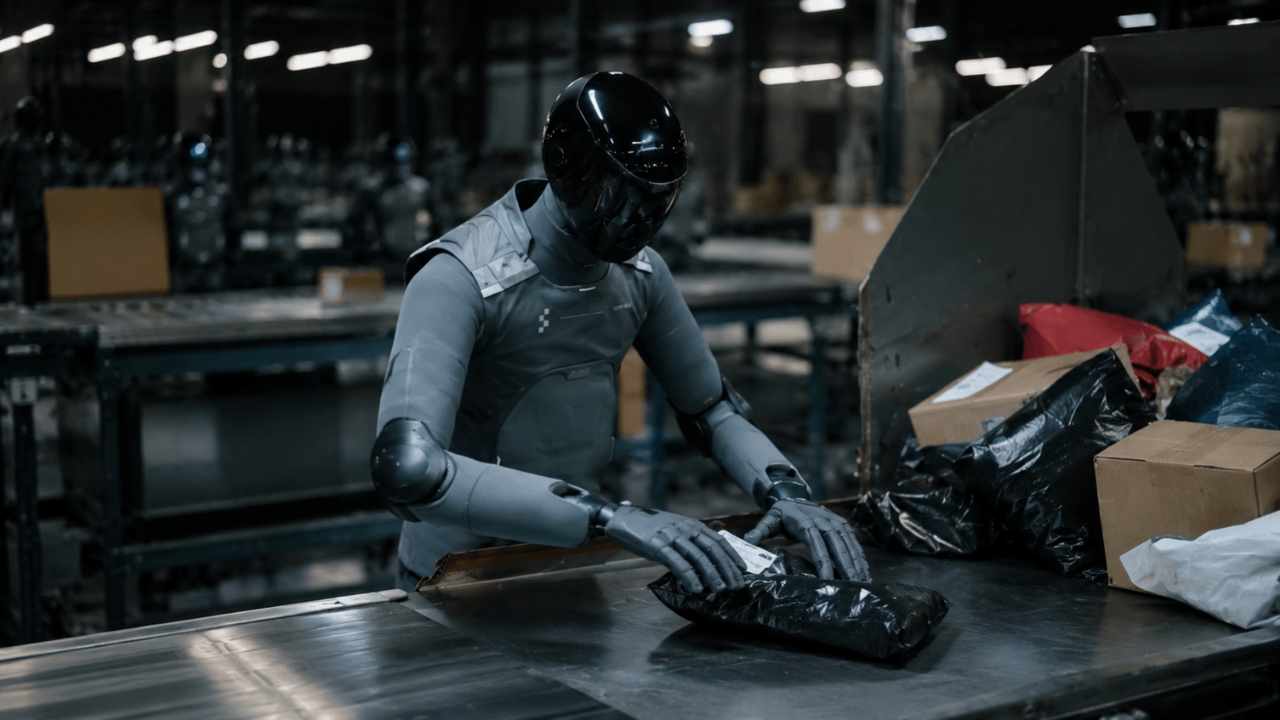


Live video reignites the debate on automation, logistics jobs, and the advancement of humanoid robots capable of performing repetitive tasks for hours.
An American robotics company aired a scene that seems straight out of a movie about the future of work: humanoid robots working live, in front of the public, on a repetitive warehouse task. The broadcast by Figure AI showed Figure 03 machines handling packages in real-time, during a shift announced as autonomous and 8 hours long.
The video, called “F.03 Livestream”, became a huge discussion point because it didn’t seem like just another edited clip to impress investors. The live’s own description stated that a team of humanoids was performing a full shift “at human performance levels,” using the Helix-02 system, the company’s full-body autonomy technology.
The most striking detail is the counter displayed on the screen. From the visible data during the broadcast, the robots’ pace indicated the possibility of over 10,000 packages processed in 8 hours, something that turns a simple demonstration into a warning about the future of logistics centers.
-
Germany Opens World’s Largest Smart Power Semiconductor Factory with €5 Billion Investment, Creating 1,000 Jobs and Doubling Capacity for AI and Energy Needs

-
Kazakhstan’s Torysh Valley Holds Thousands of Giant Stone Spheres, Intriguing Scientists with Ancient Oceanic “Cannonballs”

-
Egypt Discovers 18 Ancient Tombs with Gold Tongues, Unveiling Unusual Funeral Rituals and Amulets Believed to Give Voice to the Dead

-
Nigeria Dumps 120 Million Tons of Sand into Atlantic to Build Massive City with 8.4 km Sea Wall for Protection Against Ocean Waves and Erosion




A live to prove that the robots really work
Figure’s great idea was to turn a technical demonstration into a public event. Instead of just publishing a short video, the company opened a live broadcast on YouTube to show its robots working in a logistics station.
This format changes public perception. When a robot appears for 15 seconds in an edited video, many people suspect cuts, rehearsals, teleoperation, or off-camera tricks. In a live broadcast, the company exposes itself much more.
That’s why the broadcast became a direct message: Figure wanted to show that its humanoids are not just striking futuristic poses but attempting to perform a real work routine, with repetition, pace, and endurance.


Figure 03 appears handling packages in a repetitive task
During the broadcast, the Figure 03 robots appear performing a typical warehouse task: picking up packages, positioning them, and placing them on a conveyor belt. It’s the kind of activity common in distribution centers, order sorting, and logistics operations.
At first glance, it seems simple. But for a humanoid robot, this is extremely difficult. Packages can be rigid, soft, slippery, dented, light, heavy, or deformable. Each item requires a different grip.
It is exactly for this reason that the scene impresses. If a robot can handle this variation for hours, at a constant pace, it ceases to be just a technological curiosity and starts to look like a production tool.
The transmission counter points to more than 10 thousand packages
One of the strongest elements of the video is the counter displayed in the live broadcast itself. In a capture of the transmission, the system showed 4,361 packages when the shift was at 3 hours, 12 minutes, and 26 seconds.
This pace is equivalent to approximately 1,360 packages per hour. Projected for a full shift of 8 hours, the number exceeds 10 thousand packages, reaching close to 10,880 packages if the cadence were maintained.
Therefore, the safest way to summarize is: the transmission counter indicated a pace compatible with more than 10 thousand packages in 8 hours. Even so, the number is already enough to explain why the video caused such an impact.
Helix-02 is the brain behind the operation
The name Helix-02 appears in the description of the live, but it is not the physical robot. Helix-02 is the artificial intelligence system that controls the humanoid, connecting vision, language, and physical action.
Figure claims that Helix-02 allows full-body autonomy, meaning the robot does not rely solely on arms programmed for repetitive movements. It needs to perceive the environment, adjust the body, control the hands, and react to each package.
This difference is crucial. What is at stake is not just putting a machine on a treadmill, but developing robots capable of operating in environments made for humans, with irregular objects and less predictable situations.
The company also claims to produce one robot per hour
The live becomes even more striking because it appeared at the same time Figure announced a heavy acceleration in manufacturing. The company claims that its BotQ line went from 1 Figure 03 per day to 1 per hour, a jump of 24 times in less than 120 days.
According to Figure itself, the factory has already delivered more than 350 third-generation humanoid robots. In other words, the company is not just talking about an isolated prototype, but an attempt to bring humanoids to industrial scale.
This combination is powerful: on one side, robots working live; on the other, a factory promising to accelerate production. For the market, the message is clear: the humanoid race has moved beyond just research and entered the volume phase.

The video reignites fear about jobs in warehouses
The image of humanoid robots working in real-time directly raises an uncomfortable question: which jobs will be automated first? The likely answer starts with physical, repetitive, and predictable jobs.
Warehouses, distribution centers, and factories are ideal environments for this type of technology. They have standardized tasks, high demand, pressure for speed, and operations that repeat throughout entire shifts.
This does not mean that humans will be replaced all at once. But Figure’s live show demonstrates that automation is taking on a new form: not just fixed industrial arms, but machines with humanoid bodies, designed to move in spaces made for people.
There are still questions that the live does not answer
Despite the impact, caution is needed. The broadcast shows robots working live, but the main claims about full autonomy, human performance, and full shift come from Figure AI itself.
Important questions remain: were there pauses? What was the error rate? Were all packages processed correctly? Was there off-camera intervention? Did the pace hold until the end of the 8 hours?
Even with these doubts, the video marks a symbolic moment. Figure put its humanoid robots in front of the public and tried to prove, in real-time, that they can already work for hours. For those following technology, industry, and jobs, the message is hard to ignore: the future of warehouses may have begun in a live YouTube broadcast.







Если сокращают людей то этим людям надо платить определённый % пожизненно,от прибыли владельца производства
Если сокращают людей то этим людям ,производству надо платить определённый % прибыли пожизненно.А то всё в карман владельца