





 Portuguese
  English
  Spanish
  4 min of reading
  2 comments


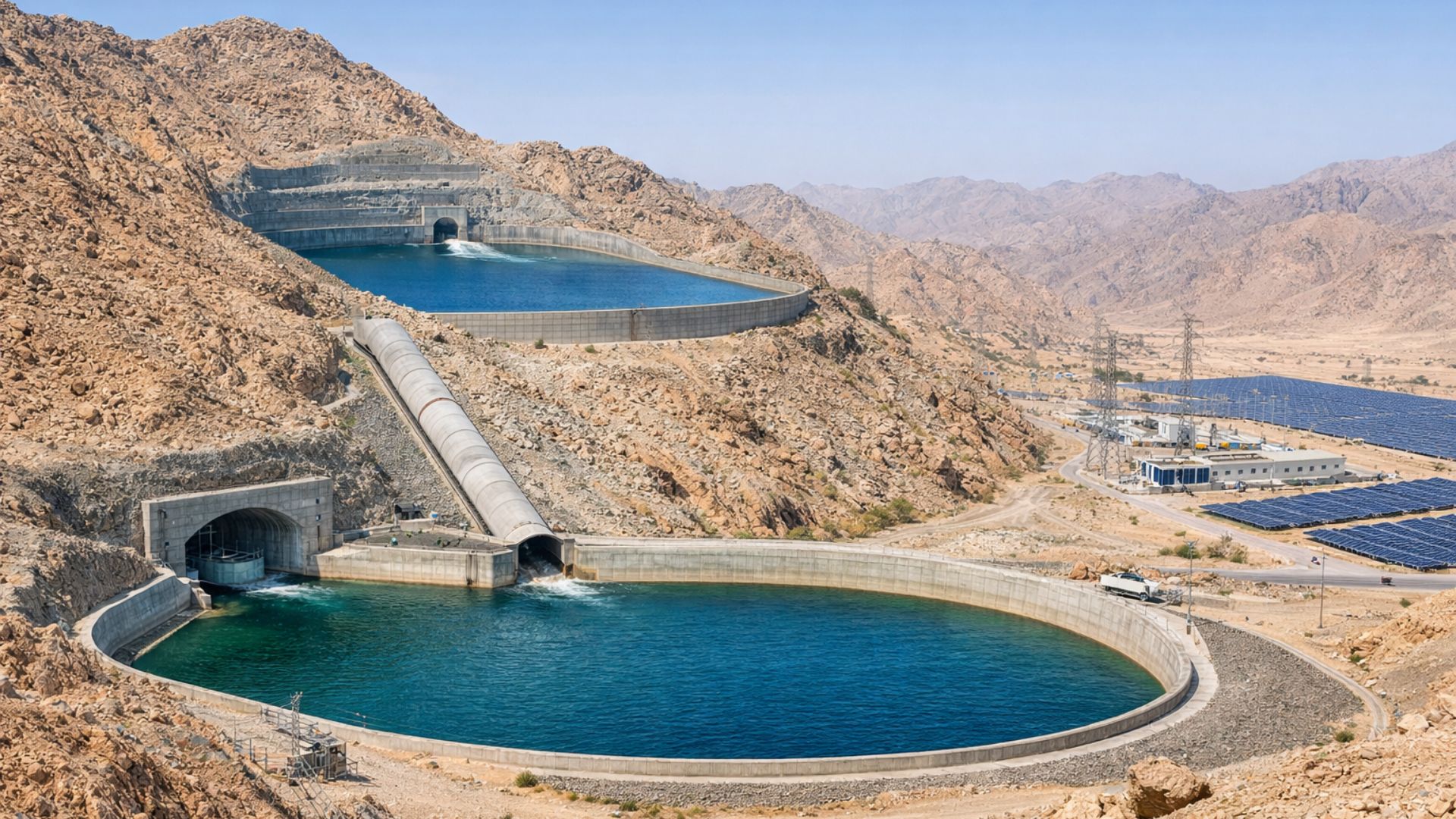


Classical Engineering Solution Is Applied in Arid Region to Store Energy on a Large Scale, Using Reservoirs at Different Altitudes and Integration with Renewable Sources. Project in Hatta Expands the Flexibility of Dubai’s Electricity System, Reduces Waste of Solar Generation, and Reinforces Energy Security During Peak Demand.
Dubai is using a classical engineering solution to face a modern energy transition challenge: how to store large volumes of electricity and return it to the system when demand increases.
In a mountainous area of the Hatta region, the emirate has implemented a pumped storage hydroelectric plant that operates like a “water battery”, capable of storing energy by elevating water between reservoirs and generating electricity in a controlled manner when the system needs it.
How Pumped Storage Hydroelectric Plant Works
The project stands out for occurring in a territory associated with arid climate and water scarcity, far from the traditional imagery of dams and rushing rivers.
-
Naval reform transforms 40-year-old sailboat purchased for $5,000 into a residential yacht: structural repair of hull/keels, Awlgrip painting, engine replacement with Beta Marine, autopilot, sealing of chain plates, and complete interior retrofit for $25,479.

-
Firjan proposes to ANTT the acceleration of works on BR-101 in Northern Fluminense to improve logistics, urban mobility, and regional competitiveness.
-
Couple that traveled by Kombi through many countries moves forward with the land in the south of SC: machines level the refuge in the woods, reinforce embankments, set up a construction camp, and train chainsaw operators to speed up the building process.
-
Couple leaves the city and builds a steel frame house in the countryside: sandwich roof, beams and columns secure the roof, X-braces prevent the walls from moving, and the 3-month deadline tightens.
The logic of the pumped storage hydroelectric plant, however, does not require large permanent water courses.
The same volume of water circulates repeatedly between two reservoirs at different altitude levels, using reversible pumps and turbines.
When there is excess electricity on the grid, water is pumped up.

As demand grows, it flows down, turns the turbines, and produces energy.
Integration with Dubai’s Electricity System
The Hatta facility has been developed to serve as storage and flexibility infrastructure for Dubai’s electricity system.
The operation is coordinated by the Dubai Electricity and Water Authority (DEWA), responsible for integrating generation, storage, and distribution of energy in the emirate.
According to institutional information, the plant was designed to provide power quickly, helping to stabilize the grid during periods of high consumption or decreased production from other sources.
Engineering and Topography as Key Factors
Technically, the operation relies on a natural elevation difference between two reservoirs, connected by tunnels and pressurized conduits.
High-power pumps move the water to the upper reservoir when the grid has enough electricity available.
In the opposite direction, the released water drives turbines that convert potential energy accumulated into electricity.
This cycle can be repeated daily, with precise control of stored volume and delivered power.
The choice of Hatta is linked to the mountainous topography of the region, an essential factor for this type of technology.
Unlike large dams, the project does not depend on a permanent river, but on the existence of artificial reservoirs and an adequate elevation difference to ensure energy efficiency.

In arid environments, this requires careful planning, both for water management and for operation under extreme climatic conditions, such as high temperatures and dust.
Strategic Role in Advancing Renewables
The role of energy storage gains relevance as the share of variable renewable sources, such as solar, increases.
In electrical systems with high photovoltaic generation, production tends to concentrate at certain hours of the day, while consumption may peak at other times.
The pumped storage hydroelectric plant allows for shifting that energy in time, storing electricity when it is surplus and releasing it when the grid needs it, without relying on fossil fuels.
Energy planning experts consider this type of plant a strategic reliability resource.
Unlike chemical batteries, which respond quickly and take up little space, pumped storage typically operates with larger volumes of energy per cycle, making it suitable for medium and large-scale storage.
In several countries, these plants are viewed as an essential part of the infrastructure to integrate renewables on a large scale.
Complementarity with Solar Energy
In the case of Dubai, the project also relates to the expansion of solar energy in the emirate.
Although the pumped storage hydroelectric plant does not generate energy on its own continuously, it enhances the utility of already produced renewable electricity, reducing waste and helping to balance the system.

The logic is of complementarity: solar generation during the day and storage for use during peak demand hours or lower production periods.
Infrastructure, Operation, and Systemic Impact
Beyond its energy function, the project involves a complex chain of civil engineering, electromechanical equipment, control systems, and long-term maintenance.
The operation requires constant monitoring of structures, pumps, turbines, and reservoirs, as well as integration with the dispatch of the electricity system.
In desert regions, factors such as evaporation, temperature, and access logistics directly influence design and operational costs.
The contrast between desert and hydroelectric plant contributes to the visibility of the project, but the central point is less about the scenery and more about the model adopted.
The Hatta plant illustrates how cities and countries are combining known technologies to respond to new challenges, adapting old solutions to different contexts, with a focus on energy security and grid flexibility.
As electricity becomes cleaner and more variable, projects of this kind help redefine the concept of energy infrastructure.
Instead of just producing energy, it becomes equally important to know when and how to deliver it to the system.







Grande exemplo de como se aproveitar riqueza para gerar riqueza, e bem estar para quem produz riqueza!!!!!
A população que vive esse lugar inóspito é que possuem sim seus problemas como todos os povos mais, os governantes não usan antolhos!!!!¡
Parabéns!!!
Texto estilo PTista:
“O sistema e dialoga com outra…”
Aprende a escrever, ****!