






 Portuguese
  Spanish


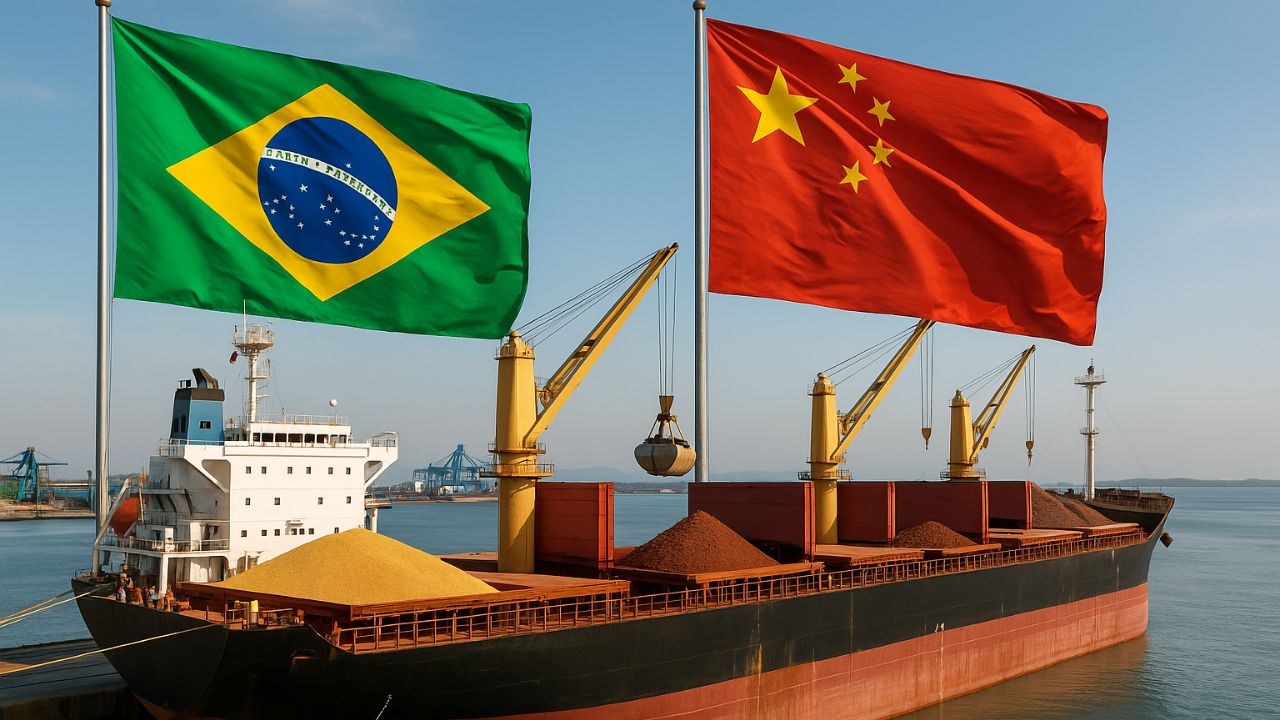

Brazil Exports More Than Ever to China, But Experts Warn: Dependency Threatens National Industry and Economic Future.
The advancement of the relationship between Brazil and China has reached historical levels in the last two decades. Today, almost one-third of Brazilian exports are destined for the Asian giant, consolidating a strategic partnership while also raising alarms about the future of the national industry.
Experts point out that the current model, based on the shipment of commodities such as soy, iron ore, and oil, may weaken the country’s productive base.
The phenomenon, which some call the “China Effect”, is already impacting Brazil’s economic complexity and reigniting the debate about the country’s role in the global scenario and in the BRICS.
-
Abandoned Factory in Rio’s North Zone Becomes Urban Hazard with Standing Water and Debris

-
The U.S. Navy Conducts Submarine Tests in Idaho Lake to Detect Underwater Noises Hidden by the Ocean

-
British Factory Transitions from Mechanical Parts to Producing 420,000 Electric Power Units Annually, Supplying 70% of Ford’s Electric Cars Sold in Europe
-
France Launches Network to Recycle 20 Million Cookware Pieces by 2027, Accepting All Brands for Aluminum and Coating Separation


China Dominates Exports and Redefines the Trade Balance
Between 2013 and 2023, Brazil exported more than US$ 838 billion to China, with over 60% consisting of soy and minerals.
The numbers reflect an apparent success in trade exchanges but also highlight the concentration in low value-added products.
According to Ana Elisa Saggioro Garcia, a professor of International Relations at PUC-Rio, the Asian country has established itself as a manufacturing and technology center while Brazil has directed its efforts towards the shipment of primary products.
“While Brazil dismantled the facilities to grind soybeans or process ore, China installed large grinders and processing plants at its own ports,” explains the researcher.
This dependency intensified after 2004, when the Brazilian government recognized China as a market economy.
Since then, trade flows have multiplied, and the country has surpassed the United States as the main buyer of Brazilian products.
Exports on the Rise, But Industry on the Decline
The growth of exports to China is accompanied by a concerning phenomenon: deindustrialization.
In 2023, 74% of products imported from China were of high and medium-high technology, while only 5% of Brazilian exports to the country had this profile.
A study by the Institute of Economic Development Studies (IEDI) shows that 90% of Brazilian exports to the Chinese market are basic goods.
As a consequence, Brazil’s Economic Complexity Index (ICE) fell from 23rd place in 1998 to 49th in 2023, highlighting the loss of productive sophistication.
Another factor contributing to this scenario was the Kandir Law, which exempted the export of unprocessed products from taxes.
For Ana Garcia, this policy encouraged the shipment of raw materials without processing, rather than fostering industrial development.
“Brazil opened its market to the entry of much more competitive Chinese products, which led to a strong dismantling of the national industry,” she states.
Brazil Exports More, But Processes Less
The country is currently the largest exporter of soy in the world, but only the third largest processor, behind China and the United States.
According to Abiove, Brazilian production grew 79% between 2014 and 2024, while processing advanced only 48%.
China, in turn, has expanded its refining and processing plants at ports, ensuring autonomy in products such as oil and meal.
The same occurs in mining: in 2024, Brazil sold 280 million tons of minerals to China, almost all in raw form.
Despite having one of the largest mineral reserves on the planet, Brazil still invests little in processing.
Data from the International Council on Mining and Metals (ICMM) shows that the country has many facilities, but still lags behind China, Russia, and the United States in mineral processing.
Relationship with China or Failure of National Strategy?
For experts, the problem is not the partnership itself, but the lack of internal strategy.
“It is not China that deindustrializes Brazil. The problem lies in national policies,” says Evandro Carvalho from FGV Direito Rio.
“We cannot blame China when we haven’t done our homework for 20 years,” adds Roberto Dumas, a professor at Insper.
The Brazilian government is trying to reverse this situation with the New Brazil Industry Plan (NIB), launched in 2024, which envisions R$ 300 billion in investments by 2026.
The goal is to boost industrialization and add value to exports. At the same time, the arrival of Chinese electric vehicle manufacturers is seen as an opportunity for technology transfer within the BRICS.
Commercial Dependency and Future Risks
Currently, 30% of Brazilian exports are destined for China. For Dumas, this concentration is risky:
“Having 30% of exports concentrated in a single country is dangerous. Any political or economic crisis could affect this relationship.”
Moreover, China has been seeking food and energy self-sufficiency, which could reduce its dependence on Brazilian imports in the future.
The possibility of a new trade agreement between the United States and China, encouraged by Donald Trump, could also redirect some Chinese purchases of American soy.
Perspectives for the Future of the Partnership
Despite the risks, diplomats and economists believe that the relationship between Brazil and China will remain strong.
The former ambassador Marcos Caramuru assesses that the two countries have similar views on multilateralism and the role of global trade.
“The relationships are going very well. Even with political changes, there is unlikely to be a rupture,” he asserts.
The challenge, according to analysts, is to transform the surplus in exports into domestic development, focusing on innovation, technology, and reindustrialization.
Brazil, they assert, needs to stop being just a supplier of raw materials and become an industrial protagonist within BRICS.


