





 Portuguese
  English
  Spanish
  4 min of reading
  0 comments


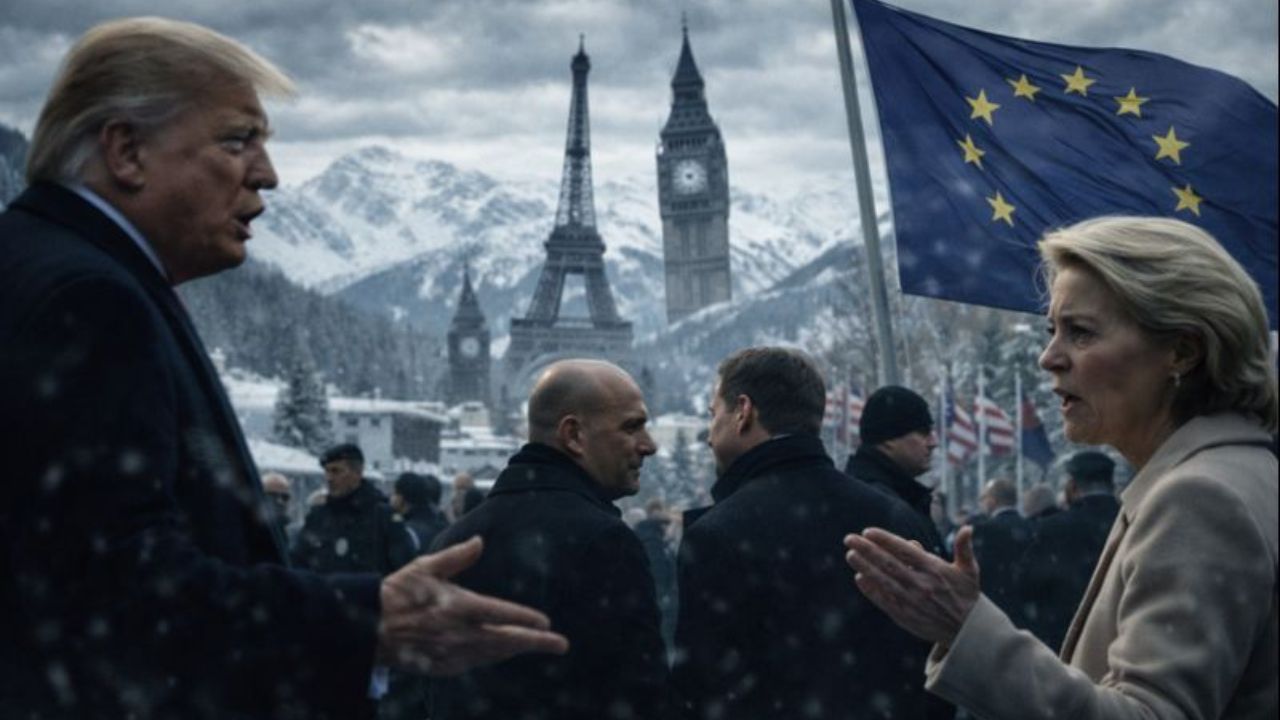
One Year After Trump Returns to the White House, Davos 2026 Shows Economic Growth, but Global Cooperation in Freefall.
Davos 2026 begins this week in a setting marked by a stark contrast. The global economy continues to show resilience in the indicators, but trust among countries, businesses, and governments exhibits clear signs of wear.
It is in this context that the World Economic Forum brings together, from January 19 to 23, political, business, and institutional leaders in Davos, Switzerland, exactly one year after Trump’s return to the White House.
The meeting takes place to discuss how to grow, cooperate, and invest in a more fragmented world, with less predictability and greater competition for economic power.
-
“No one will make us change the Pix,” says Lula after the US report.

-
Lula responds directly to Trump and says that Pix is from Brazil and will not change under pressure from anyone, after a report from the United States pointed out the Brazilian payment system as an American trade barrier.

-
Amazon has just announced a new fee on all deliveries, and your online purchases will become more expensive starting April 17, including for those buying from the United States here in Brazil.

-
He sold his share for R$ 4 thousand, saw the company become a giant worth R$ 19 trillion, and missed the opportunity of a lifetime.


Global Economy Resists, but Cooperation Loses Strength
The numbers underpinning the debates of Davos 2026 indicate that the engine of the global economy is still running.
Growth, investments, and innovation remain active in various regions. However, the political and institutional environment that supports this mechanism shows signs of exhaustion.
The prevailing perception among business leaders is that the world has become less collaborative.
According to a survey presented by the World Economic Forum, 85% of board members state that there is “less” or “much less” international cooperation in trade, capital, and innovation than there was a year ago.
See more: U.S.-EU Trade Relations Enter Alert Mode with New Geopolitical Tensions
When it comes to climate, the scenario is even more pessimistic. For 87% of executives surveyed, global cooperation has regressed, a fact that directly concerns those who decide where and how to invest.
The Trump Factor and the New Global Dynamic
The one-year anniversary of Donald Trump’s return to power adds both a symbolic and practical component to the World Economic Forum.
The President of the United States is the main attraction of Davos 2026 and personifies, for many participants, the change in the gears of international governance.
Nevertheless, the official forum report avoids attributing the crisis of trust solely to Trump.
The document describes the current moment as a “new global era,” marked by ongoing fragmentation, growing distrust, and record levels of forced displacements.
According to the text, the erosion of the multilateral system has been deepening for at least 15 years. Since the 2008 financial crisis, dissatisfaction with global rules has increased, exacerbated by successive shocks such as the Covid-19 pandemic, the war in Ukraine, conflicts in the Middle East, the energy crisis, and the rise of protectionism.
Davos 2026 Bets on Pragmatism, not the End of Globalization
Despite the harsh diagnosis, Davos 2026 does not start from the premise that globalization is over. The prevailing reading is one of transformation.
The report from the World Economic Forum indicates that cooperation has not disappeared but has become more selective and pragmatic.
Gone is the ideal of a world without borders. In comes a logic of collaboration “where and when” there is strategic interest.
This pragmatism, viewed by some as realistic and by others as cynical, is expected to guide much of the discussions throughout the meeting.
It is with this approach that leaders will attempt to advance solutions to crises that, despite political barriers, continue to cross national borders.
What is the World Economic Forum and Why Does it Matter
Founded over five decades ago, the World Economic Forum has established itself as the main informal space for dialogue among governments, businesses, and international organizations.
Although it does not produce binding decisions, Davos acts as a barometer for the economic year.
There, early signals about trade, investments, industrial policy, technology, innovation, and international cooperation emerge.
In 2026, the event occurs under the theme “A Spirit of Dialogue,” in an environment of contested norms and pressured alliances.
Davos 2026 Agenda: Tensions, Transition, and Technology
The programming of Davos 2026 includes debates on geopolitics, economic growth, international trade, energy security, climate transition, and artificial intelligence.
The central focus will be on how to rebuild some degree of economic cooperation amid tariffs, strategic disputes, and less regulatory predictability.
Highlights will also include topics like the labor market, professional reskilling, productivity, social well-being, and financing the energy transition, as well as the sustainable use of natural resources.
Who Participates in Davos 2026
This year’s edition is expected to gather around 3,000 participants from more than 130 countries. Approximately 400 political leaders are anticipated, including nearly 65 heads of state and government and six representatives from the G7.
Confirmed names include Ursula von der Leyen, Javier Milei, Volodymyr Zelenskyy, Keir Starmer, and Mark Carney.
The forum also brings together leaders from multilateral organizations, such as Kristalina Georgieva, Ngozi Okonjo-Iweala, and Ajay Banga, as well as around 850 global CEOs.
Expectations for Trump’s Speech and the Role of Europe
Trump’s speech is one of the most anticipated moments of Davos 2026. European governments, investors, and markets are looking for signals about the next steps in American trade policy, especially after threats of new tariffs linked to recent tensions with Europe.
The expectation is that Trump will reinforce the use of tariffs as a pressure instrument. The tone adopted in Davos will be interpreted as indicative of openness to dialogue or a more confrontational stance throughout 2026.
Meanwhile, the European Union arrives at the forum discussing possible countermeasures, including retaliatory tariffs and the use of the Anti-Coercion Instrument.
Davos, therefore, returns to fulfilling its historical role: less as a space for consensus and more as a stage for early readings of the directions of the global economy.









-

-

2 pessoas reagiram a isso.