





 Portuguese
  English
  Spanish
  8 min of reading
  0 comments


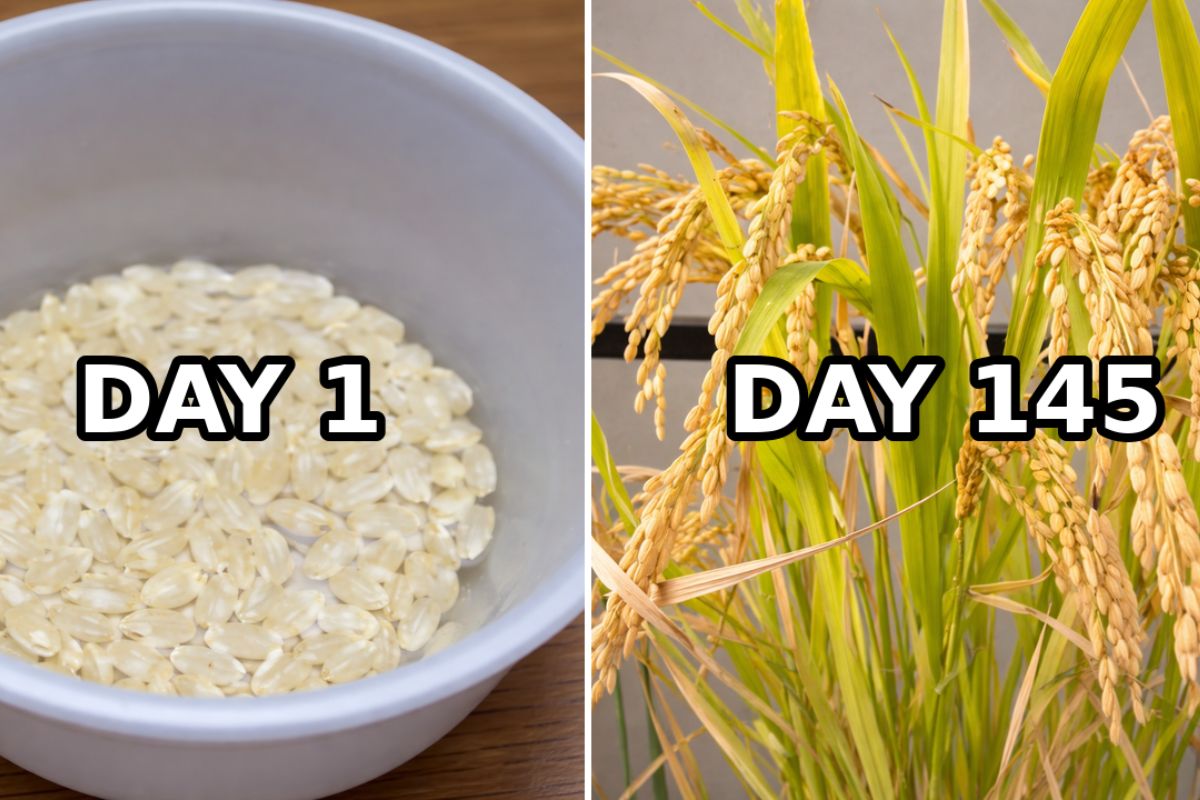
See How to Plant Rice, Set Up a Bucket of Rice, and Face Pests, Diseases, and Frustrations Until Harvesting a Little Brown Rice in Amateur Agriculture.
Planting brown rice in buckets seemed like a quick curiosity test. In practice, it turned into a saga of 154 days of rain, mud, pests, diseases, and a harvest of rice so small it fit in the palm of his hand, but big enough to change how he sees food, time, and work in the field.
Over nearly five months, this resident took the brown rice he used to eat, germinated it, planted, replanted, drained, flooded, battled mosquito larvae, leaf diseases, grasshoppers, and in the end, cooked just over half a cup of his own rice. The result was a wake-up call about how rice reaches the table and how much amateur agriculture requires patience, technique, and humility.
From the Grain in the Cupboard to the First Bucket of Rice
The experience started almost naively. At the end of April, he took the common brown rice from the pantry, submerged it in water, and spent a few days changing that water daily.
-
Sleeping at different times each day can be a bomb for your heart and even double your risk of having a heart attack.

-
Without help and without heavy machinery, a woman builds a house from scratch with stone, wood, and cement, erects a chimney, creates a complete leisure area, and transforms an empty lot into her dream home.
-
Couple transforms abandoned house after years of being closed; residence was overgrown with weeds, had a green pool, and a deteriorated structure in the interior of Rio de Janeiro.

-
Hidden marks on the walls of the site associated with the Last Supper of Jesus for centuries have been deciphered in Jerusalem, revealing medieval inscriptions left by pilgrims, European nobles, and travelers from the Middle East.

After about three days, the grains began to germinate. He selected about 30 germinated grains, picked the best ones, and planted 19 seeds in a potting soil, with the sprouts facing up, as the bucket rice manual instructs. He covered it with dirt, filled the bucket with water to the soil level, and waited.
Six days later, the first green rice shoots started to appear. By day ten, the shoots were already pushing out more vigorously.
However, only 11 of them developed well. Early on, he realized that growing brown rice was not so simple: without its original hull around it, the grains rotted more easily, especially in very moist soil.
When Rice Becomes Mud and Buckets Become Experiment

At 16 days, it became clear that the first attempt had flaws. The rice did not sprout as well as he had hoped. The solution was to restart part of the process, this time focusing more on the rice soil than just the grain.
By day 30, he began to dry the garden soil to use as a base for the new rice buckets. The next day, he sifted this soil with a coarser sieve, placed the filtered soil in a 10-liter bucket, and began a ritual that any rice producer knows well: adding water, stirring until a homogeneous mud forms, and repeating this process several times, until piling the soil to about 7 cm from the edge.
Only then did he return to the buckets, now in a setting closer to a miniature rice field. The rice seedlings were planted in groups of four, expecting them to grow strong.
The initial recommendation was to keep the water at about 1 cm deep. He started like that, but was already planning to increase this water level as the rice developed deeper roots.
Rice, Algae, Larvae, and Medaka: The Ecology Inside the Bucket

Five days after the replanting, at 36 days into the rice saga, algae began to appear in the water of the buckets. Instead of a problem, this was a sign that the environment was alive and well-nourished. He marked on disposable sticks the water depth, adjusting it to about 3 cm.
When the rice reached 44 days, the algae gave way to another surprise: a surge of mosquito larvae. To avoid turning the homemade rice field into a mosquito breeding ground, he decided to introduce medakas, small Japanese fish, as a biological control.
The water level was around 5 cm, and to prevent the fish from jumping out, he placed a net over the top.
With 60 days of cultivation, and 29 days after the final planting, the rice reached a height of 45 to 55 cm. It was time for a classic management procedure: drain the water to allow the soil to dry for a few days. He rescued the medakas, took them back to the tank, and let the rice buckets breathe.
Rains, Mud, and the First Shock with Real Rice

In theory, it would just be a matter of draining, drying, and resuming irrigation. In practice, it was a year of intense rainy season. At 67 days of cultivation, it rained practically every day. Still, he insisted on maintaining a drying cycle of about a week, waiting for that crack at the edge of the bucket that indicates well-dried soil.
After that, he entered the phase of intermittent irrigation: water level of 2 cm, going down to 0 cm, rising again, repeatedly. It was a simulation, on a household scale, of managing a rural rice field, but with a cruel difference: any mistake was much more visible, and there wasn’t accumulated experience from generations to fix it.
By day 73, the leaves began to wilt. He started to wonder if he had overdone the drying. Worried, he applied 5 grams of chemical fertilizer in the 8-8-8 formula, to try to balance the nutrition.
A week later, at 79 days, the leaves started to grow back and the rice gained volume. However, at 86 days of cultivation, new frustrations arose: the leaves began to break, even with the roots spreading and the rice reaching about 100 cm in height. He installed a kind of circular cage to prevent the plants from falling over.
Disease, White Leaves, and the Race Against Time

At 93 days of cultivating rice, and about 62 days after planting in the buckets, the situation worsened. The wilting of the leaves progressed and clear symptoms of disease emerged: half of the leaves turned white, others broke, and the tips wilted.
Without a laboratory diagnosis, he suspected a rice blast disease, seeing the contrast between his problematic buckets and the neighboring rice fields, where the plants were already producing ears. Meanwhile, the bucket rice continued to grow, surpassing 110 cm in height, but under threat.
It was exactly then that the first signs of victory appeared. The ears finally emerged. To his surprise, even the seedlings left in pots, without replanting, emitted ears.
At 109 days, the rice reached 120 cm in height, with many ears pointing out from the green mass. The white flowers began to appear, signaling that pollination was underway.
But even this came at a cost. Looking closely, he saw brownish areas on the ears and marks of insects feeding on the newly formed rice.
Grasshoppers, Net, and Ears Falling: Rice Under Attack
At 114 days, the lighter and whiter ears drew attention but also revealed another problem: the stems of these ears had been nibbled by grasshoppers at the base. To try to save what was left, he covered the rice buckets with an anti-insect net.
In total, 18 stems became white ears, distributed among four buckets: zero ears in one, seven ears in two buckets, and four in the last.
Even protected, the rice was still suffering. At 129 days, when he removed the net, grasshoppers were still present, and some ears began to droop. The color of the ears changed, going from green to yellow and then to brown.
At 136 days, when the ears started to turn brown, a month had passed since the first appeared. He decided to drain the water completely to initiate the final maturation process of the rice.
Nine days later, at 145 days of cultivation, the ears displayed the long-awaited golden color. It was harvest time.
Harvest of 128 Grams: The Rice That Reveals the Cruel Mathematics

When removing the rice from the buckets, he realized how dense the root system was: the roots had taken up all the soil volume, forming a compact block. Then, he cut the rice plants, bundled the stems together, and tied them with string, preparing for the sun-drying process.
Nine days later, at 154 days into the journey, the drying of the rice was complete. He separated only the parts with unhulled grains and counted the production: 32 stalks, 26 stalks, 30 stalks, and 19 stalks, according to each bucket.
Using a pair of chopsticks, he began to thresh the rice, releasing the grains from the ears. He discovered it would have been better to do this inside a bag to prevent the grains from flying out of the bowl. After all this threshing work, the weight of the rice without hulls reached about 185 grams.
It was still not the final brown rice. It was necessary to remove the husks. He improvised: placed it in a bowl, used a soft baseball to rub the grains, and gradually separated the husks from the brown rice.
With a careful blow, the lightweight husks were blown out of the bowl, but sometimes a few grains of brown rice went along, increasing the loss.
After several rounds, he managed to turn the result into homemade brown rice. The final weight: approximately 128 grams. It was all the brown rice harvested after 154 days of work.
What to Do with So Little Rice and So Much Learning
Comparing the homemade brown rice with commercial brown rice, it was clear that the goal was not to compete with the industry, but to understand the process. Still, nothing was wasted: the brown rice, husk, and straw were separated for use in his own garden, as food, cover, and organic matter.
He even started polishing it with a mortar, pounding it from top to bottom, trying to turn the brown rice into white rice. He realized that this manual polishing would take about 24 hours for such a small volume and that rice mills only work with at least 1 kg. He gave up on that last step.
When cooking, even with less than a cup, he used 1 cup of water. The rice turned out a little watery, but the aroma was strong, the texture sticky, and the flavor, to him, exceptional. Not for the yield, but for the journey: it was rice he had planted, tended, and harvested himself.
As an unexpected bonus, the water and tank system also performed well on another front: the medakas that had been taken to the tank reproduced and generated about 40 fry. In an experiment to make rice, he also ended up creating a small domestic aquatic ecosystem.
In the end, the lesson was simple yet harsh: producing rice is not just about putting grain in the soil. It’s about understanding soil, water, climate, pests, diseases, and time. A lot of time.
And you, after seeing that 154 days of work yielded only 128 grams, would you have the courage to try planting your own rice at home or would you prefer to keep buying it in the market?








-

-

2 pessoas reagiram a isso.