





 Portuguese
  English
  Spanish
  5 min of reading
  1 comment


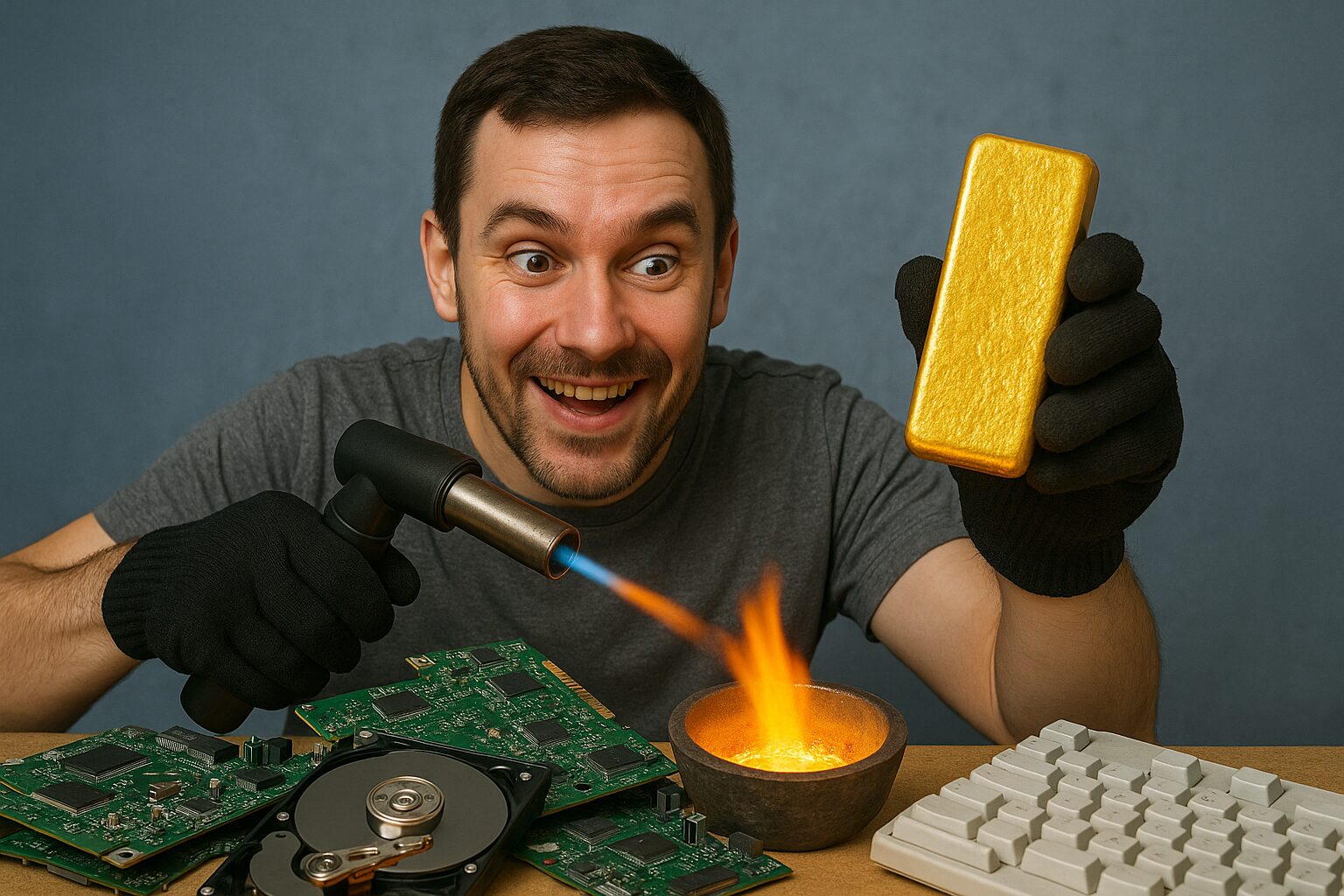

How One Man Turned Computer Boards Into a Gold Bar — Understand the Chemical Process Used and the Environmental Challenges Behind Electronic Waste
A small gold bar made entirely from electronic waste caught attention on social media.
Have you ever thought that old broken computer, forgotten at the back of the closet, might contain gold? A viral video on the internet showed exactly that: a man managed to extract gold from discarded circuit boards and, with the obtained material, forged a small golden bar.
The scene attracted attention and generated curiosity: how is this process possible?
-
The Brazilian colonial city that stopped in time and shares territory with a rocket launch base.

-
79-year-old woman challenges limits, visits 193 countries in the world after 56 years of planning and reveals the behind-the-scenes of a global journey that few have managed to accomplish.

-
These are the drivers who may stop paying tolls on highways in a project that promises to reduce costs for those who live from transportation in Brazil.

-
(Video): Italian pilot lands plane on moving train at 120 km/h and achieves unprecedented feat in aviation, even with a narrow runway and without direct visual contact.


Behind the common appearance of electronic circuits, there is a combination of valuable metals, including gold. The video revealed a reality often ignored: electronic waste can be a real treasure — if we know how to process it.

The Hidden Value in Electronic Waste — It’s a Real Gold Bar
The video starts with the man collecting pieces of electronic boards, specifically those that contain golden metallic areas.
Most of these fragments come from connectors and RAM memory terminals, as well as processor pins. The golden shine is not paint: it’s real gold.
This use of gold is not new. In the electronics industry, the material is applied in very thin layers over other metals.
Although silver has superior electrical conductivity, gold has a decisive advantage: it does not oxidize or corrode over time. This makes it ideal for ensuring stable and reliable connections, even after many cycles of use.
For this reason, gold is used in precision components, such as communication systems, medical equipment, and even satellites. Despite the high cost, gold plating ensures constant performance.
Separating Gold From Other Metals
After gathering the metal pieces, the man begins a chemical process. First, he uses nitric acid to remove less noble metals. Then, he probably applies aqua regia — a mixture of hydrochloric and nitric acids — to dissolve the gold present in the boards. The metal is then recovered through chemical precipitation.
During the reaction, the solution in the container changes color. This happens because, besides gold, other metals like copper and tin also react with the acids, forming colored compounds.
The appearance of the mixture may deceive, but these changes are part of the purification process.
After dissolution, a precipitating agent is added, which separates the gold from the solution. It turns into a fine powder, which is then filtered, dried, and heated in a forge. When melted, the gold is shaped into a small bar — the highlight of the video and the technique.
Do Not Try This at Home
Although the process shown is technically feasible, it involves serious risks; thus, it is crucial that this process is conducted in a laboratory and by qualified professionals.
The acids used are extremely corrosive and release toxic vapors. Additionally, improper handling can cause serious accidents.
Another point is the amount of material required. To produce a single bar, the man needed a large quantity of accumulated electronic waste.
Even so, the recovered gold represents only a tiny fraction of the total processed boards.
The feat is impressive, but it requires knowledge in chemistry, safety equipment, and a lot of patience.


The Environmental Challenge of Electronic Waste
The video also highlights a growing problem: the disposal of electronic waste. Known as e-waste, this type of waste includes everything from old cell phones to computer motherboards.
Unlike other types of waste, such as plastic or glass, electronic waste contains heavy metals and toxic compounds.
If improperly disposed of, it can contaminate soil and groundwater, posing serious environmental risks.
Furthermore, the rapid evolution of technology makes this issue even more urgent.
Each new launch of a cell phone or computer makes the previous model obsolete. This stimulates consumption and increases the amount of discarded devices.
The World Is Already Suffocated by Electronics
According to the Global E-waste Monitor 2024 report released by the UN, humanity generated 62 million tons of electronic waste in 2022. That’s equivalent to more than 1.7 million trucks loaded.
In the US alone, each citizen disposed of an average of 21 kg. In Norway, this number reached 27 kg per person — the highest in the world.
Much of this volume is not recycled. Only 22% of global electronic waste was processed properly.
The rest ended up in landfills, incinerated, or simply exported to poor countries. In these locations, waste is often treated informally, without protection for workers or the environment.
Waste as an Urban Mine
Despite the environmental problem, electronic waste holds immense value. Metals account for half of the total volume, and just in 2022, these materials amounted to an estimated value of 91 billion dollars.
Among the most valuable metals are gold, copper, iron, platinum, and rare earth elements such as neodymium — essential for turbines and batteries.
Recovering these metals is what experts call “urban mining.” Instead of digging the earth for minerals, the focus is on reusing what has already been produced.
This practice avoids environmental damage, reduces greenhouse gas emissions, and decreases reliance on countries with large mineral reserves.
If the world recycled all electronic waste properly, it would be possible to prevent the emission of 52 million tons of CO₂ per year, according to the UN report.
Why Do We Recycle So Little?
The answer involves several factors. Lack of regulation, poor waste management, and consumer disinterest are some of the main issues.
Many companies do not offer adequate disposal systems. And consumers, in turn, often do not know how or where to recycle.
The lack of technology is also an obstacle. Recycling gold and rare metals requires expensive and complex methods.
Most recycling plants still lack the infrastructure to process electronics efficiently and safely.
Startups Seek Viable Solutions for Electronic Waste
But not everything is lost. Companies like New Zealand’s Mint Innovation are developing new ways to extract metals using green chemistry, biotechnology, and electricity.
The goal is to make the process cheaper, safer, and more sustainable.
The Royal Mint in the UK has also entered the race. With government support, the institution is betting on the recovery of precious metals as an alternative to traditional mining.
For them, electronic waste is the new source of wealth of the 21st century.
Why Is Gold So Widely Used in Technology?
Even being expensive, gold remains essential in critical applications. It ensures that electrical signals remain stable over time.
In medical equipment, for example, where any failure can be fatal, gold is used for its reliability.
The aerospace industry also relies on the material. Satellites, probes, and communication systems in general must operate for years without maintenance, and gold guarantees constant performance.
The Future Is in the Drawers
Every day, tons of cell phones, tablets, printers, and laptops are discarded around the world. Many of these devices end up forgotten in closets and drawers, collecting dust. But the video of the man who made a gold bar serves as a warning: this waste has value.
Proper and conscious recycling can turn waste into resources. With the right policies, environmental education, and accessible technology, electronic waste can cease to be a problem and become a solution.






Como aprender a efetuar esta separação pode ser do interesse de muitas pessoas.