





 Portuguese
  English
  Spanish
  4 min of reading
  0 comments


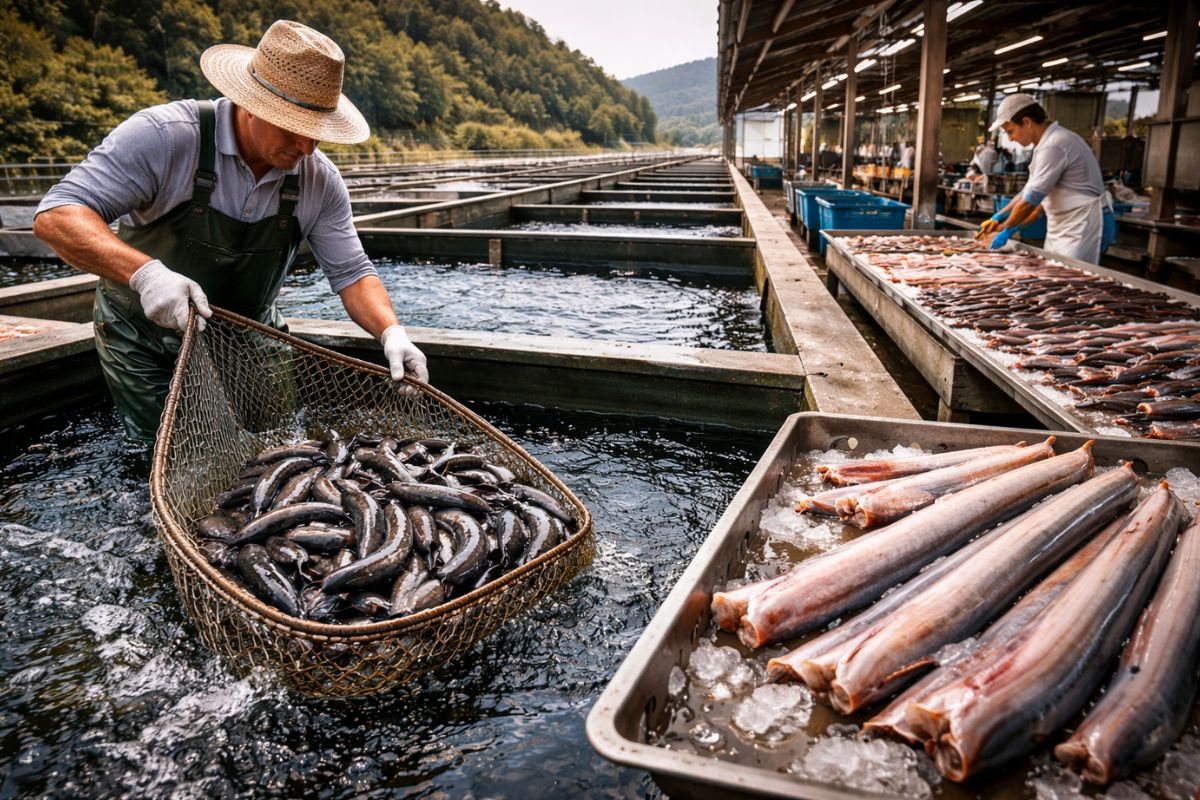
In The City Of Shibushi, In Kagoshima, The Process Begins At The Organic Farm, Goes Through Ice To Stun The Eel, Moves To Bone Removal And Grilling Over Charcoal, Then Receives Sauce Four Times, With 30-Minute Breaks, Until Vacuum Packaging And Sterilization In Water Cooled To 10°C
A process that seems like home cooking, but operates as a continuous line, begins with the eel still in the tank and ends vacuum-sealed, with temperature, time, and inspection becoming parameters. The use of ice, grilling over charcoal, and applying sauce in cycles make the flow repeatable, not improvised.
In Kagoshima, in the city of Shibushi, the production described brings together farm, feed, preparation, and packaging within the same system. The central question is not just how the eel is made, but why this process gained industrial scale, instead of being restricted to a local tradition.
From Organic Farm To Factory Schedule

The chain begins before the cut: there is a process of feed production and a cultivation cycle that distinguishes four-month-old fry from ten-month-old eels.
-
Home environment can influence the brain, mood, and well-being: studies indicate an increase of up to 15% in productivity, a reduction of 12% in stress with plants, and a direct impact of the circadian rhythm on the 24 hours of the day.

-
A Brazilian millionaire couple restores a farm over 150 years old in the interior of São Paulo and transforms the historic property with Portuguese tiles, antique furniture, and new spaces into a refuge that blends tradition, comfort, and sophistication.

-
Submerged city in a lake in Minas reveals intact streets, preserved vehicles, and houses after more than 60 years, impressing divers.

-
Yellowstone has started to rise again in an area of the caldera, and the movement rekindles fears surrounding the U.S. supervolcano, as scientists monitor the deformation and try to understand what is happening underground.


By organizing ages, lots, and feeding, the operation creates predictability and reduces variations that, in practice, appear in flavor, texture, and product safety.
This design also changes the logic of work.
When the eel enters the process and preparation stage, the operation already knows how much to produce, when to grill, and how to synchronize charcoal, sauce, and cooling.
What seems like a “recipe” becomes a schedule, with a defined beginning, middle, and end so the same result can be repeated at scale.
Ice, Fine Bones, And Charcoal As Critical Points

The process of preparation begins with cold ice to stun the eel, a step that standardizes handling and reduces movements on the line.
Next, the removal of fine bones appears as a technical bottleneck: it is meticulous work, but it is also what separates a comfortable product from one that brings the experience back to improvisation.
Then comes the charcoal.
The choice is functional: the charcoal is described as a generator of far-infrared effect, helping to grill intensely and relatively evenly.
In the industrial process, charcoal is not romanticization, it is a way to maintain thermal repetition so that the eel reaches the next stage with the same surface and cooking standard.
Sauce In Four Applications And 30-Minute Breaks
The repetition of sauce is the feature that most reveals the line logic.
The process calls for applying the sauce four times, with replacement every 30 minutes, creating a controlled window for adhesion, caramelization, and balance between moisture and heat in the charcoal.
This cadence does not exist for whim, but for consistency.
When the sauce comes in at the same interval each time, the factory controls a variable that, in artisan contexts, changes with climate, haste, and intuition.
Here, the sauce is specification, and the eel is treated as a product with tolerances, not as a unique dish.
Vacuum Packaging, Metal, And Sterilization To Close The Loop

Upon completing the grilling and sauce cycle, the process moves on to quick freezing, weighing, and inspection.
The check for foreign substances with a metal detector and the vacuum packaging highlight a priority: to reduce risk and extend stability, something crucial when distribution is greater than the immediate surroundings of the farm.
Sterilization enters as the final barrier.
The described flow mentions boiling in hot water at 90°C, followed by a step at 10°C and cooling with cold water, in addition to dehydration to remove water from the film after sterilization.
This sequence explains why the line becomes industry: it transforms a sensitive food into a transportable, standardized, and auditable item.
What begins with ice and ends in vacuum packaging shows why the eel has ceased to be merely tradition and has become an industrial process: predictability, risk control, and scale.
Charcoal and sauce remain central, but now function as controlled variables, not as improvisation.
If you had access to a product made this way, what would weigh more in your decision: the appeal of tradition, the confidence in the process, or the idea that standardized eel and sauce change the flavor?









-

-

-

3 pessoas reagiram a isso.