





 Portuguese
  English
  Spanish
  5 min of reading
  0 comments


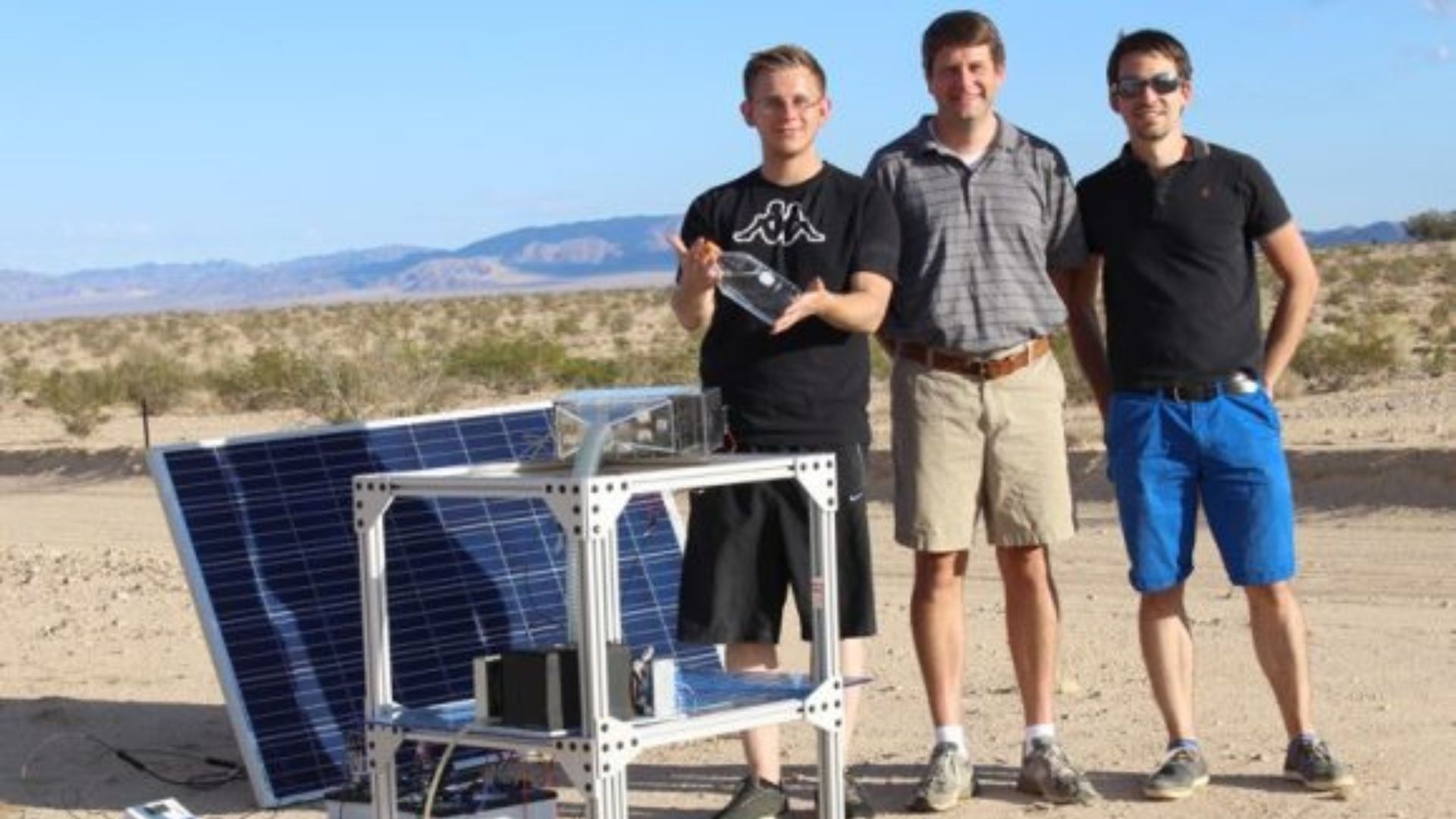
Experimental Technology Transforms Extremely Dry Air Into Drinking Water Using Advanced Porous Materials and Solar Energy, Demonstrating Daily Production Even in Conditions of Minimal Humidity in the Desert and Paving the Way for Independent Systems Capable of Supplying Houses, Isolated Communities, and Regions Affected by Water Scarcity.
A device developed by researchers at the University of California, Berkeley, managed to produce drinking water from desert air, even in extreme dryness conditions, by combining a MOF-type porous material with ventilation, gentle heating, and a condensation system.
According to the team, in an indoor environment with dry air, the collector was able to generate up to 1.3 liters per day for each kilogram of the absorbent material, operating with a relative humidity below 40%, a threshold at which traditional condensation methods become energetically unviable.
Test in the Desert and Performance in Low Humidity
The machine underwent field trials for three days in the Mojave Desert, United States, and maintained an average production of 0.7 liters per kilogram of MOF per day, in a real scenario of heat and low availability of water vapor.
-
Four humans are flying towards the Moon inside the Orion capsule launched by the SLS rocket, and on April 6, Artemis II will disappear behind the far side of the Moon without communication with Earth for nearly an hour.
-
Worlds covered by water, atmospheres filled with hydrogen, and the possibility of life beyond Earth: ocean planets are rewriting the map of cosmic search and forcing scientists to rethink where to look.

-
Argentina achieves the unimaginable after more than 110 years and reintroduces the largest native herbivore of South America to the Chaco to restore a lost link in nature.

-
Returning to the Moon now costs a billion-dollar bill and reignites the competition between the USA and China for science, technology, and rare minerals on lunar soil.

Even on the driest day of the period, with relative humidity of 7% and temperatures above 80°F, the device continued to operate and collected about 0.2 liters (200 ml) per kilogram of material, according to the study authors and the description of the tests.
Although the volume seems modest, the researchers argue that, in emergency situations and in the absence of immediate sources, this level of production can represent the difference between maintaining minimal hydration and progressing to a severe case of dehydration.

How the Machine “Pulls” Water from the Air
The heart of the equipment is a metal-organic framework, or MOF, an extremely porous material that traps water molecules inside its pores by adsorption and raises the local vapor concentration until condensation occurs under conditions close to ambient temperature.
In the configuration described by the team, a fan makes ambient air flow through a cartridge filled with MOF inside a transparent box, and the concentrated vapor is then released from the material by gentle heating, proceeding to a condenser.
Unlike conventional dehumidifiers, which usually rely on damper air and intense cooling, the group claims to have avoided the need to “freeze” the air in order to extract water, a point highlighted by coordinator Omar Yaghi while explaining the logic of the process.
The energy for the fan and the small heaters comes from paired solar panels and a battery, allowing cycles over 24 hours, including at night, when thermal variation can favor the adsorption dynamics.
Prototype Evolution and Efficiency Gain
This is the third model of the collector created by the group, in a development line that began with a passive prototype presented in 2017, capable of capturing water during the night and releasing it the following day only with solar heat.

The following year, in 2018, the team tested a second version that collected about 0.07 liters per kilogram of MOF per daily cycle in the Arizona desert, still based on solar heating, a result that served as proof of concept.
This time, the architecture ceased to be entirely passive and began using forced ventilation to expose the material more quickly to the air, as well as controlled heaters to accelerate the vapor release, shortening the time between “capturing” and “delivering” water.
According to the study, the advancement also depended on a new MOF, identified as MOF-303, based on aluminum, described as faster and with higher retention capacity than the previous MOF used in the group’s early prototypes.
The team claims that, under ideal conditions, MOF-303 can perform adsorption and desorption cycles in about 20 minutes, paving the way for repeated collections throughout the day, increasing the overall yield.
Water Quality and Limits of Technology
In the tests described, the researchers report not having found traces of metals or organic compounds in the collected water, a sensitive point when using a material with metal components and organic ligands in its structure.
Still, the reported performance is linked to specific conditions of temperature, humidity, and cartridge design, and the article itself describes measurements in controlled and field environments, without asserting that the maximum yield is repeated in any climate.

The tested device was mounted in an acrylic box with an internal cartridge and piping for the condenser, and the public description of the project makes it clear that the engineering of air flow and vapor path is a central part of the productivity gain.
Scale, Off-Grid Use, and Production Plans
As it is a system that can operate without connection to a public grid, the team points to applications in rural areas and locations with unstable supply, as long as there is sufficient sunlight to power the panels and recharge the integrated battery.
Omar Yaghi and collaborators have linked the development to a startup that is testing a model the size of a microwave, estimated to produce between 7 and 10 liters per day, a volume described as sufficient for the consumption and cooking of two to three adults.
In addition to this format, the disclosed plan mentions a larger version, comparable to the size of a small refrigerator, with the potential for 200 to 250 liters daily, and an ambition for equipment at village scale capable of reaching 20,000 liters per day.
When presenting the project, Yaghi summarized the objective as the creation of “ultra-pure” water that could be widely available without connection to distribution networks, linking the proposal to the idea that water should be treated as a human right.






-

-

3 pessoas reagiram a isso.