





 Portuguese
  English
  Spanish
  4 min of reading
  33 comments


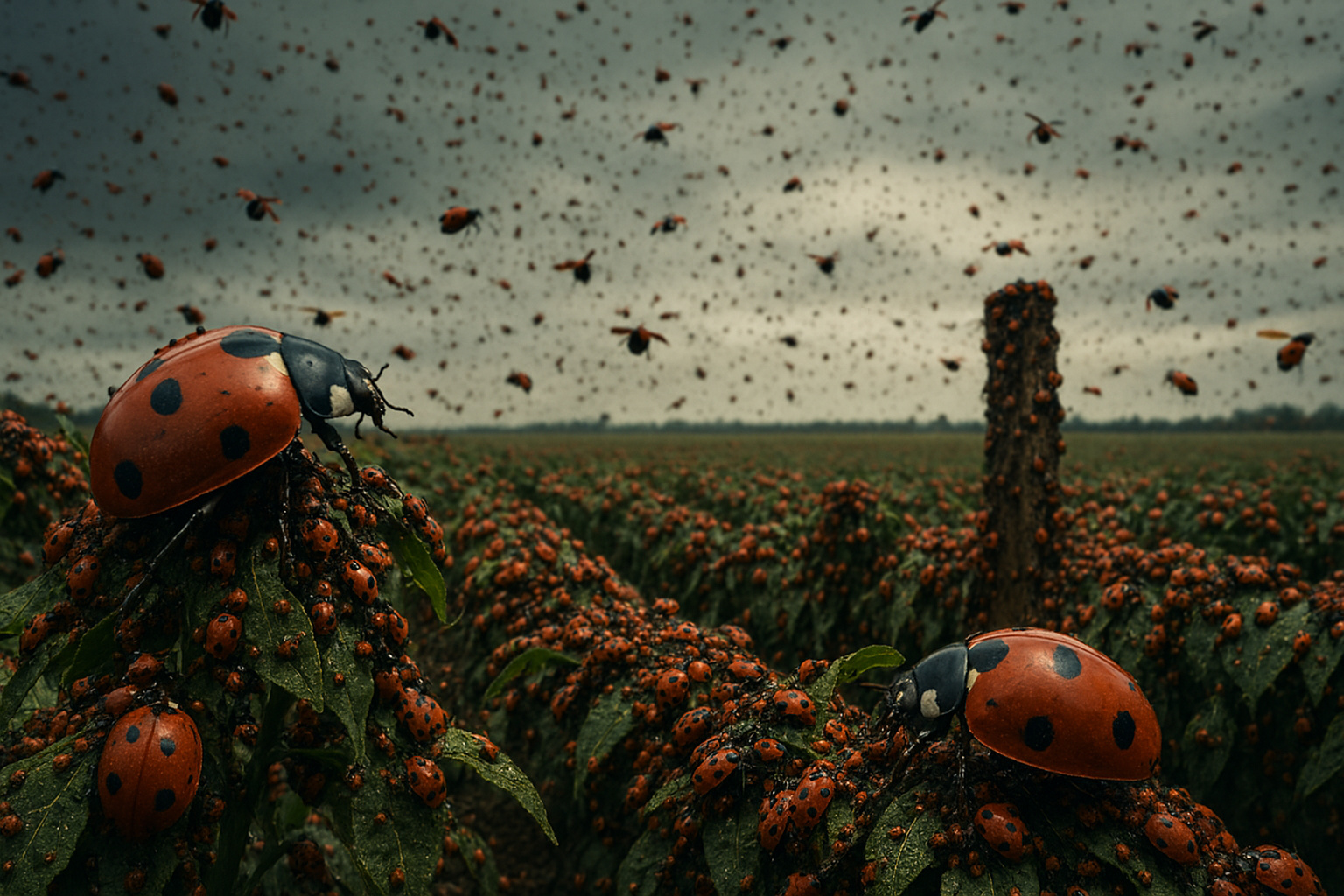


Introduced in Europe from the 1980s for aphid control, the Asian ladybug became, until 2004, one of the most emblematic cases of biological invasion, with lasting agricultural and ecological impacts.
In 2004, agricultural authorities and researchers from different European countries began to realize that a solution considered “clean,” “natural” and environmentally friendly had crossed a dangerous threshold. Millions of Asian ladybugs, introduced years earlier to combat aphids in crops and greenhouses, stopped being silent allies of agriculture and began to spread uncontrollably through fields, forests, cities, and entire ecosystems. What started as a biological control experiment turned into one of the most emblematic cases of biological invasion documented on the European continent.
The insect at the center of this story is the Harmonia axyridis, known as the Asian ladybug or harlequin ladybug. Native to East Asia, it was deliberately brought to countries like France, Italy, and Germany as an alternative to chemical insecticides. The promise was simple and seductive: an extremely efficient natural predator, capable of consuming thousands of aphids over its lifetime, reducing the use of pesticides and production costs.
For a few years, the strategy seemed to work. In greenhouses and controlled agricultural areas, the Asian ladybug eliminated entire colonies of aphids with impressive speed. The problem is that, unlike native European species, it exhibited biological characteristics that made it nearly impossible to contain outside these environments.
-
The water that almost everyone throws away after cooking potatoes carries nutrients released during the preparation and can be reused to help in the development of plants when used correctly at the base of gardens and pots, at no additional cost and without changing the routine.

-
The sea water temperature rose from 28 to 34 degrees in Santa Catarina and killed up to 90% of the oysters: producers who planted over 1 million seeds lost practically everything and say that if it happens again, production is doomed to end.

-
An Indian tree that grows in the Brazilian Northeast produces an oil capable of acting against more than 200 species of pests and interrupting the insect cycle, gaining ground as a natural alternative in soybean, cotton, and vegetable crops.

-
The rise in oil prices in the Middle East is already affecting Brazilian sugar: mills in the Central-South are seeing their margins shrink just as ethanol gains strength.


Why the Asian Ladybug Got Out of Control
The Harmonia axyridis brings together a set of evolutionary advantages rarely seen in a single insect. It reproduces rapidly, tolerates a wide range of temperatures, survives in urban and rural environments, and does not exclusively depend on aphids for food. When food becomes scarce, it starts consuming eggs and larvae of other insects — including native ladybugs.

Studies published since 2004 in scientific journals such as Proceedings of the National Academy of Sciences showed that, in some regions of Western Europe, populations of native ladybugs began to collapse a few years after the arrival of the invasive species. In certain areas, Harmonia began to represent over 80% of the ladybugs observed in the field, an almost absolute ecological dominance.
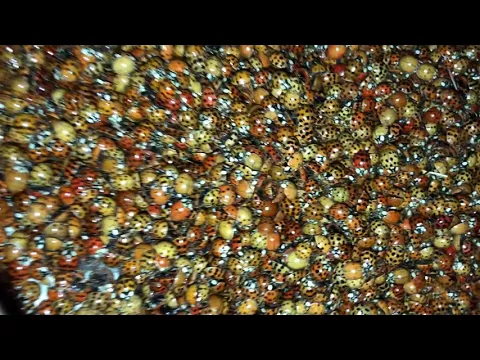
Another decisive factor was the aggregation behavior. During the fall, millions of these insects seek shelter in human buildings to spend the winter.
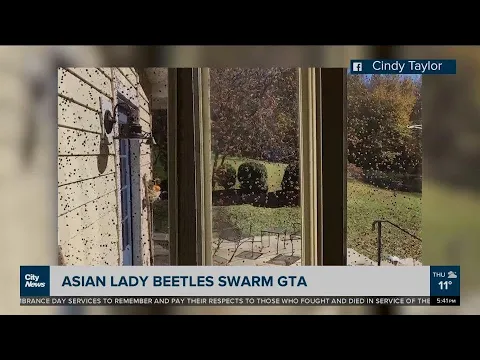
Houses, historic buildings, barns, and even hospitals began to register massive infestations, with walls literally covered in ladybugs. Aside from the visual nuisance, they release defensive substances that stain surfaces and cause allergic reactions in some people.
Unexpected Agricultural and Ecological Impacts
From an ecological perspective, the impact was profound. The Asian ladybug not only competed with local species but also altered entire food chains. By drastically reducing populations of native insects, it affected insect-eating birds and other predators that depended on these species to survive.
In the agricultural sector, the problem also took unexpected turns. In grape-producing regions, researchers began to document a phenomenon known as ladybug taint.
During mechanical harvesting, crushed ladybugs mixed with the grapes release chemical compounds that alter the taste of the wine, resulting in significant economic losses for wineries.
Reports from European environmental agencies estimated that, in some countries, the indirect costs associated with the invasion — including damage to biodiversity, agricultural impacts, and control expenditures — reached tens of millions of euros over a decade.
From Green Solution to Global Alert
The case gained momentum precisely from 2004, as it was at this time that the first consolidated data showed that the invasion was not localized but continental.
From then on, the Harmonia axyridis began to be recorded in practically all of Europe, as well as spreading to North America, South America, and parts of Africa.
The episode became a classic example cited by scientific and environmental institutions whenever the topic of “biological control” comes up for debate. It did not invalidate the technique as a whole, but made it clear that the introduction of exotic species, even with good intentions, carries enormous risks when not accompanied by long-term studies.
Today, the Asian ladybug is considered one of the hundred most problematic invasive species in the world. Total eradication programs are deemed unfeasible, and the focus has shifted to monitoring, mitigating impacts, and protecting the few remaining native ladybug populations.
What This Case Taught Science and Agriculture
The story that began in 2004 changed international protocols. Currently, the release of biological control agents in Europe and other regions requires much more rigorous ecological assessments, including dispersion simulations, genetic studies, and impact analyses on complete food chains.
More than an isolated mistake, the case of the ladybugs demonstrated how “green” solutions can generate side effects as severe as the problems they aim to solve. It also reinforced a central lesson of modern ecology: natural systems are too complex for simplistic interventions, even when based on good intentions and short-term evidence.
And you, reader: how far is it worth the risk to intervene in nature to solve immediate agricultural problems, when the consequences may last for decades?










Em resumo da minha parte :
*Cada **** no seu galho.*
Em qual sentindo
Tudo que Deus criou é perfeito mas o homem simplifica a engenharia de Deus ou não analiza as consequências a curto ,médio e longo prazo..Isso em todas as áreas..Os clones , cópias ou multiplicação do original sem avalição prévia trará caos ..Isso já é notório.. Deus abencoe todos os projetos para o bem ..Sem erros não há acertos mas euipes multidisciplinar para não se achar sábio aos próprios olhos e errar menos ..Somos seres em evolução e aprendizado constante..