





 Portuguese
  English
  Spanish
  3 min of reading
  1 comment


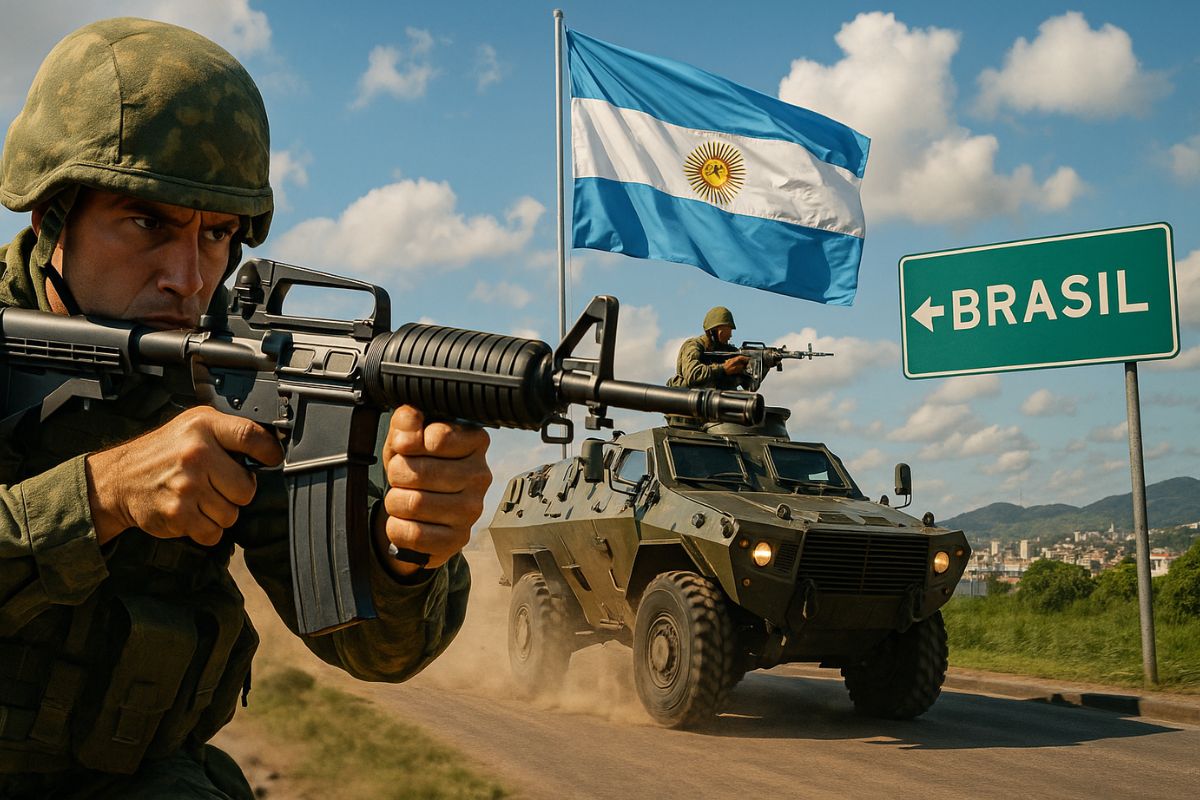


Argentine Military Movement Occurs After Action That Left More Than 120 Dead in Rio de Janeiro and Reinforces Vigilance on the Dry Border Between the Two Countries
Argentina has entered a state of total alert and determined the deployment of between 150 and 200 military personnel to the border with Brazil, following the mega-operation against Comando Vermelho in Rio de Janeiro. The movement, considered the largest tactical movement in the country in the region since 2019, aims to contain a possible escape of faction members to Argentine territory.
The command of the Argentine armed forces confirmed that the reinforcement will focus on Bernardo de Yrigoyen, in the province of Misiones, a strategic point bordering the Brazilian cities of Dionísio Cerqueira (SC) and Barracão (PR). The decision was made after intelligence reports indicated a risk of migration of armed criminals and stolen vehicles toward the border with Brazil.
Troop Planning and Deployment
According to information obtained from sources in the Argentine Ministry of Defense, the mobilized troops are specialized in mountain operations and dry border combat, with experience in difficult terrain.
-
A bottle thrown into the sea by two Australian soldiers in 1916 on their way to the trenches of World War I was buried in the sand for over 100 years, and the letters inside it were still legible when they were found.

-
China invests over R$ 4.2 trillion, builds the largest water network in the world with 95,000 reservoirs and 1 trillion m³, expands piped water access to 96% of rural areas, attracts R$ 565 billion in foreign investments, and advances with the “longevity gene” in rice.

-
Heineken’s factory in Brazil surprises the world by reducing water consumption for beer production from nearly 10 liters to just 2.2 liters per liter produced, achieving a 23% decrease with real-time technology.

-
This climbing plant covers the walls of the house, blocks up to 80% of solar radiation, and reduces the internal temperature by up to 5 degrees in the summer without spending a dime on the electricity bill, and it also produces bunches of grapes in the backyard.


The group includes reconnaissance units equipped with radars, drones, and two patrol helicopters.
The deployment was determined by the Minister of Defense, Luis Petri, in direct coordination with President Javier Milei.
Part of the troops will depart from the city of Salta, in the north of the country, where they were monitoring the border with Bolivia.
Even with the transfer, the Bolivian region will continue to be monitored by local contingents.
Regional Context and Coordinated Response
The Argentine decision comes amid a series of strengthened security actions in neighboring countries, following the operation in Rio de Janeiro, which resulted in more than 120 deaths.
Paraguay also announced similar measures, declaring that it will classify the Brazilian factions PCC and Comando Vermelho as terrorist organizations.
With the Argentine movement, the government aims to prevent a “criminal exodus” and demonstrate strategic alignment with regional countries in combating arms and drug trafficking.
The main focus is on clandestine routes crossing the border with Brazil, used by criminal organizations for transporting arms and stolen vehicles.
Equipment and Surveillance Strategy
The military sent to Misiones have new communication and protection equipment, as well as satellite tracking systems and continuous air support.
The operation includes nighttime monitoring and the use of thermal cameras at unofficial crossing points.
According to the action plan, the operations will be joint between the Armed Forces and the National Gendarmerie, which already conduct routine patrols on the border with Brazil.
Territorial reconnaissance began this week, mapping the main smuggling routes and clandestine crossing points.
Repercussions and Expected Impacts
The military mobilization represents a direct reflection of the escalation of violence in Brazil and the growing concern about the export of urban conflicts to border regions.
Analysts believe that the movement of troops could reconfigure the security dynamics in the Brazil–Argentina–Paraguay axis, increasing regional control over factions operating in a transnational network.
Still, the Argentine government maintains a cautious stance, avoiding official statements on the duration or expansion of the operation.
Sources close to the Ministry of Defense say that the plan could be extended indefinitely, depending on the evolution of the situation in Brazilian territory.
Do you believe that the deployment of troops to the border with Brazil can realmente contain the advance of organized crime in the region?







真免费!价值万元资源,不要一分钱,网址:https://www.53278.xyz/