





 Portuguese
  English
  Spanish
 6 min of reading


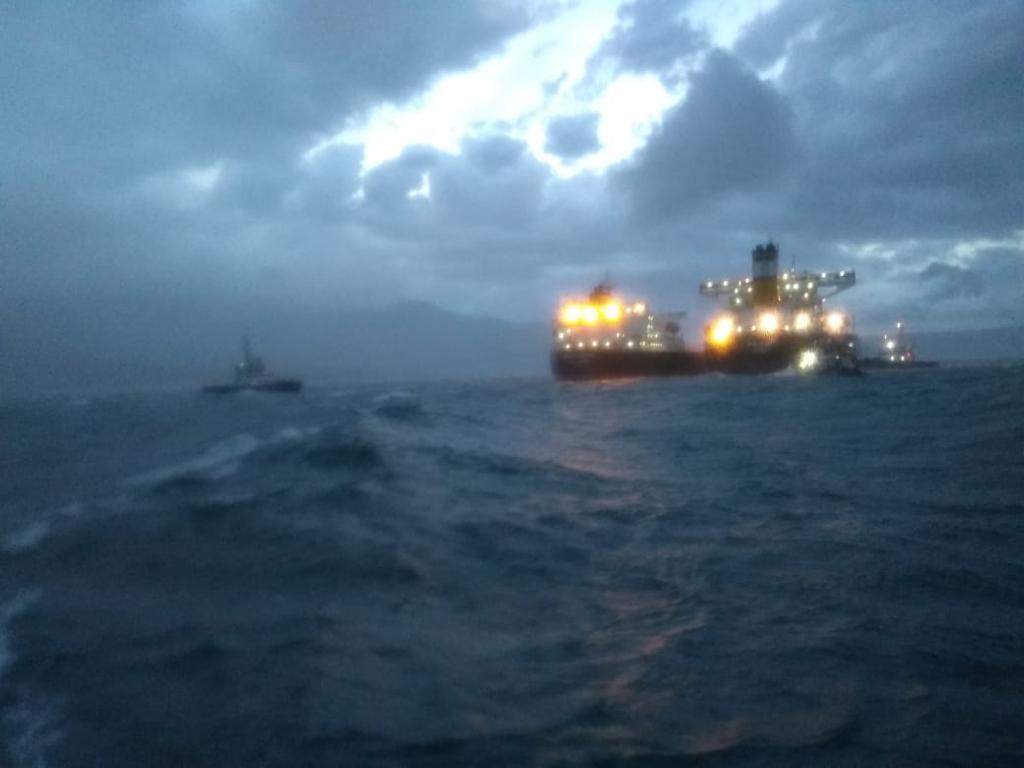
For Preventing a Serious Accident in Ilhabela, Pilots Marcio Santos Teixeira and Fábio Rodrigues Alves de Abreu Won the IMO Award for Exceptional Bravery at Sea, Reinforcing a Work that Prioritizes 24 Hours of Safety at Sea and for the Community While Maneuvering Ships with Excellence and Precision
For nearly six hours, pilots Marcio Santos Teixeira and Fábio Rodrigues Alves de Abreu faced a storm with gusts of over 130 km/h (70 knots), waves of 1.5 to 2 meters, constant rain, high tension, and a huge challenge ahead: in the midst of this chaos, safely anchoring two oil tankers loaded and tethered to one another by steel cables. These ships were adrift in the São Sebastião Channel, carried by the force of ocean currents, dangerously heading towards Ilhabela, putting its residents and the environment at risk. As if all the stress from the commanders of both vessels and the crew was not enough, they also had to interrupt the delicate operation to evacuate a crew member in critical condition and send him to shore for urgent hospital assistance.
To overcome these adverse weather and sea conditions, they used all their knowledge of the region and their experience, successfully completing this mission, now internationally recognized with the IMO Award for Exceptional Bravery at Sea from the International Maritime Organization, considered the highest global recognition.
Nominated by Brazil for their determination, professionalism, and expertise in handling ships demonstrated during an emergency caused by extreme weather conditions while operating at the Almirante Barroso Terminal in the Port of São Sebastião, the safe and assertive actions of pilots Marcio and Abreu saved lives and prevented serious damage to dock structures and oil facilities, with the potential for a large ecological disaster involving an oil spill. All facts and procedures were considered during the lengthy award process, which involves several stages and participation from a jury of entities recognized by the international community.
-
With 74% of companies facing difficulties in hiring, technicians and engineers in renewable energy are becoming scarce in Brazil and are essential to support the expansion of solar, wind, and green hydrogen projects.

-
Europe is trying to create an ammonia-powered marine engine without auxiliary fuel, which could unlock the race for giant emission-free ships. The technology aims to eliminate one of the biggest obstacles to clean maritime propulsion.
-
A 4,500-ton frigate with just over 100 crew members, state-of-the-art radar, and cruise missiles is being touted as the new standard of naval warfare in the 21st century.
-
The first commercial hydrogen-powered ferry enters operation in the U.S., eliminates the use of diesel, uses fuel cells to generate clean energy on board, and transforms San Francisco Bay into a landmark of the new era of emission-free navigation.

-
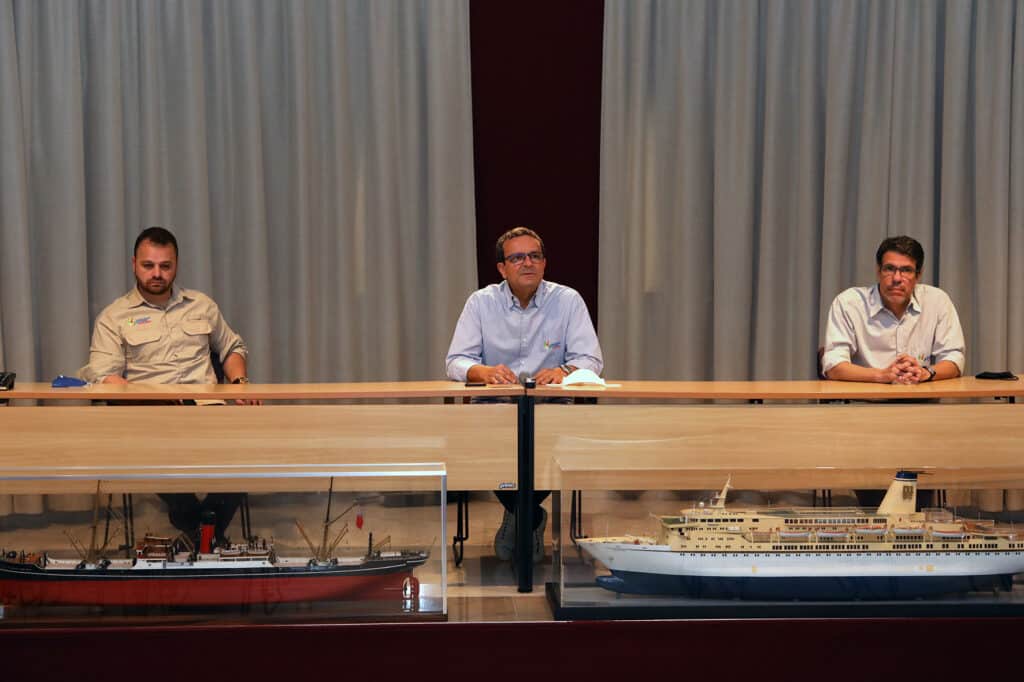
Press Conference -
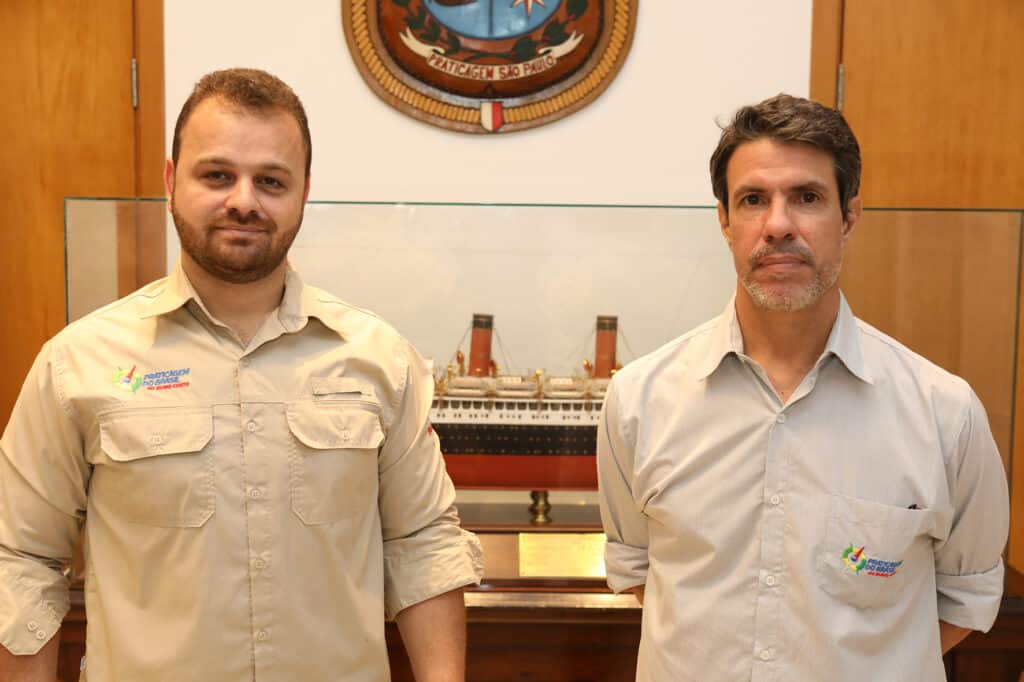
Pilots Marcio Santos Teixeira and Fábio Rodrigues Alves de Abreu -
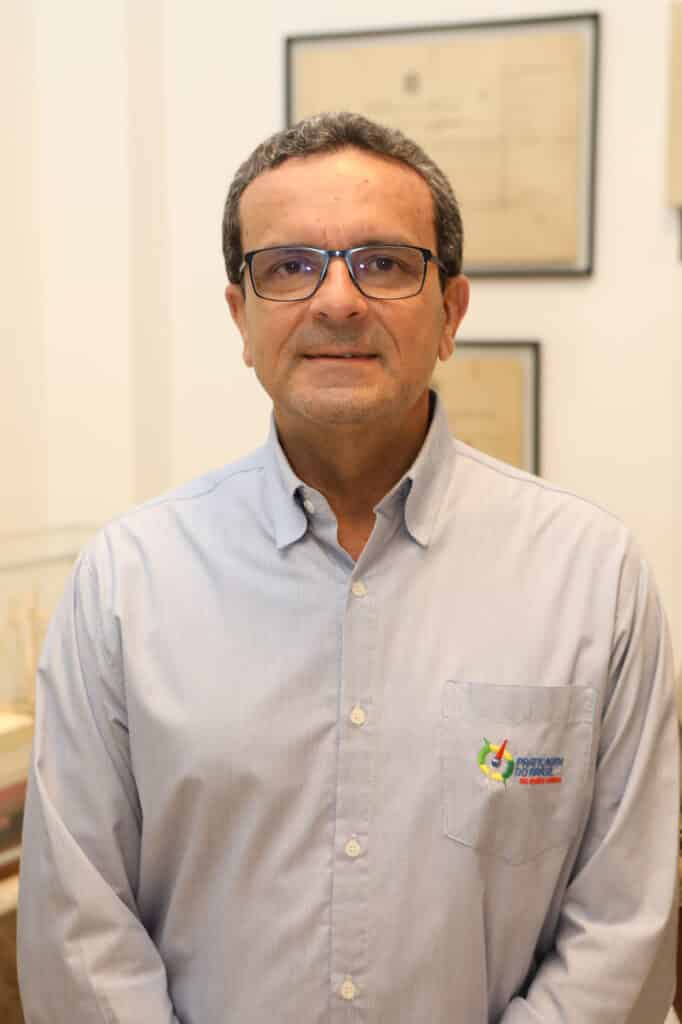
President Carlos Alberto de Souza Filho
The result was announced on September 10, 2020, and was received with much enthusiasm at the Piloting Company of São Paulo. For President Carlos Alberto de Souza Filho, the award is a great honor for the company and highlights, once again, the importance of the activity as essential for the public interest in the efficient coordination of maritime traffic and in the overall risk management inherent in navigating in confined waters. “We work 24 hours a day in any weather and under any conditions, prioritizing safety, responding to emergencies, and ensuring operations. It’s an activity that involves many risks, and we have the knowledge, technique, courage, and determination as basic principles for exercising the profession, as demonstrated by our brave pilots Marcio and Abreu,” he stated.
How It All Started
On April 28, 2019, pilots Márcio and Abreu were alerted by the Terminal manager that, due to unprecedented wind gusts of up to 70 knots, the mooring cables of two oil tankers docked in a ship-to-ship operation were breaking. With poor visibility due to heavy rain and high waves in the channel, the two pilots boarded the Piloting boat to attempt to reach the tankers, when they realized that the ships were already adrift.
Under very challenging conditions, Márcio managed to board the tanker Rio 2016, where he found the crew quite apprehensive. He initially gathered information about the critical situation to plan the best approach since the two vessels were still connected by oil hoses and mooring cables and drifting toward the Ilhabela region.
Meanwhile, risking serious danger, Abreu managed to climb the pilot ladder of the tanker Milton Santos. Having a pilot on each ship was essential for communication and as a backup plan. Márcio commented: “It was an unprecedented event and a great learning experience for us. This operation had never been carried out by the Piloting Company of São Paulo. Abreu and I only discovered that the ships were already adrift and still tethered to one another when we approached them with the Piloting boat. One vessel was docked alongside the other at the same berth when the 20 steel cables connecting them to the pier broke under the force of the wind. Besides the difficulties of the entire operation, a major challenge was boarding due to the weather conditions. The ship was practically stationary, without propulsion, which hindered the stability of the boat, contrary to what one might think. Boarding the ship at a normal speed of six knots (11 km/h) is much easier.”
Priority Was to Assist the Crew Member
One of the most tense moments occurred when Márcio was alerted by Abreu that there was a crew member in critical condition, apparently suffering from cardiac problems on the Milton Santos, and that he needed to be urgently disembarked to be taken to the nearest hospital. This became the top priority. As it would be impossible to disembark the crew member directly from the Milton Santos to the Piloting boat due to the sea conditions, Márcio, along with the commanders and Abreu, decided that he would be transferred first to their ship and then to the tugboat. “It happened very quickly, the crews worked very well, the patient was taken on a stretcher by crane and in less than five minutes was already on the tugboat. It was a critical moment; a tugboat would be greatly needed, but human life was the priority. The Operations Center of the Piloting Company had already requested an ambulance that was waiting, but unfortunately, he did not survive even upon arriving at the hospital.”
Rescue Operation
The only alternative was to use the anchorage area in the northern part of the channel and only the resources of the “Rio 2016,” which was towing the “Milton Santos” alongside. “We had to proceed at a maximum speed of one and a half knots, more exposed to winds and currents, because the hoses for transferring oil were still connected. As the winds were pushing us towards Ilhabela, we had to point the bow towards São Sebastião. The ship was actually navigating sideways. But I showed the Commander on the screens of the equipment that this was what we had to do, and we worked as a team, including the commanders of the tugs,” Márcio recounted.
Márcio continued navigating the Rio 2016, towing the Milton Santos alongside, at a maximum speed of 1.5 knots (2.8 km/h), towards the anchorage area. After 40 minutes of navigation and a challenging evacuation of the critically injured crew member from the Milton Santos, unfortunately, the information arrived that he had passed away. The wind speed decreased to 56 km/h (30 knots), and while the anchor of the Rio 2016 was being released, the vessels were disconnected.
The two pilots carefully maneuvered the Milton Santos away from the Rio 2016 with the help of tugboats, and after more than five stressful hours, the ship finally also dropped anchor.
After 5 hours and 30 minutes of careful and efficient work, they finally managed to prevent a serious accident with the two Suezmax-class oil tankers.
Completing the operation, separating the tankers, and safely anchoring both in the middle of the channel brought a feeling of relief and accomplishment: “I think that the most critical phase, with all possible calculations and knowledge of the region, was getting the ships turned to the anchoring point safely and removing them from the danger area. Our feeling, mine and Márcio’s, when it was all over, was that the crew had no idea of the risk they were all running if the ships continued to drift, but we knew what could happen and that is why all actions were taken very swiftly,” Abreu said.
Second Award
Of the 31 nominations for the award, one shared first place with the Brazilian pilots. It was that of the second-class petty officer Ralph Ofalla Barajan of the Philippine Coast Guard, nominated by the Philippines for the leadership and determination demonstrated, off-duty, during the flooding and sinking of M/V Siargao Princess, where he was a passenger along with 54 others.








Seja o primeiro a reagir!