





 Portuguese
  English
  Spanish
  5 min of reading
  0 comments


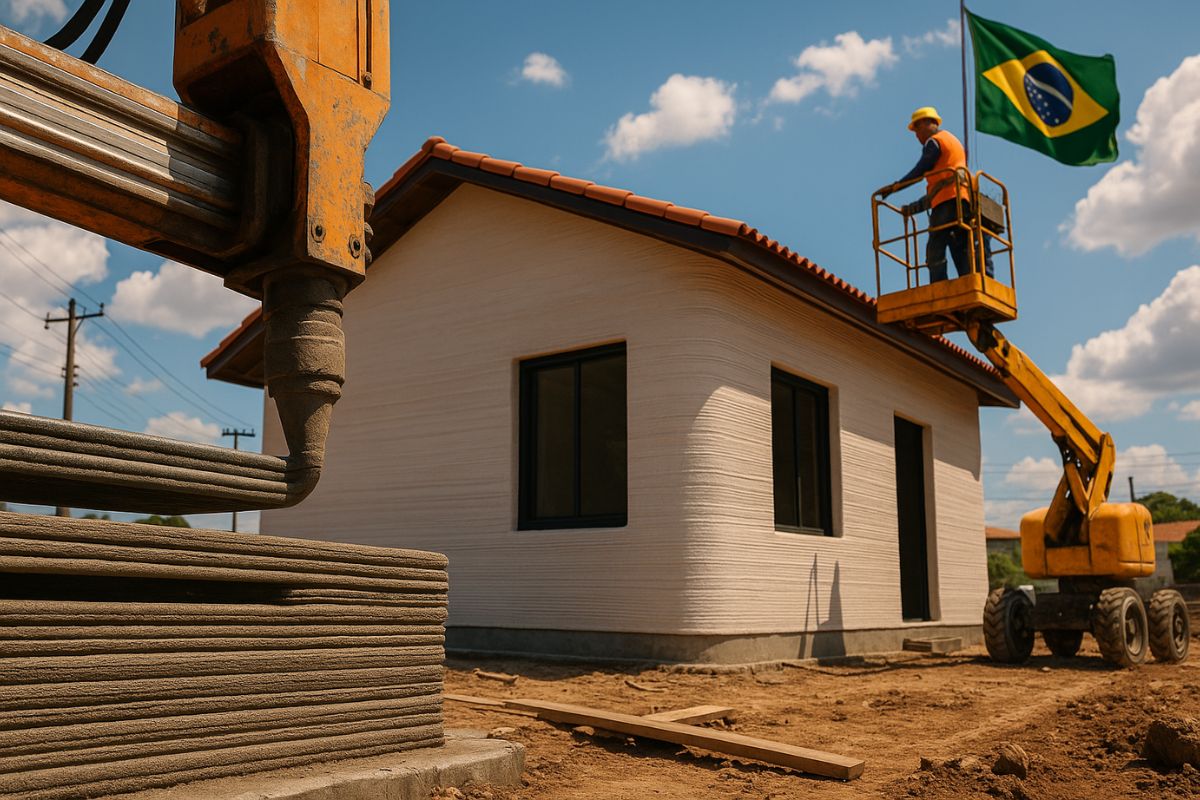
Built in Nova Lima (MG), the 57 m² residence was printed in record time and inaugurates a new era in civil construction, promising agility, sustainability, and cost reduction.
The first 3D house in Brazil is already a reality and was built in Macacos, a district of Nova Lima, in the metropolitan region of Belo Horizonte, breaking paradigms of national civil construction. The innovative project, conducted by the Brazilian startup InovaHouse 3D, delivered a functional residence of 57 square meters, with two bedrooms, living room, kitchen, and bathroom, at a total cost of R$120 thousand. The great differential, which captures the imagination and redefines the concept of “construction”, lies in the astonishing speed: the walls of the structure were completely printed, layer by layer, in just four days, and the complete assembly of the house, ready to move in, took only eight days.
This pilot project is not just a technological curiosity; it represents a milestone and a turning point for a historically traditional and low-productivity construction sector. By using a large-scale 3D printer that deposits layers of a special micro-concrete with robotic precision, the technology offers a construction process that is dramatically faster, cleaner, sustainable, and with material waste close to zero. For a country facing a chronic housing deficit estimated in millions of units, 3D printing emerges as a promising and tangible alternative for the large-scale production of housing in a more affordable, dignified, and, above all, efficient manner.
The Technology Behind the Walls
The method used, technically known as Concrete 3D Printing (3DCP), is an additive manufacturing process that brings the logic of industrial automation to the construction site.
-
A gigantic dam project in the Himalayas could solve one crisis but silently create another for millions of people.
-
Nikola Tesla said that intelligent people tend to have fewer friends, and now science partially confirms this: a study with over 15,000 people showed that for the more intelligent, socializing too much can even reduce life satisfaction.

-
A superyacht worth US$ 17 million is delivered in impeccable condition, sets out to sail, and hits a bridge in the Bahamas just two hours later.
-
Residents of Australia woke up to a sky completely red like blood before the arrival of Cyclone Narelle, which hit the coast with winds of 250 km/h, tearing off roofs and lifting iron dust in a scene they described as apocalyptic.


An enormous gantry-type printer, which moves on tracks, is the main protagonist, operating autonomously.
Following a digital project (BIM model), the machine extrudes the walls, layer by layer, with millimeter precision that eliminates common human error in masonry.
The material is not common concrete, but a special cementitious mortar, the exact formula of which is an industrial secret.
It needs to have almost contradictory properties: being fluid enough to pass through the pump without clogging, but viscous enough not to run and support the weight of the subsequent layers immediately after deposition (stackability), along with an accelerated curing time to ensure stability.
The walls are designed with internal openings, a feature of intelligent engineering that optimizes and accelerates the entire construction process.
These hollow spaces act as natural conduits, allowing the passage of all electrical and plumbing infrastructure quickly and cleanly, without the need to break walls, as happens with traditional methods.
Additionally, they allow for the insertion of steel rebar for structural reinforcement, ensuring that the building meets all safety standards.
After printing, the house is finished with conventional methods, such as the installation of slabs, roofs, doors, and windows, integrating the best of innovation with the already established practices in the market harmoniously.
Cost and Speed: The Revolution on the Construction Site
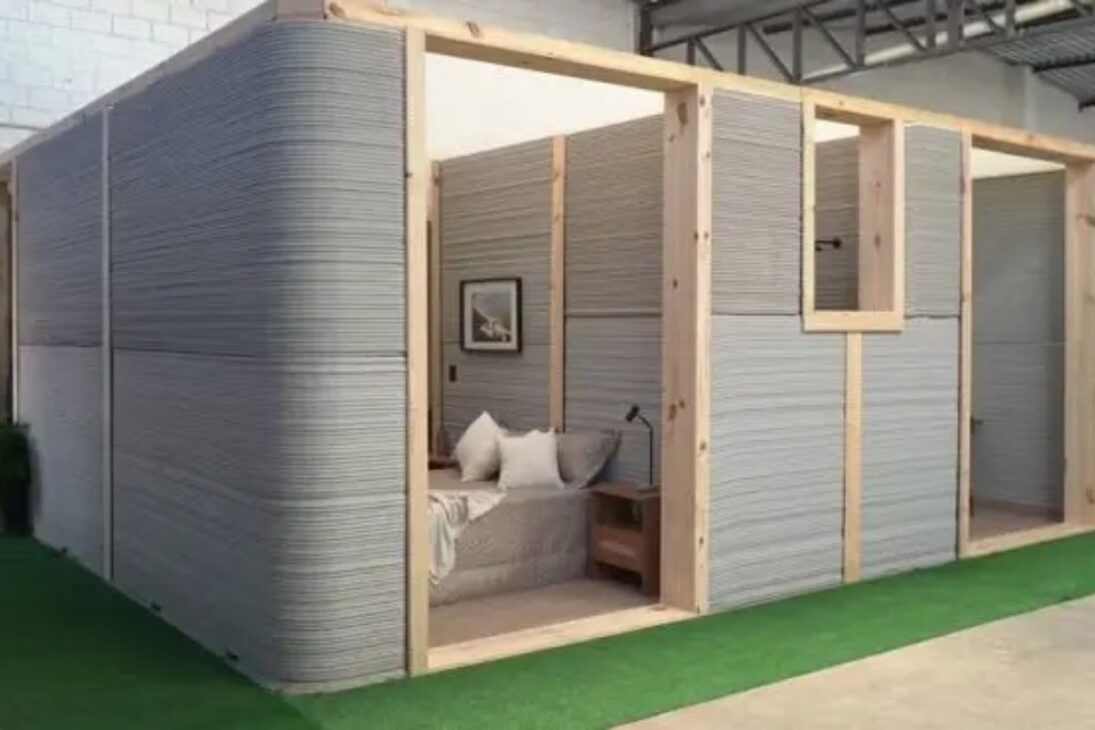
The cost of approximately R$2,105 per square meter proved to be highly competitive already in the first project.
According to data from the Construction Industry Union in the State of Minas Gerais (SINDUSCON-MG), the Basic Unit Cost (CUB/m²) for a standard residential project in the region is around R$2,000 to R$2,300, not including various indirect costs.
The great advantage of 3D printing, however, goes beyond direct costs: the drastic reduction in time and material waste, which can reach less than 5%, represents a gigantic indirect savings.
Think of fewer dumpsters of debris, lower transportation costs for materials, less equipment rental time, and, most importantly, a much leaner payroll.
While a traditional masonry construction with the same footage may take months to complete, the main structure of the 3D house was ready in less than 100 hours of effective printing.
This impressive agility has the potential to revolutionize not only the residential real estate market but also the response to natural disasters, allowing for the rapid construction of shelters, field hospitals, and emergency housing with superior quality.
The speed, combined with the precision of the machine, drastically reduces the need for a large team on site, which lowers the risks of work accidents and the associated costs.
The Regulatory Challenges and the Future of 3D Construction
Despite the project’s success in Minas Gerais, the popularization of the technology in Brazil still faces a significant and predictable obstacle: regulation.
Currently, there is no specific technical standard from ABNT (Brazilian Association of Technical Standards) for construction with 3D printing.
The lack of this standard creates a vacuum of legal insecurity: how to approve a project at the city hall? How will an insurer assess the risk? And, most importantly, how will banks finance the purchase of a property built with a non-standardized method? The formal path for innovative technologies like this goes through SiNAT (National System of Technical Evaluations), which issues a document called DATec, certifying the safety and performance of the system so that it can be accepted in the market.
However, the scenario is changing at a pace that matches the technology itself. In August 2025, ABNT put the first proposal for a technical standard for the sector out for public consultation, a crucial step to provide legal security and confidence to builders, investors, and buyers.
Additionally, in July 2025, the Ministry of Regional Development issued the first DATec for a 3D printing system in the country, officially opening the doors for such projects to be financed by Caixa Econômica Federal.
These advances are crucial and indicate that the biggest barrier to the expansion of the technology is beginning to be overcome, signaling a maturation of the market.
The Impact on Brazil’s Housing Deficit
Brazil faces a chronic housing deficit estimated between 6 and 7 million homes, according to data from the Getulio Vargas Foundation (FGV) and Abrainc.
It is a complex problem that traditional construction, with its high costs and slow pace, cannot resolve at the necessary speed.
In this context, the construction of houses by 3D printing ceases to be a niche innovation and becomes a strategic tool of high social impact.
The ability to build faster, with fewer resources, and at a competitive and decreasing cost (with scale) is exactly the combination that the country needs to tackle the issue of housing shortages on a large scale sustainably.
The potential is so great that it already inspires concrete government actions. In May 2025, the Bahia government launched the first bid for the construction of a housing complex of 50 affordable houses in Feira de Santana using the technology, with a target cost of R$80 thousand per unit, which would be impractical with conventional methods at the same speed.
The flexibility of digital design also allows for adapting projects to the needs of families and the conditions of the land without significant additional costs.
It is clear that the first 3D house in Brazil was not just a prototype; it has opened a viable path that can, in the coming years, transform the urban landscape and, more importantly, the lives of millions of Brazilians.







-

Uma pessoa reagiu a isso.