





 Portuguese
  English
  Spanish
  5 min of reading
  0 comments


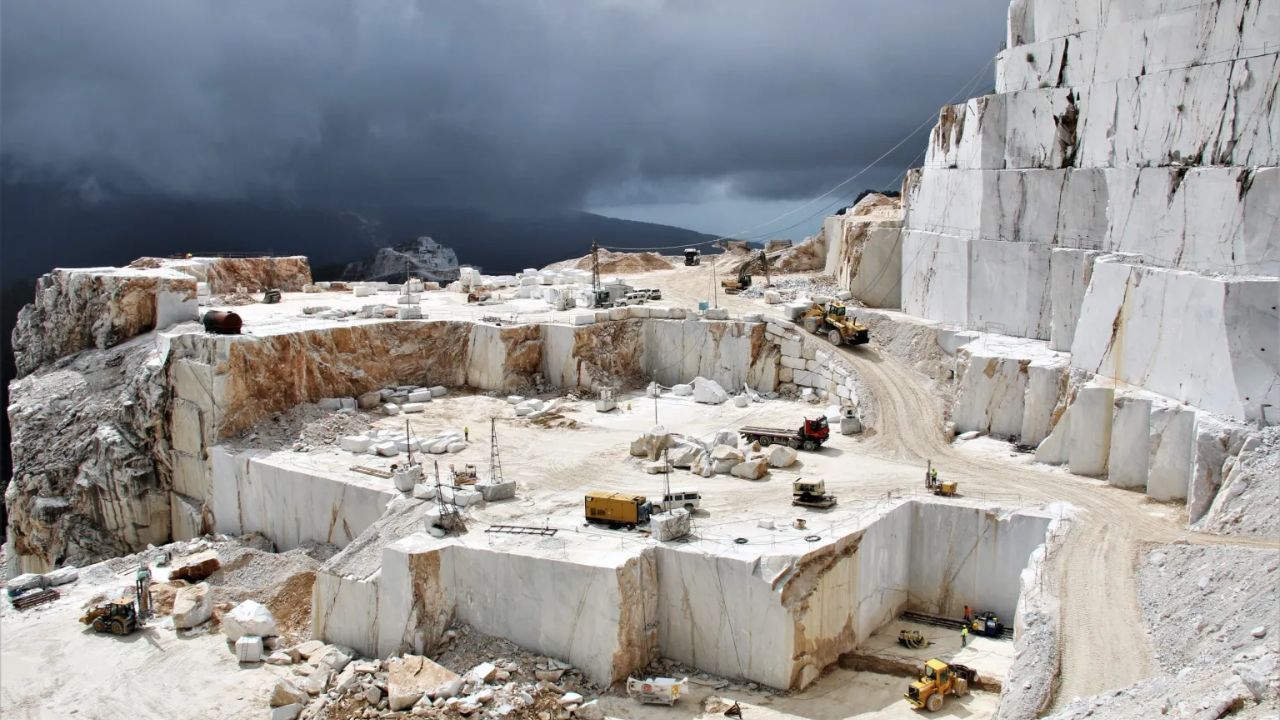
Surgical Operation in the Apuan Alps Combines Industrial Climbing and Ultra-Precision Cuts to Extract the Most Luxurious White Marble That Covers Global Icons Such as the One57 Building.
What a distant observer perceives as a static landscape of “eternal snows” in northern Tuscany is, in reality, an industrial theater where geology collides with modern engineering. At altitudes exceeding 1,200 meters, workers and engineers defy gravity to extract the most luxurious white marble from the global market. It is no longer about brute force with explosives, but rather a geological surgery: continuous loops of steel cables embedded with diamonds slice entire mountains as if they were bread, revealing the pristine interior of the Apuan Alps.
This quest for the perfect stone has created dizzying and unique scenarios. At places like Cava Cervaiole, centuries of extraction have carved what geologists and operators call “lithic cathedrals”, amphitheaters of white rock where vertical walls rise to 200 meters high.
It is in this setting of extreme risk and raw beauty that the value of a material capable of costing hundreds of thousands of dollars per piece is defined, turning Jurassic limestone powder into the ultimate symbol of economic power today.
-
The Brazilian colonial city that stopped in time and shares territory with a rocket launch base.
-
79-year-old woman challenges limits, visits 193 countries in the world after 56 years of planning and reveals the behind-the-scenes of a global journey that few have managed to accomplish.

-
These are the drivers who may stop paying tolls on highways in a project that promises to reduce costs for those who live from transportation in Brazil.

-
(Video): Italian pilot lands plane on moving train at 120 km/h and achieves unprecedented feat in aviation, even with a narrow runway and without direct visual contact.


The Vertical Cathedrals and the Geometry of the Abyss

The scale of these operations challenges immediate visual understanding. According to visual and geographical data provided by Henraux S.p.A., the historical operator of Cava Cervaiole, the landscape has been shaped by decades of strategic cuts, resulting in “geometries of vertical and horizontal planes” that create a surreal open-air architecture.
The company describes these formations as “dazzlingly height walls”, transforming the quarry into a vast white amphitheater, isolated from the rest of the world by altitude and the blinding whiteness of the sun’s reflection on the stone.
The extraction in these walls is not random; it follows the strict logic of geological veins. Unlike plain quarries, here engineering must deal with absolute verticality. The rock is not just taken from the ground; it is sliced from walls that rise like skyscrapers above the workers.
The preservation of the structural integrity of these “cathedrals” is vital not only for the aesthetics of the quarry but also for the operational safety, requiring a planning that borders on reverse architecture: dismantling the geological building without causing it to collapse on the crew.
The Diamond Wire Technology: Speed and Tension
To overcome the resistance of metamorphic calcium carbonate without destroying the block, the industry replaced explosives with diamond wire technology. According to technical research from the Dipartimento di Ingegneria at the University of Pisa, the process involves a steel cable equipped with rings (pearls) impregnated with synthetic diamonds, which runs in a continuous loop at tangential speeds of 30 to 40 meters per second (approximately 140 km/h).
The study from the University of Pisa details the geometric complexity of this operation: to initiate the cutting of a bench, it is necessary to execute perpendicular pilot holes, one vertical and another horizontal, that must meet with millimeter precision in the massive interior of the mountain to allow the passage of the wire.
The system relies on machines that automatically control the tension; if the wire is too loose, it slips; if the tension is excessive, it breaks, becoming a lethal whip. Continuous water cooling is essential, not only to lower the temperature but also to remove the “marmettola” (stone mud), preventing the equipment from getting cemented inside the cut.
The Price of Exclusivity: From Powder to Penthouse

All this logistical and technological effort is justified by the final value of the product in the ultra-luxury market. When a block of the most luxurious white marble, such as Statuario or Calacatta, is extracted intact and has a rare vein pattern, its price skyrockets as it leaves the mountain. The New York real estate market offers the most tangible example of this extreme appreciation, where the stone ceases to be a building material and becomes a work of art.
As reported in analyses from Business Insider regarding the luxury real estate market, the One57 building, on the famous “Billionaire’s Row” in Manhattan, used these stones as a multimillion-dollar sales differentiator.
The report highlights that a single slab of marble processed for this project was valued at around $130,000. This material was used to create monolithic bathtubs and sculpted countertops from solid blocks, validating Carrara marble’s status as an essential “jewel” for elite architecture.
The Guardians of the Abyss and the Industrial “Kitchen”
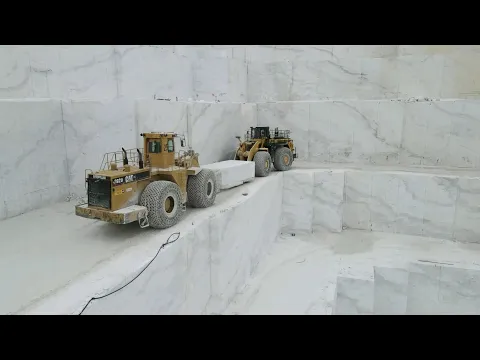

Despite the advanced technology of diamond wires monitored by computers, the human factor remains irreplaceable and dangerous. The central figure on this stage is the tecchiaiolo, a specialized worker who rappels down the 200-meter vertical walls to “clean” the rock face.
They remove unstable fragments that could fall on the machines and colleagues below. It is a job that combines climbing and mining, reminding us that behind the cold elegance of a luxury kitchen countertop lies real sweat and life-risking danger.
Alongside the glamour, there exists a pragmatic economic reality. Not every mountain becomes a $130,000 countertop. The vast majority of the extracted material, fragments, powder, and imperfect blocks feed a massive secondary industry of Calcium Carbonate.
This “white gold” in powder form is used as filler in plastics, paper whitening, and even abrasives in toothpaste. Thus, the mountain finances its own destruction: the profit from the toothpaste powder subsidizes the hunt for rare blocks of Calacatta that adorn global skyscrapers.
Does seeing the brutal and technical origin behind the elegance of a marble piece change the way you view luxury in architecture? Or is the impact on the landscape a fair price for the eternal beauty of the stone?
Leave your opinion in the comments below, we want to know the perspective of those who value design and engineering.




-

-

-

-

6 pessoas reagiram a isso.