





 Portuguese
  English
  Spanish
  4 min of reading
  0 comments


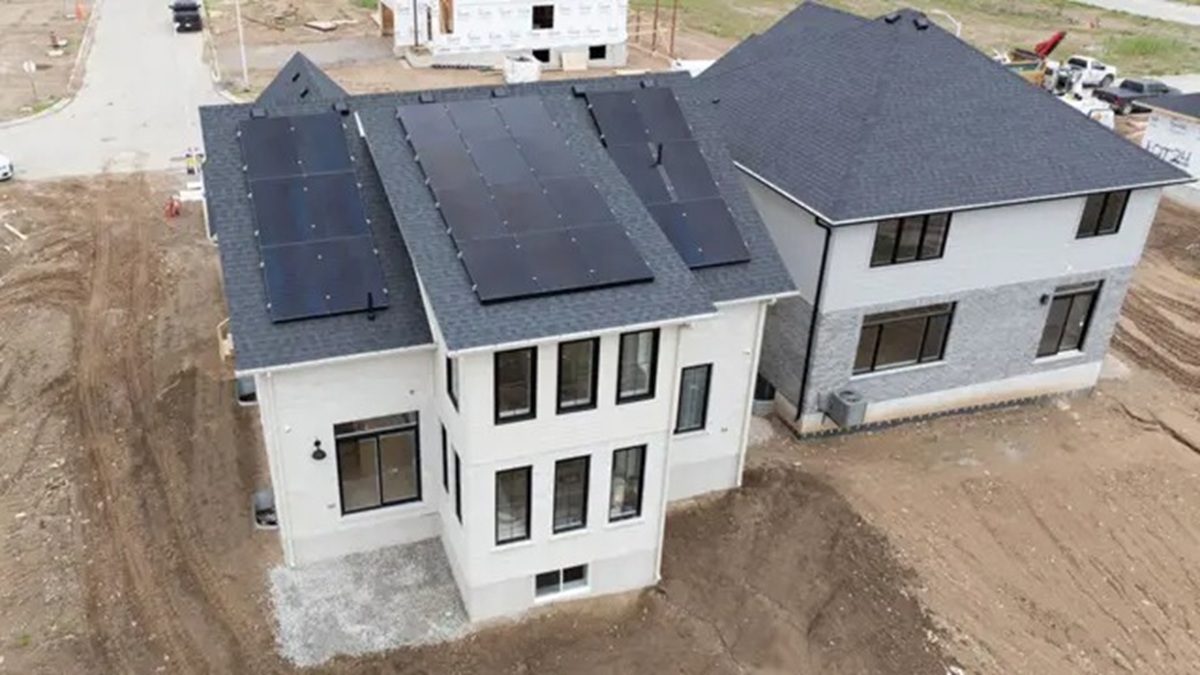
In Ontario, A Team of Engineers Creates a Self-Sufficient House That Combines Solar Panels, Heat Pump, and Thermal Battery, Reducing Costs and Emissions and Showing That Clean Energy Can Be Efficient and Affordable
A team of Canadian engineers unveiled, on October 28, a fully electrified house in Komoka, Ontario, that promises to redefine how people produce and consume energy. The project combines solar panels, a heat pump, and a thermal battery to eliminate the use of fossil fuels and drastically reduce energy costs and emissions. The researchers believe that the innovation could set a new global standard for zero-carbon emission homes.
A Living Laboratory for Clean Energy Innovation
The initiative is led by Joshua Pearce, a professor at Western Engineering and the Ivey Business School, and by PhD student Shafquat Rana. The team also includes Anthony Straatman, head of the mechanical and materials engineering department, Kamran Siddiqui, engineering professor, and Jaime Crncich, president of the construction company Magnus Homes.
Together, they designed a home system capable of using locally generated solar energy to heat and power the house. The two-story building in Komoka functions as a real laboratory, where the team collects and analyzes performance data.
-
Archaeologists use satellite technology and find a mysterious structure of 500 m² buried up to 6 meters beneath an ancient city in Egypt.

-
Supercomputer calculates when humanity may disappear from Earth, predicts a scorching supercontinent, temperatures of up to 70 degrees, and a planet moving towards becoming uninhabitable.

-
INMET danger alert: heavy rains between the 3rd and 4th may drop up to 100 mm/day and winds of 60 to 100 km/h in several regions of Brazil require extra caution.

-
The parts crisis may bring back the drop notch and microSD in 2026; while Windows 11 promises to become lighter, leaks mention batteries of up to 10,000 mAh and 200 MP cameras.


The initial results are impressive: the installation reduced electricity bills by 45% and carbon emissions by 55%. Additionally, the thermal battery—which stores heat using materials like salt or wax—has increased solar energy utilization by 60%, reducing dependence on the electrical grid.
Pearce highlighted that the cost of solar energy is already lower than that of conventional electricity in Canada. According to him, the project demonstrates the economic and practical viability of combining solar panels, a heat pump, and a thermal battery to meet all the energy demands of a residence.
Efficiency and Expansion Potential
The system’s efficiency comes from the interaction between its components: the solar panels capture energy, the heat pump converts that electricity into heat, and the thermal battery stores the surplus for later use. The result is a house that is four times more efficient than traditional systems.
“The goal is to prove the system’s effectiveness over a year, with the aim of completely eliminating the need for fossil fuels for residential heating,” explained Rana. He added that, after validating the results, the plan is to expand the technology to other homes in Canada and, eventually, to the rest of the world.
To monitor performance, Rana equipped the house with smart sensors and wiring that measure energy consumption and generation. All data is monitored in real time through an app. Crncich himself, who lives in the experimental house, tracks the daily balance between energy production and usage.
“We have a unique opportunity to create and consume energy in our own homes. It is fascinating to observe, as both a resident and builder, how these two aspects balance each other out,” commented Crncich. He also emphasized the importance of owner awareness about energy consumption to achieve sustainability.
A neighboring house, built by Crncich without the integrated solar system, serves as a control model, allowing direct comparisons between the two buildings.
An Important Step Toward Clean and Affordable Energy
Although heat pumps and thermal batteries are already expanding in the United States, the concept is still recent in the Canadian real estate market. This novelty makes the project particularly relevant, considering the high heating costs in a country with a harsh climate.
“Unfortunately, many homes in Canada do not even meet current codes, let alone have cutting-edge photovoltaic technology,” said Pearce. He noted that most Canadian residences still use natural gas or traditional electric heating, which is expensive and inefficient.
The professor also highlighted the importance of renewable energy as a form of protection against price fluctuations in the energy sector. “If we can use solar energy to power our homes and transfer it to a heat pump, we can multiply the yield: for each electrical unit, we get three units of heat—an efficiency exceeding 300%,” he explained.
A Sustainable and Viable Future
For Rana, the project represents an advancement not only technically and economically, but also environmentally. He believes that the self-sufficient solar house can directly contribute to mitigating climate change.
“Climate change is real, and we need everyone to make a small effort to combat it,” he stated. “Decarbonizing the residential sector is a simple and obvious measure. Integrating this sustainable structure into Canadian homes, especially in new constructions, can significantly reduce the country’s carbon emissions and help address the global impact of the climate crisis.”
The team’s research was published in the journals Energies, Energy and Buildings, and e-Prime – Advances in Electrical Engineering, Electronics and Energy, reinforcing the scientific recognition of the initiative.
With concrete and measurable results, the solar house in Komoka shows that it is possible to combine efficiency, economy, and sustainability in a single project. If the trend holds, the Canadian model could inspire a new generation of energy self-sufficient homes in various parts of the world.









Seja o primeiro a reagir!