





 Portuguese
  English
  Spanish
  5 min of reading
  0 comments


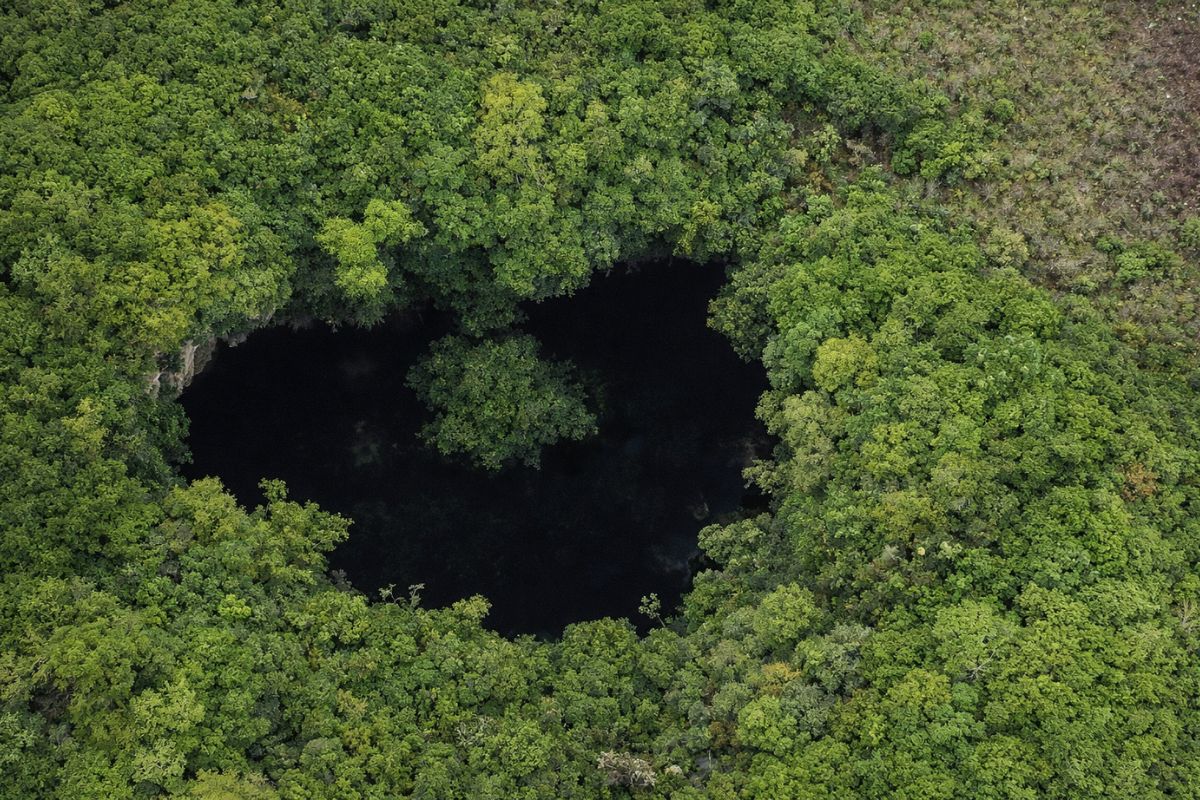
Engineers Descend Into A 200-Meter Sinkhole In China, Find Forest With 40-M Trees, High Oxygen, And Possible Rare Species, But Illegal Excavations Threaten To Destroy The Site
When a team of engineers went to conduct a simple land survey in southern China, no one imagined they would find a 200-meter sinkhole in China that seemed to swallow the very ground. Upon reaching the bottom, instead of rock and darkness, they found an untouched forest, with trees up to 40 meters tall and abnormally high oxygen levels.
What was supposed to be merely a geological curiosity turned out to be an isolated ecosystem, with its own climate, extremely rich soil, and signs of species that may be rare or even unknown to science. At the same time, illegal excavations around the 200-meter sinkhole in China opened fractures in the rock and raised the real risk of complete collapse of the formation, capable of destroying the underground forest in a matter of minutes.
Where The 200-Meter Sinkhole In China Is And How It Formed
The 200-meter sinkhole in China is located in the Guangxi region, in the south of the country, in a limestone landscape marked by cliffs, caves, and other large natural holes.
-
Home environment can influence the brain, mood, and well-being: studies indicate an increase of up to 15% in productivity, a reduction of 12% in stress with plants, and a direct impact of the circadian rhythm on the 24 hours of the day.

-
A Brazilian millionaire couple restores a farm over 150 years old in the interior of São Paulo and transforms the historic property with Portuguese tiles, antique furniture, and new spaces into a refuge that blends tradition, comfort, and sophistication.
-
Submerged city in a lake in Minas reveals intact streets, preserved vehicles, and houses after more than 60 years, impressing divers.

-
Yellowstone has started to rise again in an area of the caldera, and the movement rekindles fears surrounding the U.S. supervolcano, as scientists monitor the deformation and try to understand what is happening underground.

From an aerial view, the depression looked like a huge cut in the earth, measuring about 306 meters in length, 150 meters in width, and nearly 200 meters in depth, equivalent to a 60-story building fitting in there.
This region is a classic example of karst topography, resulting from thousands or millions of years of slightly acidic rain dissolving the limestone underground. Water opens tunnels, forms giant caves, and when the ceiling can no longer hold, it all collapses, creating deep sinkholes that the locals call “heavenly wells”.
The Descent Into The Heart Of The “Mouth Of Heaven”
Before the descent, the engineers attempted to use drones to observe the interior, but the depth and darkness prevented clear images. The solution was to go in person.
In 2022, a team of engineers, speleologists, and biologists descended the steep walls using ropes and safety equipment, in a slow operation that took hours to reach the bottom, at about 192 meters deep.
During the descent, they passed through three large cave openings in the walls, like doors to an even larger underground world. As the light faded, the air became cooler and more humid, setting the stage for the surprise that awaited when the lanterns finally illuminated the floor of the 200-meter sinkhole in China.
The Hidden Forest With 40-M Trees And High Oxygen


At the bottom, instead of bare rocks, there was thick, moist soil covered with ferns, mosses, and understory plants. Among them, towering trees emerged, with some specimens reaching about 40 meters in height, forming a closed canopy over the small underground forest.
The instruments showed unusually high oxygen levels near the ground, indicating intense photosynthesis. The sunlight that enters through the top of the 200-meter sinkhole in China is enough to sustain this mini-ecosystem, creating a kind of “natural greenhouse” protected by the canopy itself. It was as if the team had stepped into a time capsule, a piece of forest that the world forgot, preserved for centuries away from human presence.
The scientists suggest that this isolation may have allowed plants and animals to evolve in particular ways, giving rise to rare or even unknown species. Small streams cut through the bottom of the sinkhole, reinforcing the idea of a self-sustaining system, with water, fertile soil, stable climate, and little external interference.
Why This Underground Ecosystem Is So Valuable
It is not just an impressive scenery. The forest at the bottom of the 200-meter sinkhole in China serves as a natural laboratory to understand how ecosystems evolve in isolation, how species resist external changes, and how the local climate influences biodiversity.
Furthermore, the rich soil, the layers of organic matter accumulated over long periods, and the vertical structure of the forest provide clues about nutrient cycles, ecological succession, and the resilience of closed environments. In a world that seeks to better understand how to conserve forests and face climate change, an ecosystem like this may hold important answers.
Illegal Excavations And The Risk Of Total Collapse
Shortly after the discovery, reports indicated that unauthorized excavations had resumed near the sinkhole. The noise of heavy machinery and drilling echoed in the area again, despite warnings from geologists.
New imaging scans showed recent fractures in the limestone walls, indicating that the structure was under pressure. In an environment where the rock is already thin and unstable, any additional vibration could be the trigger for a chain collapse, capable of causing the cave’s ceiling to give way and crush the entire underground forest in a matter of minutes.
Technical reports warn that if the interference continues, the 200-meter sinkhole in China could suffer a total failure: falling rock, waves of air and debris destroying roots, wiping out the elevated oxygen, and leaving the ecosystem under rubble, in permanent darkness. In this scenario, virtually nothing would survive.
What The 200-Meter Sinkhole In China Teaches About Conservation
The story of this 200-meter sinkhole in China shows how the Earth still harbors hidden and extremely delicate environments that can be destroyed not by an inevitable natural disaster, but by short-term human decisions.
On one side, there is an untouched forest, with giant trees, high oxygen, and potential for rare species. On the other, illegal excavations threaten to turn this secret world into a pile of stones. The choice between immediate exploitation and the protection of a unique ecosystem says a lot about the kind of future we want for the planet.
After learning about the story of this 200-meter sinkhole in China, do you think such areas should be completely closed off from any human activity, or is it possible to reconcile research, controlled tourism, and preservation without putting the ecosystem at risk?







-

-

-

4 pessoas reagiram a isso.