





 Portuguese
  English
  Spanish
  4 min of reading
  0 comments


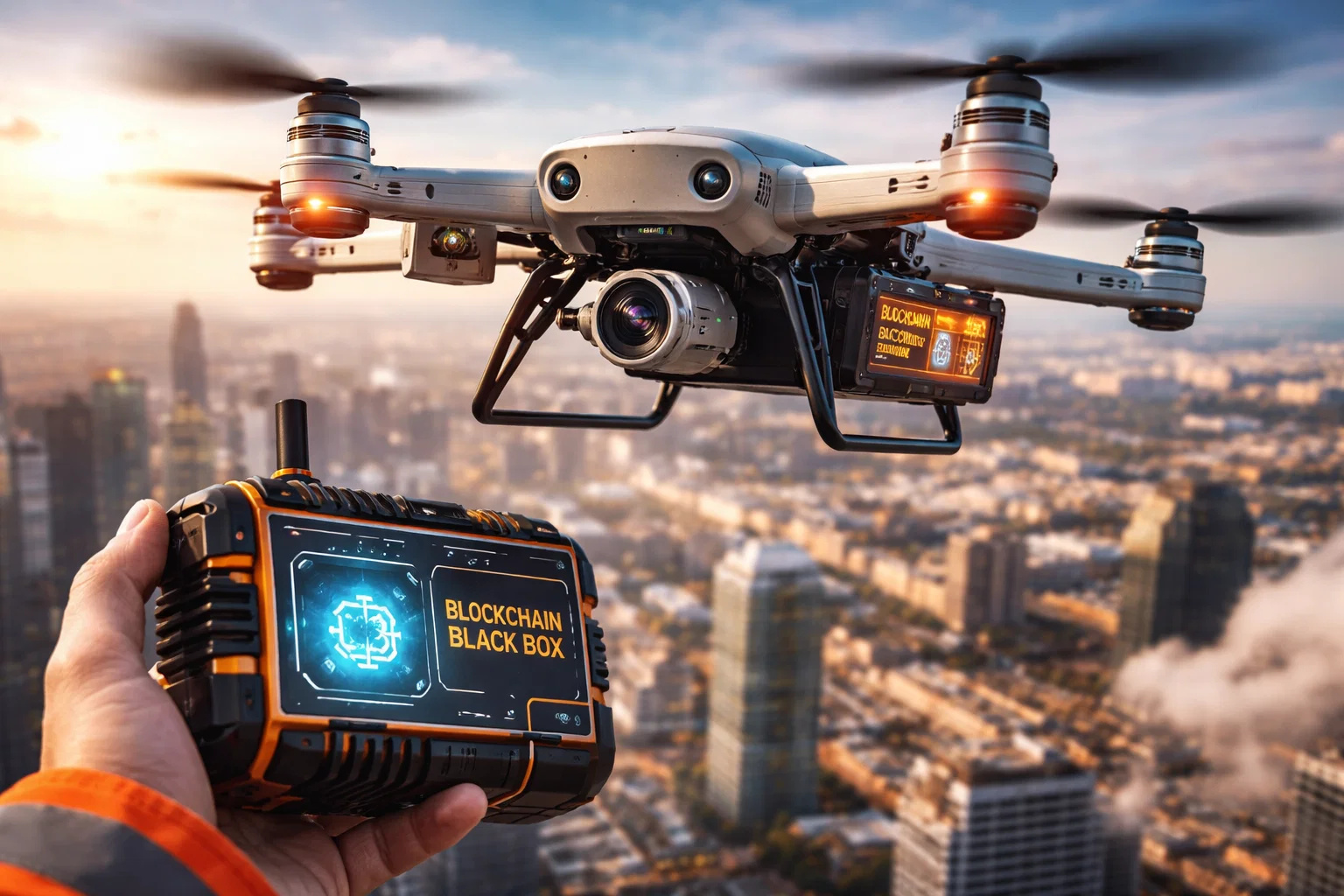
Engineering Students at the University of Southampton Test Black Box System That Records Drone Flight Data Directly Onto a Secure Network, Creating Records That Cannot Be Altered and Opening a New Path for Autonomous Machine Security
A group of engineering students from the UK was able to implement an idea that could change the operation of drones and other intelligent machines. They created a digital black box for drones, capable of recording everything that happens during a flight.
The novelty lies in where this data is stored. Instead of being kept in a regular computer or server, the information is recorded on a blockchain, a type of digital network known for maintaining permanent records.
In practice, this means that the data generated during the flight is protected from alterations or deletions. The black box system acts as a reliable memory of the machine.
-
Nikola Tesla said that intelligent people tend to have fewer friends, and now science partially confirms this: a study with over 15,000 people showed that for the more intelligent, socializing too much can even reduce life satisfaction.

-
A superyacht worth US$ 17 million is delivered in impeccable condition, sets out to sail, and hits a bridge in the Bahamas just two hours later.

-
Residents of Australia woke up to a sky completely red like blood before the arrival of Cyclone Narelle, which hit the coast with winds of 250 km/h, tearing off roofs and lifting iron dust in a scene they described as apocalyptic.

-
New 100% clean fuel produced in Brazil could retire diesel.


The experiment was conducted by students from the University of Southampton, in partnership with experts in digital technology and the company Minima.
The Growing Problem with the Expansion of Drones in Industry and Technology Services
Drones have ceased to be merely equipment used for filming or leisure. Today they are present in various industrial activities.
Companies use these devices to monitor facilities, inspect structures, and oversee operations in hard-to-reach locations.
With this expansion comes an important question. When a drone operates alone, without a pilot controlling every movement, the need to prove exactly what happened during the operation arises.
Many current black box systems record data on centralized servers or databases. This model relies on constant connectivity and an external system to store information.
If something goes wrong, figuring out what really happened can become more complicated.
It was against this backdrop that the students decided to develop a different solution.
The Test Flight That Showed the Technology Works Even in Difficult Conditions
To prove that the system would work outside the lab, the researchers installed the technology on a drone and conducted a demonstration flight.
During the entire operation, the equipment recorded operational data while airborne.
This information was recorded directly on a blockchain network, creating digital records that cannot be modified once stored.
The test took place under real operating conditions. The drone faced vibration, constant movement, power limitations, and variations in communication signals.
Even so, the system kept recording data throughout the flight.
According to the researchers, this result indicates that the technology can function within the limitations that aerial equipment faces in the real world.
The Technology That Allows Each Machine to Record and Validate Its Own Data
At the heart of the project is a protocol developed by the company Minima.
This black box system allows each device connected to the network to directly participate in verifying the recorded data.
Instead of relying on a central server, each participant maintains a copy of the information and helps confirm that the record is true.
With this model, the data remains stored on the devices themselves but continues to be verified by all participants in the network.
This reduces the need for external servers and increases the security of the information recorded by the machines.
For equipment operating in the field or in areas with limited connectivity, this change can be significant.
Direct Integration with the Processor Increased Performance and Reduced Energy Consumption
Another important advancement of the project occurred in how the system was integrated into the drone.
Instead of functioning only as a separate program, the system was executed directly within the equipment’s processor.
This integration brought the technology closer to the hardware of the machine.
According to the researchers, this change has brought significant performance improvements.
Estimates released by the team indicate gains of up to 500 times more performance and up to 10,000 percent increase in energy efficiency compared to traditional methods.
For drones, which rely on small batteries and limited processing capacity, these improvements are essential.
What This Innovation Could Represent for the Future of Autonomous Machines
As drones and other smart equipment begin to operate in public and industrial environments, the need to ensure transparency in these machines’ operations grows.
The ability to permanently record each action could become an important factor for security, auditing, and incident investigation.
According to experts involved in the project, the technology paves the way for a new model of connected equipment.
In this scenario, machines not only perform tasks but also record and verify their own actions during operation.
The experiment conducted by the British students drew attention precisely because it showed that this type of black box system can function in small, energy-limited equipment operating under real conditions.
With drones becoming increasingly present in various activities, technologies that enhance trust and transparency in these operations are likely to gain more ground.
This initiative drew attention because it shows that a technology known in the digital world may begin to gain traction within the very machines operating in the physical world.
Do you believe that drones and other machines should record all their actions to enhance security? Share your opinion in the comments.






-

Uma pessoa reagiu a isso.