Portuguese


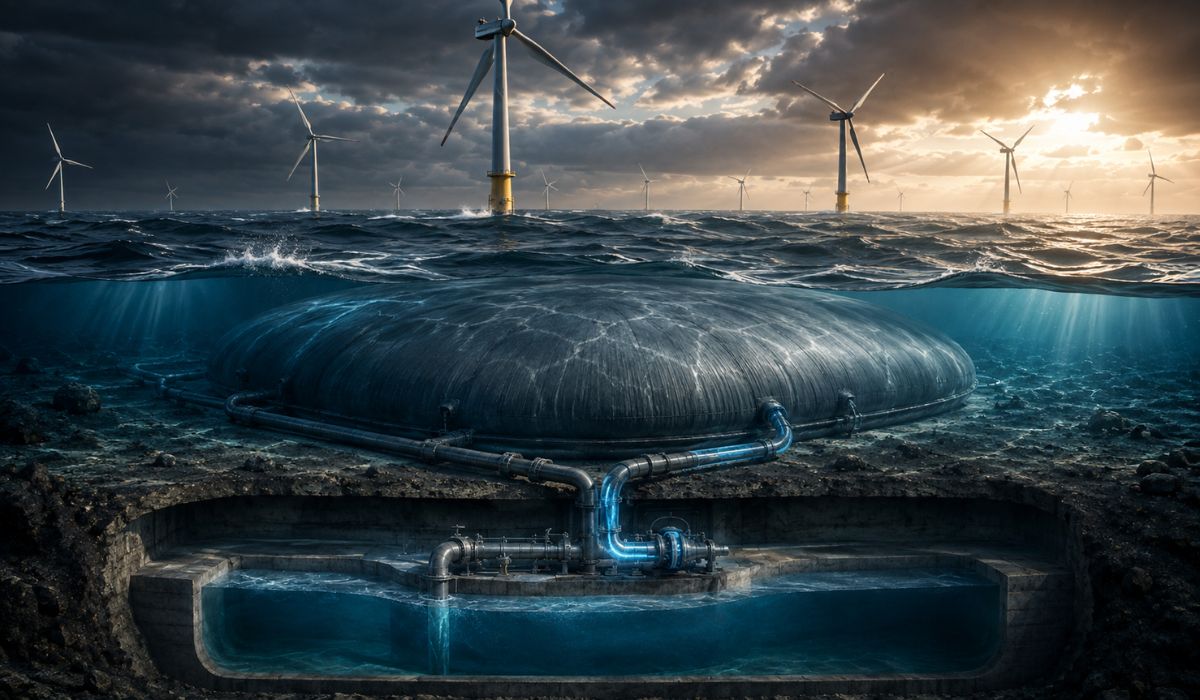

A Dutch project aimed to transform the ocean floor into part of a massive energy storage system, combining underwater engineering, water pressure, and a solution inspired by pumped hydroelectric plants.
Imagine a hydroelectric plant without a mountain, without a dammed river, and almost entirely hidden beneath the sea.
Instead of harnessing falling water from a dam, Dutch engineers designed a system capable of using the very pressure exerted by the ocean to store electricity produced by offshore wind farms.
Dubbed the Ocean Battery, the concept was developed by Ocean Grazer, a company spun off from the University of Groningen in the Netherlands.
-
The first clear photograph of a total solar eclipse was taken 175 years ago by a man almost forgotten by history: captured during an 84-second exposure, the image revealed the Sun’s faint corona and paved the way for studies that today help understand solar storms and damage to satellites.

-
Three teenagers mixed gelatin, glycerin, and water to create fishing lures that work like plastic ones. They managed to catch fish in tests and made the material disappear in about two weeks when left in the sea, winning two local awards and a national science competition in Australia.
-
Three teenagers mixed gelatin, glycerin, and water to create fishing lures that work like plastic ones. They managed to catch fish during tests and made the material disappear in about two weeks when left in the sea, winning two local awards and a national science competition in Australia.
-
Without lithium or rare earths, new hybrid battery uses 3D-printed electrode, stores seven times more charge, and retains 82% capacity after 1,500 cycles.



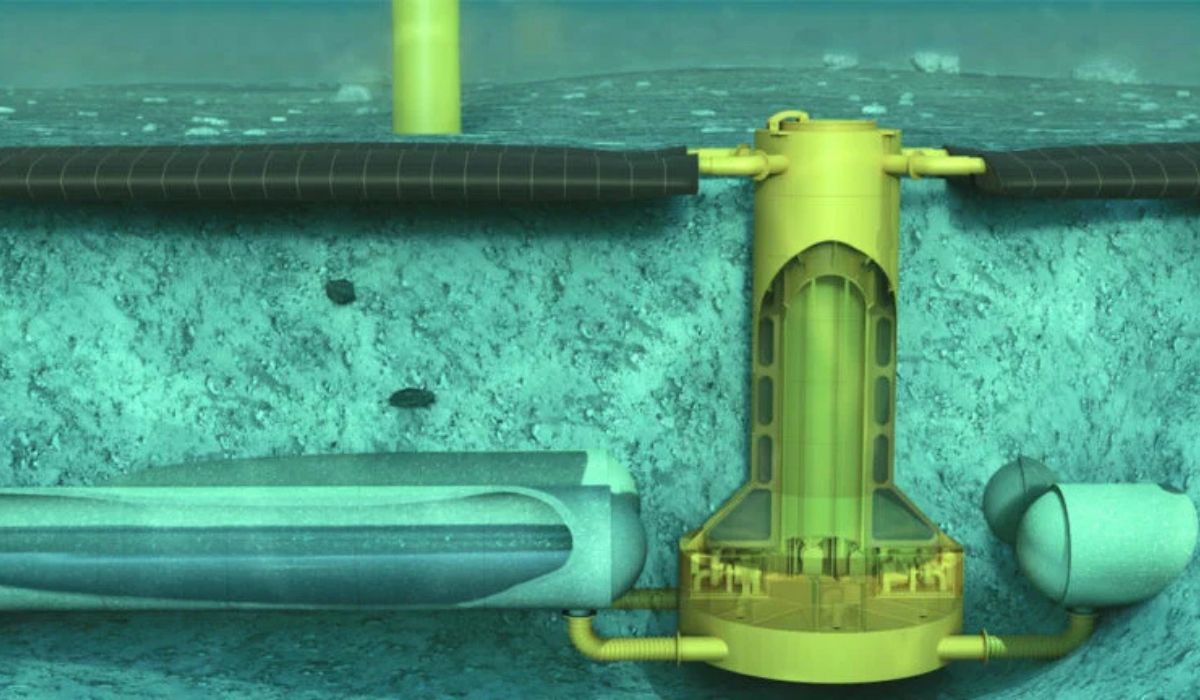
The proposal involved burying a rigid concrete reservoir on the seafloor capable of holding up to 20 million liters of freshwater, connected by pumps and turbines to a large flexible bladder installed on the ocean floor.
When excess electricity generated by wind turbines or other renewable sources is available, pumps would draw water from the underground reservoir to fill this flexible structure.
When the grid needed energy again, the process would be reversed.
The massive column of ocean water would press the bladder from the outside and force its contents back into the buried reservoir, passing through turbines that would convert the water’s movement back into electricity.
The idea has progressed to prototypes and demonstration plans in the Netherlands.
Ocean Pressure Would Do the Work of a Dam
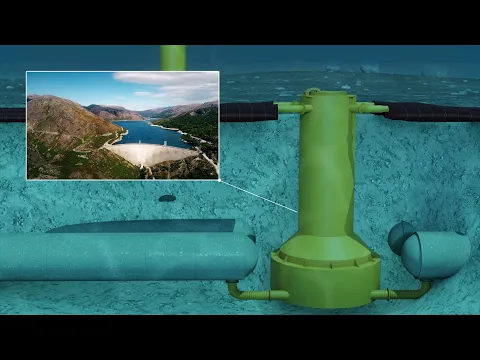
The physical principle resembles pumped hydro storage, technology that has been used on land for decades.
In traditional facilities, when there is excess electricity, pumps elevate water from a lower reservoir to another located at a higher altitude.
When demand arises, the water flows back down, passes through turbines, and returns part of the energy to the grid.
In the Ocean Battery, it would not be necessary to find two reservoirs separated by a mountain.
The pressure difference between the bladder located on the ocean floor and the buried reservoir maintained at low pressure would perform the role of height difference in a pumped hydro system.
The rigid reservoir would sit below the seabed.
Above it, a flexible bladder would remain subjected to the pressure of the ocean water.
When charged, the system would primarily store water in the bladder.
When discharged, the external ocean pressure would compress this structure and push the water downwards toward the reservoir.
On its way, the flow would pass through hydraulic turbines.
In other words, electricity would not be stored within the water like in a chemical battery.
It would be converted into hydraulic energy associated with the pressure difference and retrieved when necessary.
Submarine reservoir could hold 20 million liters
The version publicly presented in 2022 envisioned an underground reservoir with a capacity of up to 20 million liters, or about 20 thousand cubic meters of freshwater.
Ocean Grazer estimated a storage capacity of around 10 MWh for a unit of this size.
In practice, 10 MWh represents enough energy to supply 10 MW for one hour, 1 MW for ten hours, or other equivalent combinations, not accounting for losses.
The company advocated for a modular architecture.
Rather than indefinitely increasing a single reservoir, it would be possible to install several underground units.
Pumps and turbines could also be added according to the necessary power.
This distinction between energy and power is important.
The size of the reservoirs primarily determines how much can be stored, while the amount and capacity of the hydraulic machines influence the speed at which the system can receive or deliver electricity.
A wind farm could, in theory, combine various units to accumulate a larger amount of energy during periods of strong winds.
Giant bladder would use the ocean’s own pressure
The image of a giant bladder being crushed by the ocean might suggest that it needs to function as a massive pressurized tank.
The concept is somewhat different.
Because it is flexible, the structure would have its internal pressure close to that of the surrounding water.
This avoids the need for its membrane to withstand the complete difference in pressure between the seabed and the atmosphere.
The component subject to the most significant difference would be the system connecting this water to the low-pressure underground reservoir.
It is precisely this difference that causes the water to want to flow downward when a valve is opened.
The greater the column of water above the system, the more pressure can be available.
On the other hand, installing, constructing, and maintaining equipment in deeper waters tends to increase complexity.
A technical roadmap released by Ocean Grazer anticipated tests in shallow waters and an offshore demonstration linked to wind farms, initially at depths of less than 100 meters.
Excess energy would fill the bag on the seafloor
Wind farms face a problem that is not solely dependent on the size of the turbines.
The wind can produce a lot of electricity at times when demand is low or the grid cannot accommodate it all.
In these situations, some generation may need to be curtailed.
The Ocean Battery was designed to be close to the generation source and absorb some of this excess.
When electricity is available, motors would activate the pumps to move water from the buried reservoir into the flexible bag.
This movement would be the charging phase.
Hours later, in low wind or higher demand, valves would allow the water to return.
The hydrostatic pressure exerted by the ocean would cause the bag to decrease in volume and push the water through the turbines.
The system would then return electricity to the park or the grid.
The proposal has also been associated with floating solar installations and other maritime generation sources, although offshore wind energy has been its most evident application.

Ocean Battery projected efficiency between 70% and 80%
No storage system returns exactly all the electricity used to charge it.
Pumps, turbines, pipelines, motors, and generators experience losses.
Ocean Grazer estimated a full cycle efficiency for the Ocean Battery between 70% and 80%.
This would mean recovering approximately 70 to 80 units of energy for every 100 used during charging, according to projections from the developer itself.
The company also projected an operational life of over 20 years, emphasizing that the hydraulic principle would avoid many limitations related to chemical degradation found in electrochemical batteries.
Ocean Battery prototype tested in Eemshaven
The Ocean Battery was not just a computer design.
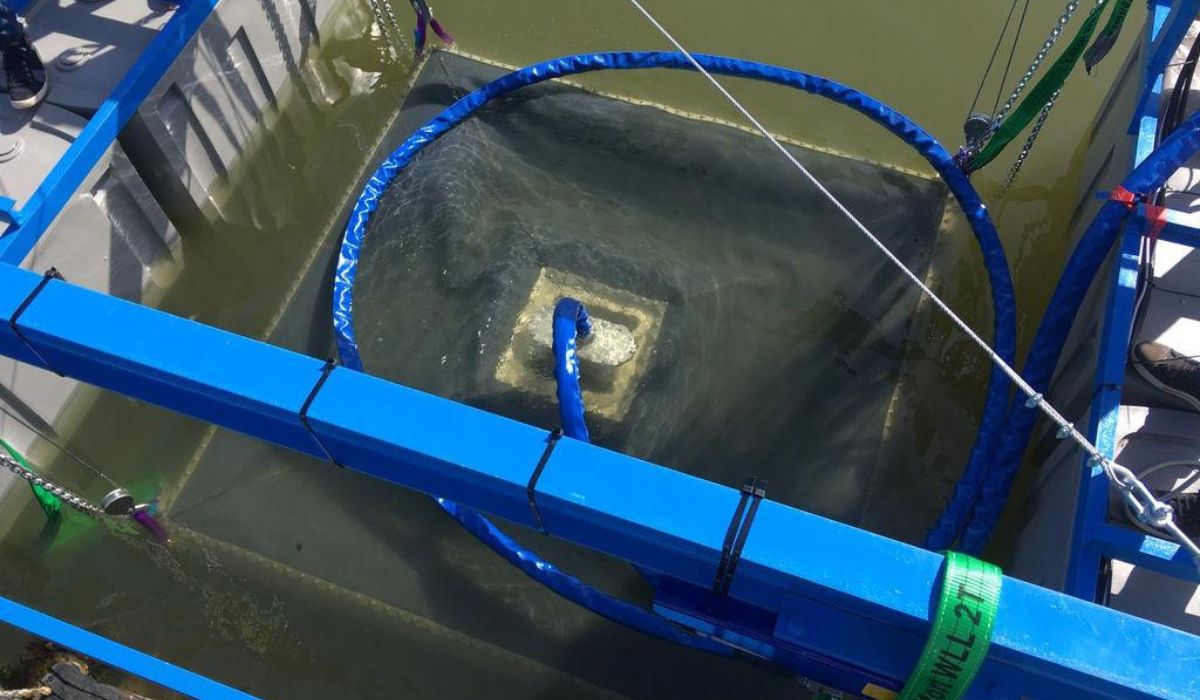
Ocean Grazer developed a prototype and conducted testing work in Eemshaven, a critical port and energy area in the northern Netherlands.
Groningen Seaports recorded the preparation of an experimental structure weighing approximately 1,500 kilograms for testing in the region.
In July 2021, the company publicly presented results and the prototype of the technology at the port.
Later, the project received European support.
In March 2023, Ocean Grazer announced securing €2.5 million from the EIC Accelerator, a program by the European Innovation Council.
The project aimed to demonstrate an operational system at scale in a lake and validate installation, operation, and maintenance.
There was also a plan more directly linked to offshore wind generation.
Documents from the Dutch government related to the Hollandse Kust West wind farm mentioned an experimental Ocean Battery of 2.5 MW of power and 3 MWh of capacity among the technologies to be assessed for energy system integration.
This was a smaller installation compared to the 10 MWh configuration presented as a reference for larger units.
Storage would be near offshore wind turbines
One advantage pursued by the project was to install storage practically at the same location where the energy would be produced.
Offshore wind farms are located tens of kilometers from the coast and need to transmit large amounts of electricity via underwater cables.
If part of the generation could be stored in the marine environment itself, the energy could be released at more convenient times for the grid.
The proposal also avoided the use of large quantities of lithium, nickel, or other materials associated with certain electrochemical batteries.
However, this did not make the project impact-free.
Large concrete reservoirs would require raw materials, seabed construction, and specialized equipment.
Bags, pipelines, and machines would also need to withstand years of exposure to saltwater and the underwater environment.
Additionally, any commercial implementation would have to assess impacts on wildlife, sediment, cables, fishing, and other maritime activities.