





Three Australian students transformed simple ingredients into biodegradable lures, tested the prototypes during fishing trips, and continued refining the formula to balance strength, flexibility, and rapid decomposition in water.
A soft fishing lure is usually made to sway in the water like a small animal, withstand multiple casts, and attract the fish before getting caught on a rock, branch, or submerged structure.
When this happens, however, part of these lures remains in the environment for much longer than the fishing trip.
It was with this problem in mind that three students from Darwin, in northern Australia, began mixing ingredients usually associated with the kitchen and household products.
-
The first clear photograph of a total solar eclipse was taken 175 years ago by a man almost forgotten by history: captured during an 84-second exposure, the image revealed the Sun’s faint corona and paved the way for studies that today help understand solar storms and damage to satellites.

-
Three teenagers mixed gelatin, glycerin, and water to create fishing lures that work like plastic ones. They managed to catch fish in tests and made the material disappear in about two weeks when left in the sea, winning two local awards and a national science competition in Australia.
-
Without lithium or rare earths, new hybrid battery uses 3D-printed electrode, stores seven times more charge, and retains 82% capacity after 1,500 cycles.
-
How much does it cost to install an electric car charger in the garage in 2026 and why cables, protections, load increase, and the distance between the parking space and the panel can raise the budget from R$ 4,000 to more than R$ 15,000?


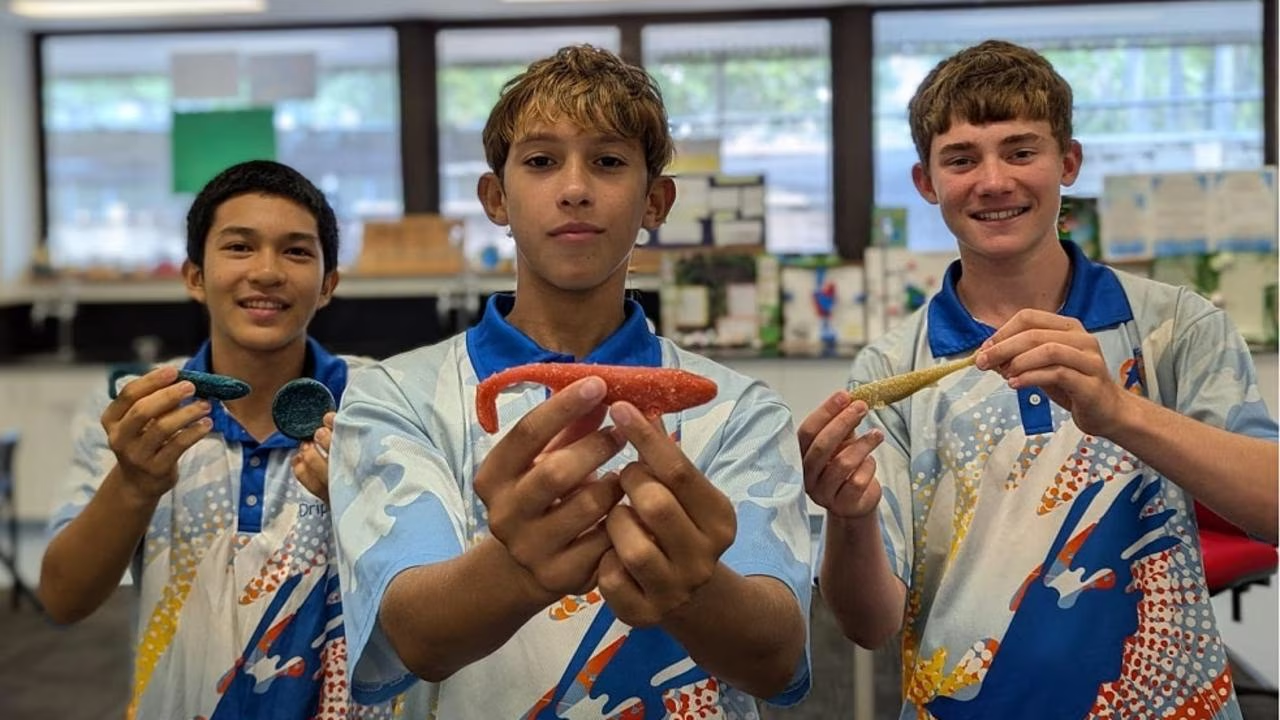
Gelatin, glycerin, and water formed the base of a small flexible lure, molded to mimic the plastic models found in fishing stores.
Biolures won a scientific competition in Australia
The project, called Biolures, was developed by Tye, Kian, and Khadim, students of Dripstone Middle School.
The invention received two awards at the Territory Young Scientists Awards and then won the Agriculture, Fishing, and Food category at the ASTA i3 Awards, an Australian scientific competition.
The story gained a new chapter in the 2025-2026 cycle of the award.
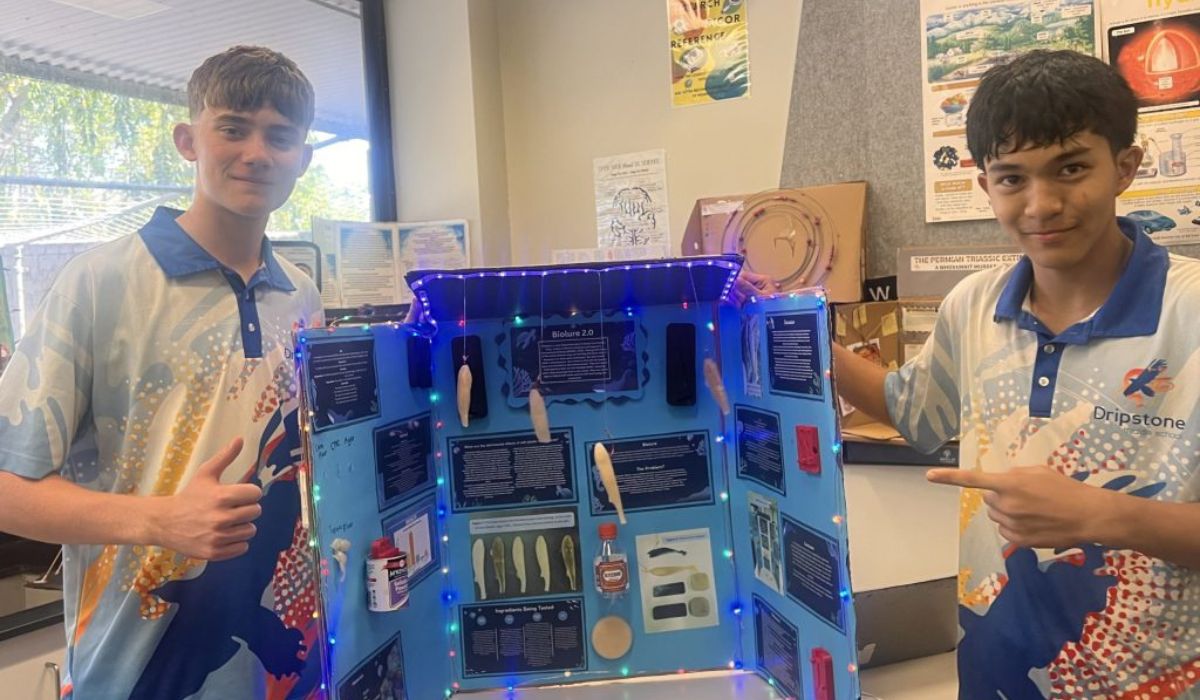
Khadim and Tye returned to the ASTA scientific portal alongside another student, Arsenii, with BioLure 2.0, a version created to solve a weakness discovered in the initial tests: the original lure disintegrated too quickly during use.
The team began experimenting with new ingredients to increase water resistance without abandoning the proposal to produce a degradable material.
Kian does not appear among the authors of this second stage in the public documentation consulted.
Fishing in Darwin inspired an alternative to plastic
The initial idea was born from a very common activity in the region where the teenagers live.
Darwin is surrounded by coastal areas, rivers, and places used for recreational fishing.
The students themselves presented in the report as fishermen interested in finding an alternative for the soft baits lost or discarded in the water.
These conventional baits are usually made with flexible polymers that allow the creation of tails, shapes, and movements similar to those of small aquatic animals.
The malleability helps during fishing, but also hinders the rapid degradation of the object when it is abandoned in the environment.
A scientific study published in 2024 analyzed 16 commercial models of soft baits and found that ten released plasticizers, including certain phthalates, during 61 days of observation in the water.
The study treated these baits as a possible source of chemical pollution and highlighted the need for further investigations on their environmental effects.
How the biodegradable baits were produced
The teenagers decided to try to reproduce some characteristics of plastic without using the same composition.
Gelatin provided firmness and helped form the body of the bait.
Glycerin had the function of balancing rigidity and flexibility, preventing the material from becoming too hard right after leaving the mold.
Water allowed mixing and heating the ingredients before molding.
Dye could be added to change the appearance, while fish oil appeared as an optional component to create smell and try to increase the bait’s attraction.
The process recorded by the students began with measuring the ingredients.
After being heated and mixed, the solution was placed with a syringe into a mold in the shape of a bait.
The material remained there for two or three hours until it cooled and acquired enough consistency to be removed.
Formula needed to balance firmness and flexibility
Reaching the desired texture required several combinations.
The students compared different proportions of gelatin, glycerin, and water, observing firmness, elasticity, appearance, softness, and storage time.
Among the three formulas tested in the initial stage, the proportion of five parts gelatin, three parts glycerin, and two parts water received the highest evaluation from the group.
The result, however, was mainly based on the authors’ own observations, rather than a broad laboratory comparison with commercial brands.
The students acknowledged in the report that evaluations from a larger group of fishermen could make the test more accurate.
Therefore, the claim that Biolures “work like plastic ones” needs to be understood within the limits of the school project.
The prototypes were designed to mimic the shape, flexibility, and movement of conventional soft lures, but did not undergo independent trials to prove equivalent performance in durability, catch quantity, or different fishing conditions.
Prototypes managed to catch fish
Even so, field tests showed that the idea could fulfill its basic function.
Tye stated that the group had caught some fish with the lures and was still trying to record new fishing trips on video to gather more evidence.
“We have already caught some fish with them, but we are trying to get footage to have more proof,” said the student, in a free translation.
Decomposition period is still an estimate
The approximately two-week decomposition period also came from the students’ report.
“If the lure gets stuck, after some time, about two weeks, it should decompose and disintegrate,” explained Kian, in a free translation.
The original report itself, however, indicated that more detailed tests would still be needed to know how long the lure would last submerged and to determine more precisely the period required for its complete degradation.
Thus, the two weeks should be presented as an estimate from the creators, not as a period validated by an independent study at sea.
Resistance during casting became a new challenge
The rapid decomposition created another challenge.
A lure that disappears when lost can reduce the persistence of debris in the water, but it needs to withstand enough time during casting, impacts, and retrievals made during fishing.
In the initial version, the material was able to reproduce the desired texture but broke after a few throws.
The BioLure 2.0 report states that the first formulation withstood approximately two to four casts.
In the most recent test, the model used as a control withstood five.
BioLure 2.0 received new ingredients
To increase this durability, the new team separately added different thickeners and stabilizers to the formula.
Tapioca flour, cornstarch, agar, xanthan gum, and carboxymethylcellulose, known by the acronym CMC, were evaluated.
Each lure was attached to a hook, cast into the water, and retrieved repeatedly until it broke or detached.
The group tried to keep the distance, drop height, retrieval speed, and water temperature the same.
Tapioca flour showed the best result: the lure withstood 39 casts, compared to five for the control model.
Cornstarch reached 17, CMC eight, xanthan gum six, and agar two.


