





Porous carbon structure coated with vanadium oxide expands the area available for storing energy, but technology remains a laboratory prototype mainly aimed at stationary storage
Researchers led by the University of California, Los Angeles (UCLA) have developed a 3D-printed electrode that allowed a zinc-ion hybrid device to store more than seven times the charge of similar technologies. After 1,500 cycles, the prototype still retained 82% of its initial capacity.
The advancement was presented in the study published in the scientific journal Small. The device combines characteristics of batteries and supercapacitors and was designed as a potential alternative for applications that require fast recharging, high power, and long operational life.
Although often presented as a “3D-printed battery,” only a central part of the device was directly produced by printing: the porous carbon electrode. After printing, the component underwent thermal and chemical treatments and received vanadium oxide.
-
The first clear photograph of a total solar eclipse was taken 175 years ago by a man almost forgotten by history: captured during an 84-second exposure, the image revealed the Sun’s faint corona and paved the way for studies that today help understand solar storms and damage to satellites.

-
Three teenagers mixed gelatin, glycerin, and water to create fishing lures that work like plastic ones. They managed to catch fish in tests and made the material disappear in about two weeks when left in the sea, winning two local awards and a national science competition in Australia.
-
Three teenagers mixed gelatin, glycerin, and water to create fishing lures that work like plastic ones. They managed to catch fish during tests and made the material disappear in about two weeks when left in the sea, winning two local awards and a national science competition in Australia.
-
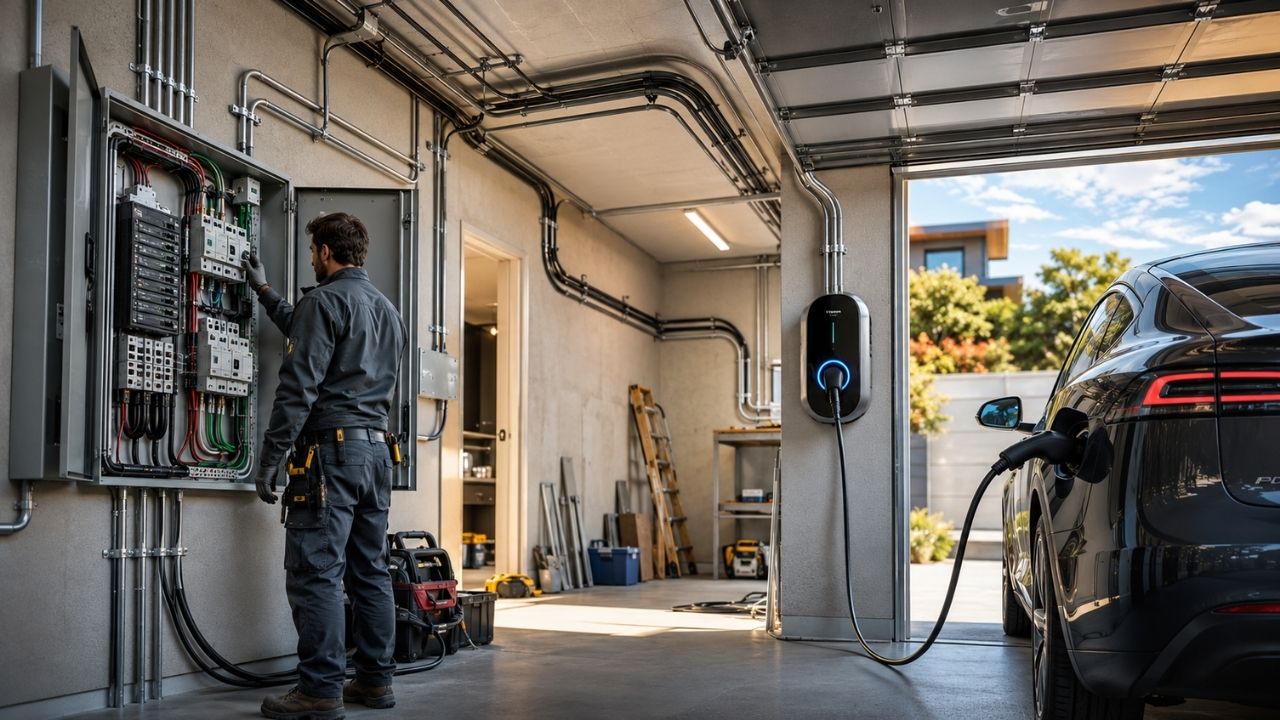
How much does it cost to install an electric car charger in the garage in 2026 and why cables, protections, load increase, and the distance between the parking space and the panel can raise the budget from R$ 4,000 to more than R$ 15,000?



Printed structure increases area for storing charge
The electrode was designed with an internal structure similar to a honeycomb or sponge, formed by a large number of small cavities. This architecture increases the area available for the reactions responsible for charge storage and facilitates the transport of ions through the material.
According to the official release from UCLA, the structure was initially produced with a liquid resin that hardens when exposed to ultraviolet light. The component was later subjected to heating and gas treatment, a process that left an open network of conductive carbon.
The researchers added vanadium oxide to the structure. The material acts in energy storage, while the pores expand the electrochemically active surface.
The internal area obtained was so high that, according to the university, one gram of the material would have, if fully extended, a surface equivalent to approximately ten tennis courts.
The developed device is hybrid. One of the terminals functions similarly to the storage component found in a traditional battery. The other uses a carbon electrode comparable to those used in supercapacitors.
Supercapacitors can charge and discharge quickly, but they usually store less energy because the charge remains mainly on the surface of the electrodes. The project tries to reduce this limitation by significantly enlarging the internal surface and incorporating vanadium oxide.
Prototype achieved 82% retention after 1,500 cycles
The electrode presented an active material charge of 38 milligrams per square centimeter. In tests, it achieved an areal capacitance of 7,129 millifarads per square centimeter, measured under a current of 3 milliamperes per square centimeter.
The areal energy density reached 1 milliwatt-hour per square centimeter, while the power density reached 44 milliwatts per square centimeter. After 1,500 charge and discharge cycles, the device maintained 82% of its capacity.
The result of seven times more charge refers to the comparison with other similar hybrid devices. The study does not claim that the prototype stores seven times more energy than a commercial lithium-ion battery.
The technology was also not presented as an immediate replacement for automotive batteries or the systems used in cell phones. Maher El-Kady, one of the corresponding authors, stated that different technologies should complement each other in large-scale energy storage.
The group considers that zinc-based devices can be studied mainly for power grids and renewable energy storage. However, no commercialization timeline, price per kilowatt-hour, or results obtained in industrial-sized modules were disclosed.
Test cell was also produced with 3D printing
In addition to the electrode, the scientists developed a 3D-printed test cell to improve the accuracy of measurements conducted in the laboratory.
The equipment has a sealed lid, which reduces electrolyte evaporation, and fixed spaces to keep the electrodes always at the same distance. In open systems normally used in research, changes in the position of components and evaporation can interfere with results.
The scientific summary reports that standardized electrodes tested in the new cell retained 98% of their capacity after 1,400 cycles. UCLA’s disclosure mentions 1,500 cycles for the same test.
According to the specialized publication 3D Printing Industry, the test cell can be adapted by other laboratories with access to 3D printing, allowing more consistent evaluations of new materials.
Research brings together scientists from the United States and Taiwan
Sophia Uemura is the first author of the work. Maher El-Kady and Richard “Ric” Kaner appear as corresponding authors. The study brings together researchers from UCLA and the National Tsing Hua University in Taiwan.
The project received funding from a University of California grant aimed at climate actions, from the company Nanotech Energy Inc., and from the Dr. Myung Ki Hong Chair in Materials Innovation.
The results demonstrate the performance of an experimental prototype, not a ready commercial battery. Scale manufacturing, full costs, durability outside the laboratory, and operation in real systems will still need to be evaluated.


