





 Portuguese
  English
  Spanish
  6 min of reading
  0 comments


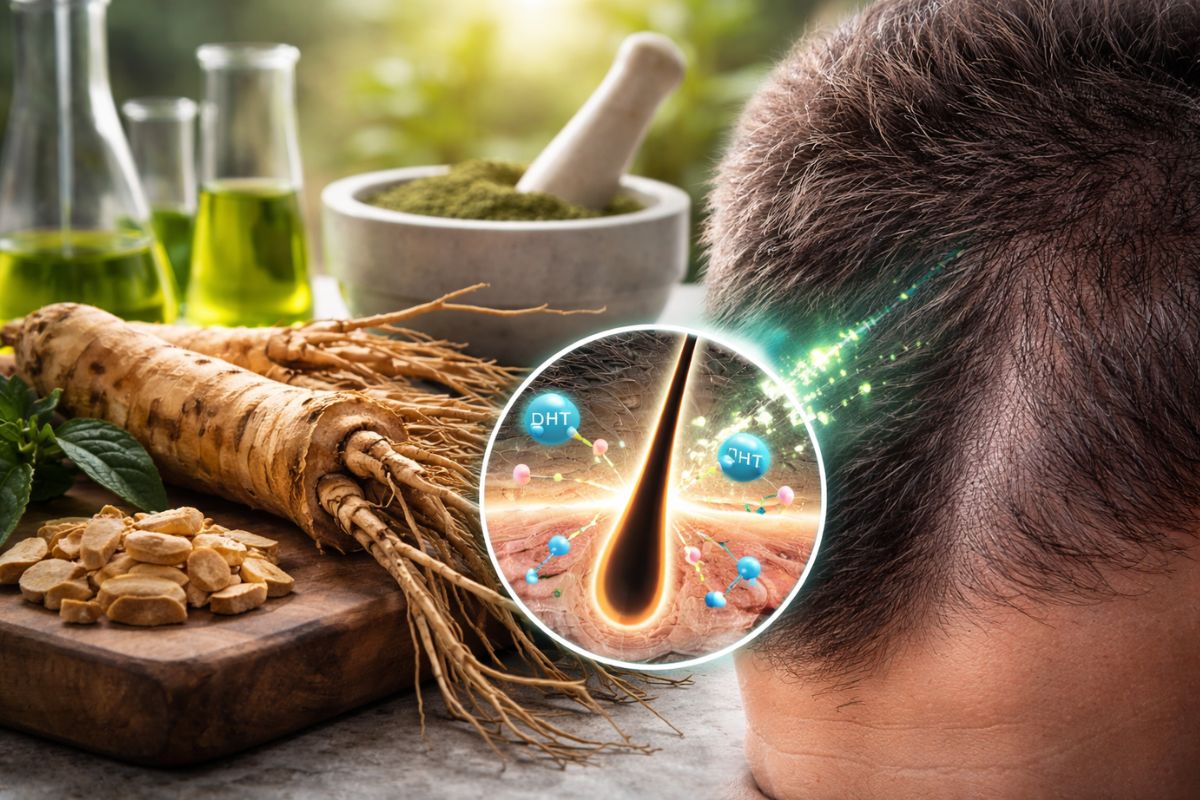
Before Switching Baldness for Implants, Researchers Analyzed the Polygonum Multiflorum, the He Shou Wu, Cited for Centuries in Chinese Herbal Medicine. The Study, Published in the Journal of Holistic Integrative Pharmacy, Describes a Comprehensive Multitasking Action: Reducing DHT, Protecting Follicles, Activating Growth Pathways, and Improving Circulation in the Scalp.
Androgenetic baldness, the most common form of hair loss, often pushes many people straight to definitive solutions like implants, especially when the thinning of the hair starts to become visible on the top of the head and at the hairline. But science is also running in another direction: understanding what actually changes within the follicle before it “gives up” on producing a strong hair.
A study published in the Journal of Holistic Integrative Pharmacy indicates that the Polygonum multiflorum, known as He Shou Wu, may act on mechanisms related to hair regrowth, including reducing the action of DHT, protecting the follicle and stimulants related to growth. The promise is not immediate, but the investigated path is noteworthy precisely because it tries to tackle the problem from more than one angle.
The Ancient Root That Returned to the Laboratory
The He Shou Wu is a root native to East Asia, used for over a thousand years in traditional Chinese medicine in formulas associated with rejuvenation and strengthening.
-
Four humans are flying towards the Moon inside the Orion capsule launched by the SLS rocket, and on April 6, Artemis II will disappear behind the far side of the Moon without communication with Earth for nearly an hour.

-
Worlds covered by water, atmospheres filled with hydrogen, and the possibility of life beyond Earth: ocean planets are rewriting the map of cosmic search and forcing scientists to rethink where to look.

-
Argentina achieves the unimaginable after more than 110 years and reintroduces the largest native herbivore of South America to the Chaco to restore a lost link in nature.

-
Returning to the Moon now costs a billion-dollar bill and reignites the competition between the USA and China for science, technology, and rare minerals on lunar soil.


The historical reputation does not prove efficacy, but it helps explain why researchers continue to scour this type of ingredient in search of biologically active molecules.
In the cited study, the Polygonum multiflorum is described as being rich in antioxidant and bioactive compounds, such as emodin and tetrahydroxystilbene glycoside (TSG).
The scientific logic behind this is straightforward: if certain compounds can influence cellular pathways and reduce oxidative stress, there may be room for effects in the microenvironment of the follicle, where the hair is born, grows, and renews itself. This is where the conversation shifts from folklore to testable hypothesis.
Why DHT Becomes the Villain in Androgenetic Baldness
DHT (dihydrotestosterone) is a hormone derived from testosterone and is frequently associated with the process of follicle miniaturization in androgenetic baldness.
In simple terms, when this thinning progresses, the hairs tend to grow increasingly thinner, with smaller diameter and shorter growth time, until the scalp begins to show areas of noticeable thinning. It’s not a “loss” overnight: it’s a shortening of the hair cycle.
This cycle has phases, and the anagen phase is the active growth stage of the hair. What the study describes, within the proposal of the He Shou Wu, is the possibility of prolonging this growth phase and, at the same time, reducing biological pressures that push the follicle into a “shrinking” state.
For those considering implants, this explanation matters because it repositions the decision: it’s not just about “putting hair”, but understanding if the scalp environment is favoring or sabotaging the hairs that still exist. Implants resolve appearance; the mechanism tries to change the terrain.
What the Study Describes About He Shou Wu in the Hair Follicles
According to researchers associated with Guangdong Pharmaceutical University, the Polygonum multiflorum would have a central feature: acting on multiple biological mechanisms simultaneously.
This includes, according to the article’s description, reducing the action of DHT, protecting hair follicle cells from premature death, activating biological pathways related to hair growth, and improving blood circulation in the scalp. It’s a “multi-target” approach, different from the standard of a single key for a single lock.
This combination, still according to the analysis presented, could prolong the anagen phase and even stimulate the emergence of new hairs, something that conventional treatments rarely achieve consistently. Here, the more prudent reading is worthwhile: “could” is the word that carries the weight of the current evidence stage.
Even so, the hypothesis is clear: if you reduce the strength of a factor that weakens the hair (DHT), protect the follicle, and improve local conditions, a window opens to recover density and thickness in some of the hairs before resorting to implants. The point is not to replace decisions, but to improve the map of options.
What Changes in Comparison with Finasteride, Minoxidil, and the Route of Implants
The study contrasts this potential “multi-mechanism” with traditional drugs like finasteride and minoxidil, described as agents that act at more specific points and can be associated with side effects.
In practice, the suggested difference is conceptual: while traditional strategies may target one stage of the problem, the investigated root would attempt to manipulate several gears at once, from hormone to follicle, from growth pathway to circulatory support. Such a comparison is noteworthy, but does not solely close the question.
For those on the threshold between persisting with treatments and opting for implants, this type of finding often raises two very human questions: “Who is studying this?” and “Why now?”.
The “who” is indicated in the study’s own report (researchers linked to a pharmaceutical university), and the “why” is almost inevitable: androgenetic baldness is common, affects self-esteem, and has a huge market of solutions, but there is still frustration with limits, maintenance, and variable results.
When a path promises to address the biological root of thinning, it becomes headline news even before it becomes consensus.
What Still Needs to Be Proven and Why Caution Is Part of the Story
The authors themselves highlight that the research is in the phase of laboratory tests, gathering data from experiments, clinical observations, and historical records from Chinese herbal medicine.
This positions the topic in the right place: a promising signal, but still far from becoming a universal recommendation, especially for those expecting something “as certain as” implants or already standardized interventions.
The “how well it works” has yet to be answered with robust clinical trials in humans.
There is also a direct warning: improper use of the herb can cause toxic effects, especially hepatic, when consumed without proper traditional preparation. This detail completely changes the tone for anyone thinking of “trying it on their own”.
Even when an ingredient has a history of use, safety depends on the method of preparation, quality control, and, above all, dosage, and the study itself emphasizes that clinical trials are still needed to determine safe doses. Caution here is not bureaucracy: it’s protection.
The idea of “forgetting implants for a moment” does not mean dismissing implants, but rather opening up space for a more complete reading of what is being investigated: an ancient root, with bioactive compounds, trying to act where androgenetic baldness truly begins, in the progressive weakening of the follicle, in the role of DHT, and in the pathways of hair growth.
It’s a story of potential, not a ready promise, with a central point that the study itself reinforces: there is still a lack of clinical tests in humans and definitions of safe dosing.
So, looking at the options between continuous treatments and implants, what weighs more for you: safety, cost, time for results, fear of side effects, or the desire to solve it once and for all?
Let us know in the comments what path you consider more realistic and why, and if you have had any experience (good or bad) trying to deal with androgenetic baldness in your day-to-day life.









Seja o primeiro a reagir!