





 Portuguese
  English
  Spanish
  9 min of reading
  1 comment


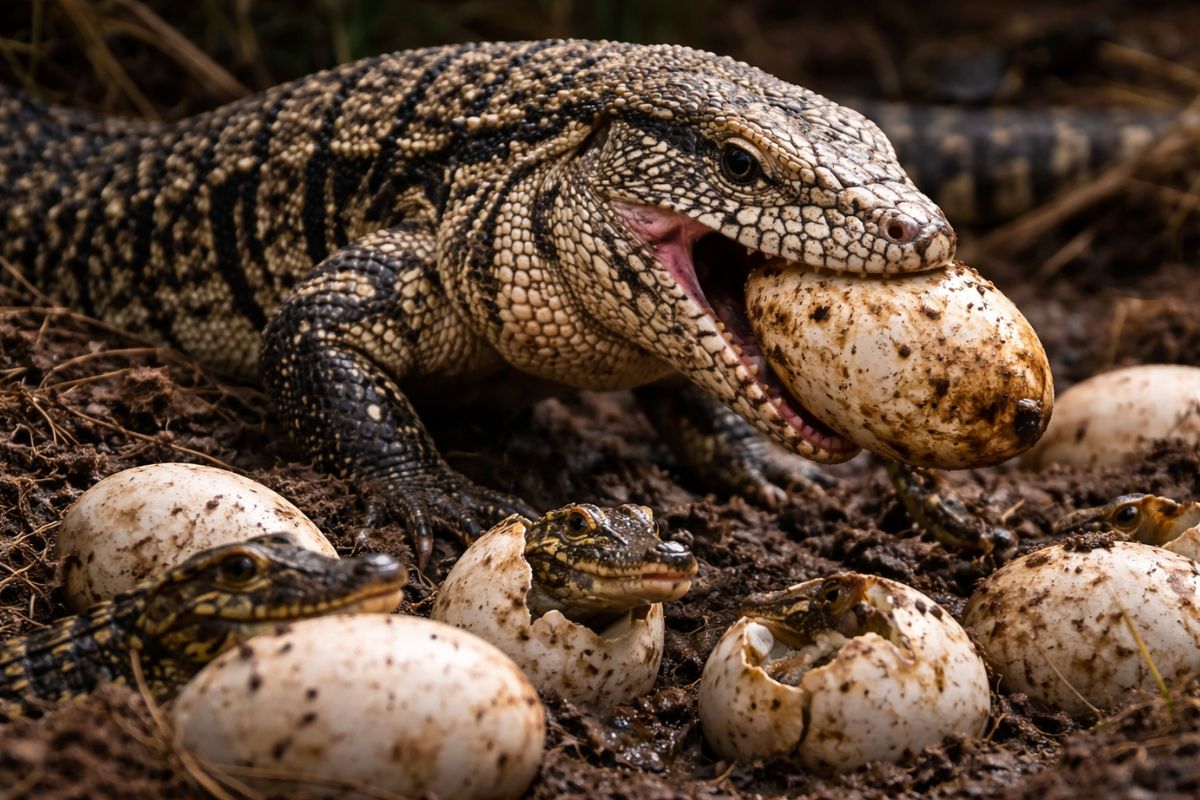


In Five Years, The Argentine Tegu Lizard Grew 250% And Spread To At Least Six States. In A County Of 2 Thousand Inhabitants, It Has Already Passed 3 Thousand Individuals. In The Everglades, It Devours Eggs And Knocks Down Trees, Leaving Native Species With Almost Zero Survival And Conservation Valued At US$ 10 Million.
An invasive lizard is advancing through the United States at a speed that already worries ecologists: in five years, the population skyrocketed by 250% and the animal spread to at least six states, showing up in backyards, invaded farms, and fragile natural areas, always leaving traces of destruction.
In Florida, the impact turned into a maximum alert when surveys indicated that 97% of turtle nests were completely destroyed in just one season, a scenario that prompted the creation of multiple conservation programs valued at US$ 10 million and exposed a decline in the survival of native species to almost zero in protected areas.
The Explosion Of The Tegu Lizard And The Advance Beyond A Single State

The growth has not been restricted to an isolated point. In five years, states have recorded a 250% increase in an invasive reptile species, expanding to at least six states.
-
Sprinkling dry baking soda directly on the carpet neutralizes odors from sweat and food without wetting the fibers, allowing you to forget about the vacuum cleaner for weeks using a product that costs less than five reais.

-
A bottle thrown into the sea by two Australian soldiers in 1916 on their way to the trenches of World War I was buried in the sand for over 100 years, and the letters inside it were still legible when they were found.

-
China invests over R$ 4.2 trillion, builds the largest water network in the world with 95,000 reservoirs and 1 trillion m³, expands piped water access to 96% of rural areas, attracts R$ 565 billion in foreign investments, and advances with the “longevity gene” in rice.

-
Heineken’s factory in Brazil surprises the world by reducing water consumption for beer production from nearly 10 liters to just 2.2 liters per liter produced, achieving a 23% decrease with real-time technology.


In a small county with about 2,000 people, there was a period when the animal population exceeded 3,000 individuals, a reversal that turned the lizard into a daily presence, even in urban and rural areas.
Reports include sightings in backyards and farms, with the lizard roaming and causing destruction everywhere.
The pattern suggests that the invasion is not being contained merely by spot surveillance, because the advance is occurring in both natural areas and spaces occupied by people, increasing the chance of frequent contact and multiplying damages.
Size Is Deceiving: The Lizard Grows Like A Dog And Eats Almost Everything

The Argentine tegu lizard does not behave like the “small lizard that disappears in a blink of an eye.” It can reach 1.2 meters in length and weigh almost 5 kg, with thick legs, strong jaws, and a powerful tail, plus enough strength to climb brick walls. The danger is not just in size but in its entire set of survival skills.
In feeding habits, the lizard is described as opportunistic and aggressive: it eats anything it can overpower, from turtle eggs and birds to poisonous frogs.
Recorded prey includes sea turtle eggs, American alligator eggs, the threatened gopher tortoise, young birds, rats, squirrels, frogs, native lizards, small snakes, fruits, seeds, and even carrion. When the target is an egg, the destruction becomes extreme and quick.
Why Nests Become Primary Targets And How 97% Can Disappear In One Season

The lizard’s focus on eggs alters the dynamics of the ecosystem because it does not only target individuals, but the replenishment of entire populations.
An adult can eliminate up to 20 nests per year, and just 5 to 10 individuals can wipe out a complete nursery of a species. On Florida beaches, reports indicate that 70% to 97% of turtle nests are destroyed in a single season.
This kind of loss is even more severe when considering that a sea turtle can take 20 to 30 years to reach maturity, while a nest can be completely consumed by the lizard in just a few minutes. In practice, it’s a slow extinction: adults still appear, but the next generation does not arrive.
Partially Warm Blood And Cold Tolerance Expand The Lizard’s Territory
One of the most unusual points attributed to the lizard is its ability to be partially warm-blooded during the breeding season. In mentioned studies, it can elevate its body temperature by 5°C to 10°C above the environment during this period, something rare in reptiles, which generally depend entirely on sunlight to function.
This advantage accelerates the development of eggs and anticipates the birth of hatchlings by 7 to 14 days, which pushes population growth at a doubling and re-doubling rate. Additionally, there is confirmation of consistent survival in Georgia and South Carolina even with winter temperatures close to 0°C, because the lizard hibernates for 40 to 100 days and digs burrows 1 to 2 meters underground, retaining enough heat to avoid freezing.
Intelligence Above Expected: The Lizard Learns, Remembers, And Evades Traps
The lizard has also been associated with clear REM sleep cycles, a type of sleep linked to memory processing and previously observed typically in mammals and birds. The behavioral consequence is direct: it learns, remembers, and adapts faster than most reptiles, which helps explain why it avoids traps after only one or two encounters and changes routes when sensing danger.
Experiments at the University of Tennessee indicated that it recognizes colors and objects two to three times faster than box turtles and rattlesnakes, two species often cited as intelligent among reptiles. In practice, the lizard opens simple chicken coop latches, knocks over trash cans, climbs wire fences, and finds hidden food, with farmers reporting that traps set today are “beaten” tomorrow because the animal changes its path.
There are also mentions of unusual behavior in reptiles: some individuals learned to travel along hot asphalt roads to cover distances of several dozen kilometers, something more associated with nocturnal mammals like foxes and coyotes. The result is an invader that not only enters the system but adjusts its own behavior to evade control.
The Scissors Effect With The Burmese Python And The Collapse In Layers Of The Ecosystem

In the Everglades, the lizard arrived at a time when another invasive species had already been causing damage for almost 20 years: the Burmese python. The overlap was likened to a scissors pulling a leaf from opposite ends, as each invader “cleans” a different layer.
The python, measuring 4 to 6 meters, specializes in large prey, such as rabbits, opossums, raccoons, fawn, and even alligators.
Cited studies indicate that, in some areas, populations of rabbits and opossums fell by nearly 100% within a few years after the arrival of pythons. Meanwhile, the lizard targets eggs and birds that nest on the ground, directly affecting the reproductive layer. When adults vanish from one side and reproduction disappears from the other, the ecosystem loses its ability to recover.
The impact becomes visible in previously common species that have nearly disappeared, and in ground-nesting birds such as quails and blue jays, with reported declines of 40% to 60%. It’s the kind of damage that seems silent at first and explodes when nest surveys reveal near-total losses.
Beyond The Eggs, The Lizard Disturbs The Soil, Knocks Down Banks, And Attracts Problems
The damage is not limited to predation. By digging burrows up to 2 meters, the lizard alters the soil structure, makes bank sand collapse, cuts plant roots, changes vegetation patterns, and also creates shelters that attract rodents. This displacement of rodents to burrows increases disease risk and amplifies indirect effects.
Practically, the lizard not only eats, it dismantles the foundation of the environment, creating conditions for new chains of impact, with loss of soil stability and changes in space usage by other species.
How The Lizard Arrived: Pet Trade, Releases, And Mass Escapes
The origin of the invasion has been associated with the trade of exotic pets. For more than two decades, the U.S. has been one of the largest consumer markets for reptiles, and there are data indicating that between 2000 and 2015, up to 79,000 live lizards were imported, not counting those bred domestically for trade.
Initially, they were seen as cheap and “easy” exotic pets, with young ones costing between 50 to 150 dollars. The problem is that the lizard which was 15 to 20 cm at purchase grows quickly and turns into an animal over 1.2 meters, weighing 4 to 7 kg, eating large quantities and escaping enclosures. By entering adulthood in 8 to 12 months, faster than many reptiles, costs shoot up and many owners release the animal into the wild.
After the pandemic, there was a sharp increase in abandonments in 2020 and 2021, with rescue centers in Florida recording hundreds of cases per month, in addition to many unreported ones.
Another factor came from commercial breeding facilities in Florida, considered central to the reptile trade in the country: after hurricanes and floods, especially between 2017 and 2020, enclosures were flooded and hundreds escaped, already adults and adapted to warm, humid environments.
The multiplying effect is clear in a described scenario: just 10 females escaping in the same area can, with a rate of 20 to 34 eggs per year, lead to a population of thousands within five years, even exceeding the human population of a small town.
The Portrait Of “Lizard City” And The Lack Of Natural Predators
In Tattnall County, Georgia, nicknamed “Tegu Town” by local media, the town has about 2,000 residents, but since 2021 authorities have recorded more than 3,000 lizards within a 5 km radius. Residents report seeing the lizard running in backyards like a loose dog, sunbathing in front of houses, and crossing roads at noon without fear.
The advance gains strength because the lizard has almost no natural predators. American alligators can eat juveniles, but these cases are rare; coyotes have difficulty attacking adults due to their thick skin and quick reflexes; eagles occasionally catch juveniles, with little impact. Without predator pressure, reproduction becomes a machine turned on.
Combat Is Expensive And Yet The Lizard Learns To Evade
Authorities rely on public reports to locate individuals and then set traps, using infrared drones to scan dense vegetation and teams with trained dogs to track scent.
However, the lizard demonstrates the ability to outsmart the system: there are descriptions of individuals dropping their tails during pursuit, with the tail continuing to move and retain scent while the animal escapes, leading teams off course by hundreds of meters.
The most commonly used tools include pheromone traps and live capture traps. The University of Florida deploys 300 live traps per year inside and outside the Everglades, using chicken eggs as bait, but even this faces obstacles: 53 traps were reported stolen or dragged away by alligators in a mentioned year.
When a lizard is captured, it needs to be placed in two tightly sealed bags and locked in a rigid container with two locks, because there have been cases of individuals chewing through bags or forcing lids with their limbs. In 2020, the United States Geological Service recorded the capture of more than 900 individuals, the highest number cited, and graphs indicated a decline in the central population, but as a fragile reduction, far from real control.
It is estimated that the country spends more than 10 million dollars a year on this fight, including drones, dogs, field personnel, transportation, and legal processes.
Laws, Hunting Permitted On Properties And Ownership Bans
At the state level, Florida and Georgia have declared the humanitarian hunting of the lizard on private property legal, as long as the landowner gives permission. Still, it is not simple, because laws against animal cruelty and local regulations remain valid, creating a legal dilemma of “permitted but restricted.”
There is also an amnesty program for exotic pets in Florida, created because many exotic pets were being released into the wild.
Meanwhile, several states have begun to introduce bans on lizard ownership, with heavy fines for illegal possession, and rules stating that any individual captured in the wild must be destroyed, although the managers themselves admit that these laws affect more the future than undo what has already escaped in the last 10 to 20 years.
What Can Happen If The Lizard Continues To Advance And Why The 2030s Are Frightening
Models attributed to the USDA And The United States Geological Survey Sketch A Harsh Scenario: between 2030 and 2040, the lizard could expand its area to up to one-third of the United States, stretching from Florida to Texas, reaching north to Tennessee and crossing borders into Mexico and Central America.
The basis would be the same type of model previously used to predict the expansion of Burmese pythons and sea lampreys, with the natural barrier of cold becoming less effective in regions where the lizard has already demonstrated tolerance.
In this scenario, ecologists point to the risk of localized extinction of native species, with the loss of tens of thousands of nests per season for sea turtles and complete disappearance of some species in certain regions.
Therefore, there is an expectation that starting in the 2030s mere traps, scent dogs, or traditional manual capture will not suffice, requiring new ecological weapons, with artificial intelligence seen as the first line of defense to predict routes, reproduction, shelters, and critical points, in addition to land robots and automated traps. Another mentioned bet is a new generation of pheromone traps capable of attracting entire groups, not just individuals.
In practice, the lizard has ceased to be merely another invader and has become a limit test for conservation, agriculture, and wildlife control.
Do you think the U.S. can still contain this lizard with traps and enforcement, or has the invasion already crossed the point of no return?










Seems like an AI article, yes, it is an AI generated story, thanks.