





 Portuguese
  English
  Spanish
  7 min of reading
  0 comments


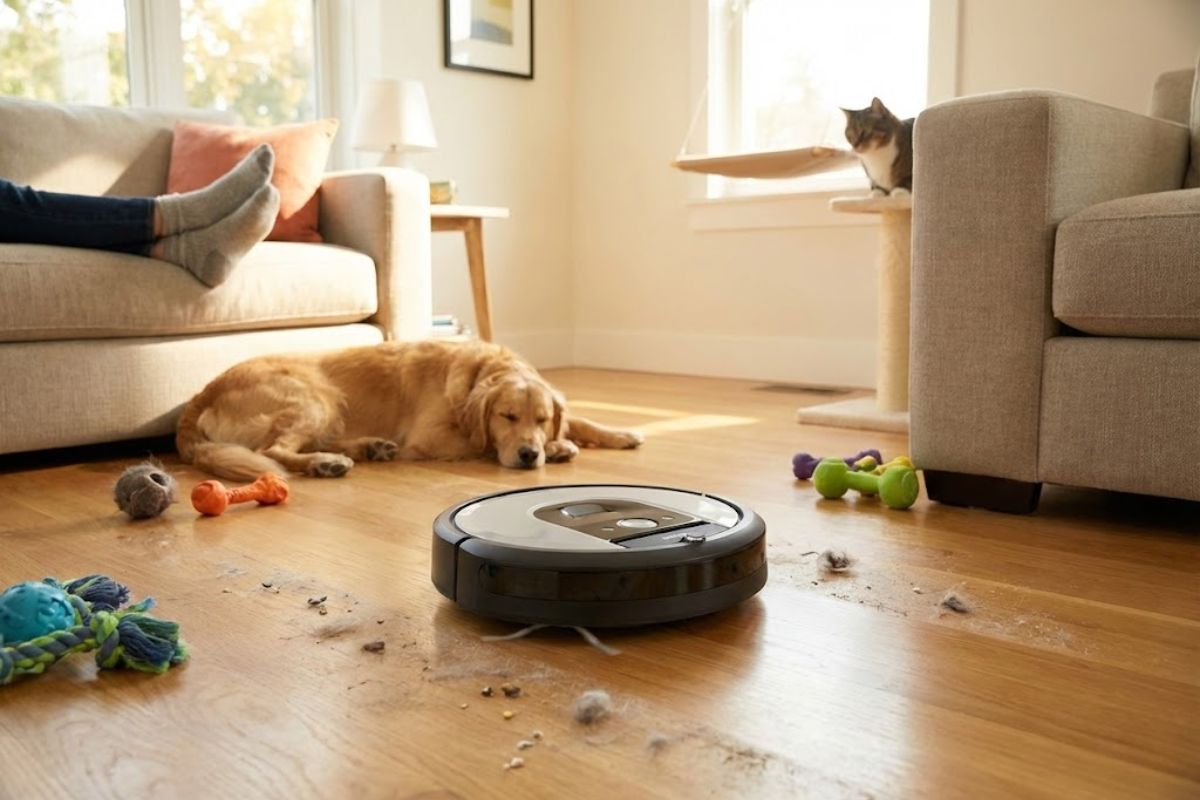
In a scenario of houses full of tasks and little free time, the vacuum robot emerges as automatic equipment capable of circulating alone, removing dust, hair, and crumbs from the floor and keeping the floor cleaner between heavy cleanings in apartments, homes with pets, and busy routines
The discussion about the vacuum robot gained new momentum by consolidating the device as one of the symbols of the smart home: it moves by itself through rooms, sucks up light dirt from day to day, and can work even when no one is home, as long as the routine and environment are minimally organized for it.
By transforming a repetitive task into an automated process, the vacuum robot promises to reduce the accumulation of dust, pet hair, and crumbs between heavy cleanings, especially on smooth floors. Still, it does not eliminate the need for a broom, mop, and traditional cloth, functioning as a frequent complement, not as a complete substitute for manual cleaning.
What Is the Vacuum Robot and How Does It Navigate the House

The vacuum robot is a cleaning equipment that moves by itself across the floor, guided by a set of sensors.
-
Beneath 25 km of ice, a moon of Jupiter hides an ocean with more water than all the seas on Earth and may have the necessary conditions to support life, according to studies supported by NASA.

-
The appliance that should cool your home may be driving up your electricity bill when installed with the wrong power, forcing the device to work harder and consume much more than necessary.

-
Airbnb now offers private car service to pick you up at the airport in 125 cities around the world with a fixed price and no extra fees: the platform aims to become a complete hotel within your smartphone.

-
Japan tests for the first time a hydrogen-powered engine for large cargo ships and achieves over 95% of the fuel’s energy at full load, paving the way to equip a 17,500-ton cargo ship already planned for 2027.


The suction usually occurs at the bottom of the device, combined with rotating brushes that push dirt toward the main entrance, where dust and debris are stored in an internal reservoir.
In simpler models, the vacuum robot follows random paths, changing direction whenever it encounters an obstacle, such as table legs, sofas, or walls, and backing up when detecting changes in height.
Drop sensors help prevent falls and stairs, reducing the risk of accidents, as long as the environment does not have holes or atypical gaps in the floor.
In advanced versions, the device creates a digital map of the house, using laser or camera, and starts following more logical paths, covering the area in parallel stripes instead of moving randomly.
In these models, the vacuum robot can autonomously return to the charging base, pause cleaning when the battery is low, and resume work from the point it stopped.
What Type of Dirt Can the Vacuum Robot Really Remove
In practice, the vacuum robot performs better with fine dust, hair, pet fur, crumbs from dry food, and debris that accumulate in daily life.
On smooth floors, such as porcelain, ceramic, and laminate, the result tends to be more uniform, with a sensation of a less rough floor to the touch and a visually cleaner appearance.
On low carpets, many models can suck up crumbs and fur, as long as the power is sufficient and the fabric is not too fluffy.
High carpets, heavy dirt, construction debris, large amounts of dirt, and liquids are beyond the scope of the vacuum robot, which is not designed for this type of waste.
In these cases, it is still necessary to resort to traditional vacuums, brooms, and wet cleaning.
Very narrow corners, deep crevices, and stairs are also weak points: the rounded shape of the vacuum robot makes it difficult to completely reach some baseboards and areas underneath very low furniture.
Therefore, it is common for it to be necessary, from time to time, to complement the work with a specific manual cleaning.
Advantages, Limitations, and Profile of Those Who Benefit Most
The main advantage of the vacuum robot is its frequency.
Instead of sweeping the floor every day, the resident can schedule the device to run at fixed times, even when away from home or sleeping.
With regular use, the tendency is for the house to accumulate less dust and fur, which can benefit those with pets and little free time.
Another convenience is the reduced effort. Having a vacuum robot does not eliminate the need for heavy cleaning, but helps reduce the frequency of this cleaning, as day-to-day life becomes less burdened by superficial dirt.
In small or medium apartments, with few obstacles on the floor, the practical gain tends to be more noticeable than in large houses crowded with furniture, carpets, and scattered objects.
Limitations appear in disorganized environments, with many cords, toys, and loose rugs. In this scenario, the vacuum robot tends to get stuck more often, requiring constant user interventions.
Moreover, people who expect the device to wash the floor, remove stains, or completely replace traditional cleaning will likely be frustrated with the results.
Basic Maintenance to Keep the Vacuum Robot Efficient
To maintain stable performance over time, the vacuum robot requires a simple maintenance routine.
Emptying the dirt reservoir regularly prevents suction drop and keeps the device from blowing dust back into the environment when it gets too full.
Another critical point is the brushes and filters.
It is necessary to remove hair, fur, and threads tangled in the brushes, especially in homes with pets, as well as cleaning or replacing filters as directed by the manufacturer.
Drop and proximity sensors must also remain free from dust to avoid the robot interpreting obstacles where there are none or failing to notice steps.
Stuck wheels, accumulated hair on axles, and small stones trapped in moving parts are common causes of extra noise and loss of efficiency.
A quick inspection after a few cycles of use helps identify these points and extends the lifespan of the vacuum robot, avoiding more expensive problems in the future.
Brands of Vacuum Robots Available in the Brazilian Market
In the Brazilian market, the vacuum robot already appears in catalogs from traditional appliance manufacturers and brands known for consumer electronics.
The reference base itself cites Xiaomi, WAP, Electrolux, Samsung, and iRobot as examples of companies that offer lines with different levels of features and prices.
In broad terms, the brands vary less in the idea of the vacuum robot and more in how they implement battery, suction, filters, and navigation software.
Some manufacturers focus their efforts on entry-level models, aimed at those who just want to reduce daily dust in small apartments.
Others invest in versions capable of mapping the house more accurately, integrating with apps and voice assistants, and managing multiple rooms in sequence, more suitable for intense smart home routines.
For consumers, this means that there is no single “best vacuum robot,” but a set of options with different focuses.
There are simpler models, designed for those who just want to keep the floor less burdened between heavy cleanings, and more complex models that try to cover larger areas, handle pet hair better, and provide cleaning reports via app.
The choice involves aligning brand, post-sale reputation, and a set of features with the type of flooring and the little time each family has for cleaning.
Price Ranges and What Changes from One Vacuum Robot to Another
In practice, the vacuum robot already appears in a quite wide price range in Brazil.
The reference itself indicates that it is possible to find basic models around 300 reais and advanced versions that exceed 4,000 reais, always depending on offers, the store, and the market moment.
Between these extremes, consumers find intermediate levels with different combinations of features.
In summary, the cheaper models tend to offer simple cleaning, more random routes, and lower autonomy, enough for small apartments with smooth flooring and without many obstacles on the floor.
As the price increases, features such as more precise mapping, the ability to use wet mops, integration with apps, control by voice assistant, and more elaborate filtration systems emerge, aimed at those living with a lot of pet hair or seeking to fit the vacuum robot into a more structured smart home.
At the higher price levels, the expectation is that the vacuum robot will deliver better build quality, more consistent suction levels throughout the battery life, more reliable sensors, and more durable software support.
For those with little time for cleaning and intending to use the device daily, the evaluation weighs less on the isolated price and more on the relationship between cost, features, property profile, and how much the device can actually reduce the need for heavy manual cleaning.
How to Choose the Ideal Vacuum Robot for Your Routine
When assessing a vacuum robot, the first step is to look at the predominant type of flooring, the number of carpets, and the presence of pets.
In environments with smooth flooring and few obstacles, intermediate models can already perform well for daily maintenance.
For homes with many animals and heavy shedding, it makes sense to prioritize higher power and specialized brushes for hair.
Features such as laser mapping, wet mopping, app control, and integration with voice assistants add convenience, but do not replace the basics: good suction, appropriately sized reservoir, and reliable sensors.
In many cases, a simple but reliable vacuum robot will be more useful than an advanced model poorly configured for the actual environment of the house.
In the Brazilian market, there are options for vacuum robots in different price ranges, from more affordable models to premium versions with multiple features.
The device tends to be more worthwhile for those with little time to clean, living with pets, and residing in small or medium apartments, where the total area is compatible with the battery autonomy and suction range.
Considering all of this, do you believe a vacuum robot would truly fit into your home routine, or do you still prefer to concentrate cleaning on more intensive manual cleanings on specific days of the week?








-

2 pessoas reagiram a isso.