





 Portuguese
  English
  Spanish
  4 min of reading
  0 comments


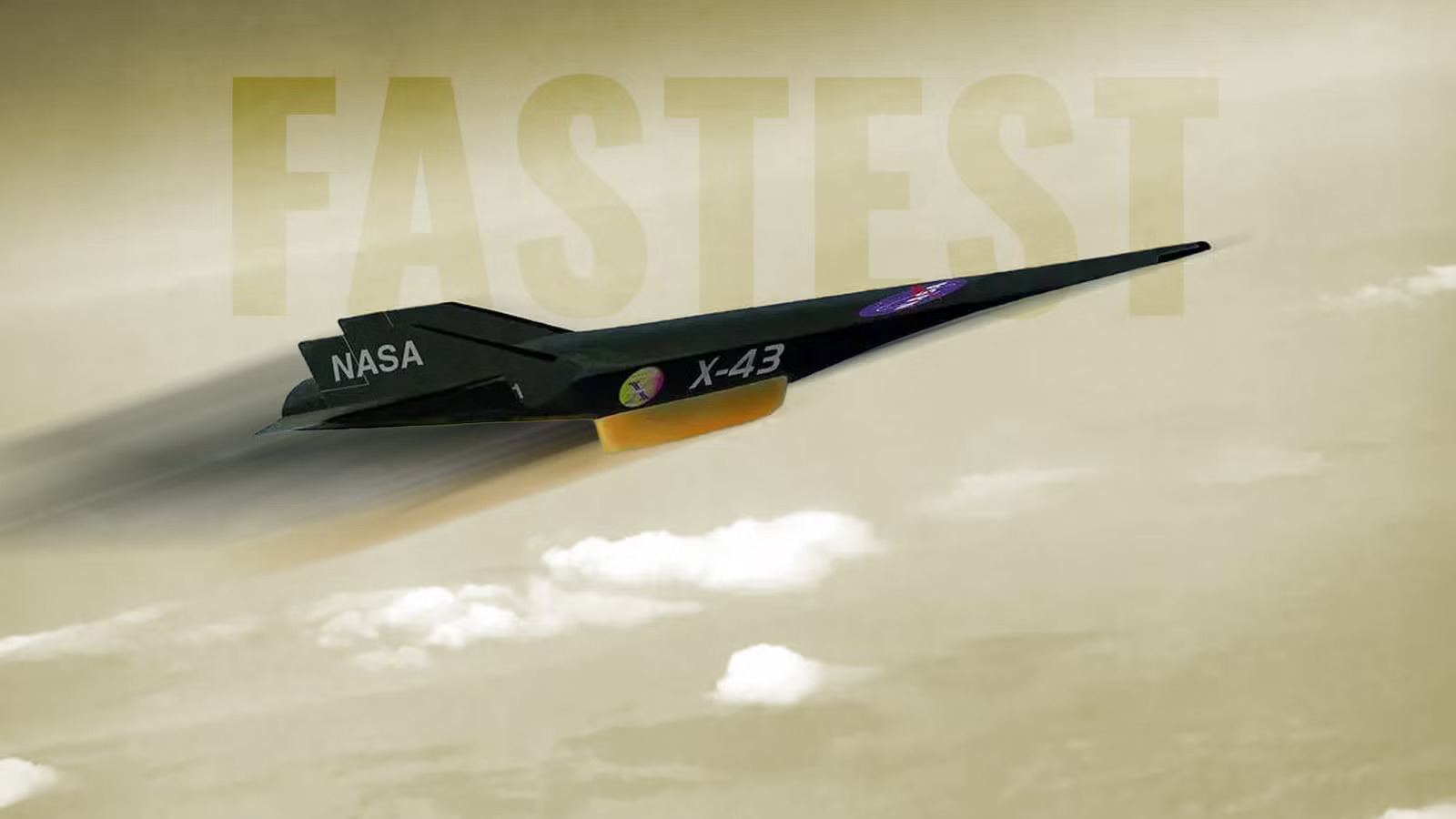
X-43A Reached Mach 9.6, Surpassed 10,800 km/h and Proved in Real Flight That Hypersonic Scramjet Engines Can Operate Using Atmospheric Oxygen.
The hypersonic flight ceased to be just a theoretical concept in the early 2000s when the United States managed to demonstrate, under real conditions, something that had existed only in wind tunnels and computational simulations for decades: stable combustion at speeds exceeding Mach 9 using oxygen from the atmosphere. The achievement was accomplished with the X-43A Hyper-X, an experimental vehicle developed under NASA’s hypersonic program in partnership with the United States Air Force.
Unlike fighters, missiles, or reusable aircraft, the X-43A was not designed for operational service. Its purpose was solely scientific and technological: to prove that the scramjet engine—one of the key components of atmospheric hypersonic flight—could function outside the laboratory, in a real environment, at extreme speeds.
What Is the X-43A Hyper-X and Why Was It Created
The X-43A was designed as a disposable technology demonstrator. At approximately 3.66 meters long, with an approximate mass of 1,300 kg, and a highly integrated shape with the engine, the vehicle had no landing gear, cockpit, recovery systems, or any intent for reuse.
-
Surrounded by the sea, the airport will have a system to prevent airplanes from falling into the water; technology will be installed in Ilhéus (BA), with an investment of R$ 70 million.

-
With a cost per shot close to zero, the DragonFire laser could change naval warfare in 2027 and provide British ships with nearly unlimited defense against drones.

-
A British startup creates tires that generate electricity in electric vehicles when passing over potholes, speed bumps, and cracks.

-
Scientists have created robots made with living cells that have their own nervous system, swim on their own, explore the environment, and self-organize without any genetic engineering, and now they want to do the same with human cells.


Each unit was built for a single flight. After completing its mission, typically a few seconds of hypersonic operation, the vehicle was lost in the Pacific Ocean. This approach allowed engineers to eliminate design trade-offs related to safety or reuse and focus exclusively on engine performance.
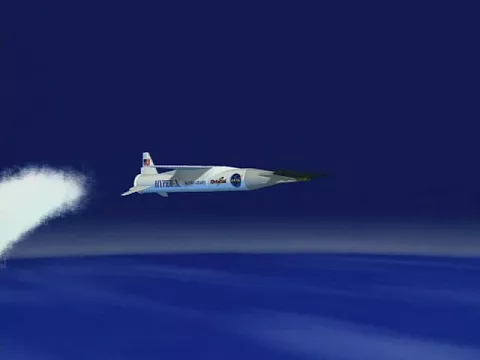

The great challenge was to validate the scramjet in real flight, something considered essential for any future atmospheric hypersonic system, whether military, scientific, or space-related.
How a Scramjet Engine Works at Hypersonic Speeds
The scramjet (Supersonic Combustion Ramjet) is a type of engine that has no moving parts. It does not use turbines, compressors, or fans. All air compression is obtained by the vehicle’s own speed traversing the atmosphere.
At speeds above Mach 5, the air entering the inlet is already extremely compressed and heated. In the scramjet, this air remains in supersonic flow within the combustion chamber, which differentiates it from conventional ramjets, where the flow is decelerated to subsonic.
In the X-43A, the fuel used was hydrogen, chosen for its high reactivity, allowing for efficient combustion even when the residence time of the air in the chamber is only fractions of a second. At hypersonic speeds, air traverses the engine in milliseconds, making ignition and flame stability critical challenges.
The Launch Profile of the X-43A and the Flight Sequence
The X-43A did not take off on its own. To achieve the speed necessary for the scramjet to operate, the vehicle followed a multi-stage launch profile:
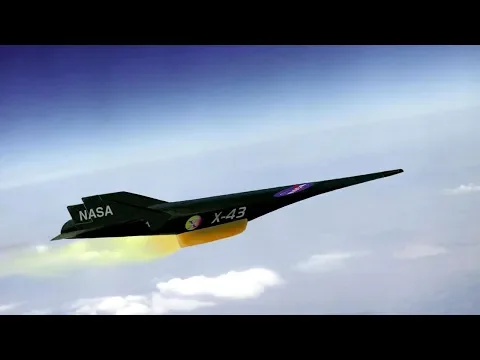
First, a B-52 bomber transported the assembly to about 12 km altitude. Then, the X-43A, coupled to a modified Pegasus rocket, was released. The rocket accelerated the assembly to speeds exceeding Mach 7 and took it to altitudes close to 33,000 meters.
Only after reaching these conditions did the X-43A separate from the rocket. At that moment, the scramjet was activated, initiating the most critical phase of the experiment: sustained hypersonic combustion in atmospheric flight.
The Historical Record: Mach 9.6 and Over 10,800 km/h
The most emblematic flight of the program occurred in November 2004. During this test, the X-43A reached Mach 9.6, equivalent to over 10,800 km/h, making it the fastest recorded jet-powered atmospheric flight to date.
The scramjet operated for about 10 to 11 seconds, a seemingly short time, but absolutely sufficient to validate:
– aerodynamic air compression
– stable fuel ignition
– generation of usable thrust
– aerodynamic control in hypersonic conditions
Before this flight, no country had managed to demonstrate, in a real environment, the sustained operation of a scramjet at such high speeds.
Why the X-43A Was a Game Changer in Hypersonic Technology
The success of the X-43A ended decades of uncertainty regarding the practical viability of the scramjet. Until then, critics argued that turbulence, thermal instabilities, and ignition problems would render the concept unworkable outside the laboratory.
The data collected by the Hyper-X program showed otherwise. It was proven that:
– scramjets are functional in real flight
– supersonic combustion can be controlled
– the engine generates usable thrust
– the concept is scalable for future applications
These conclusions directly influenced later programs, such as the X-51 Waverider, as well as military and space hypersonic projects in various countries.
Limitations of the X-43A and Why It Never Became an Operational Aircraft
Despite the technological success, the X-43A was never intended to become a functional aircraft. The use of liquid hydrogen, for example, makes direct operational applications unfeasible, due to the complexity of storage and logistics.
Moreover, the scramjet only operates efficiently above Mach 5, requiring auxiliary acceleration systems such as rockets. This makes the concept ideal for missiles, test vehicles, and space stages, but impractical for conventional airplanes.
The program also revealed structural challenges, especially related to extreme aerodynamic heating, which imposes severe limits on materials and the duration of hypersonic flight.
The Legacy of the X-43A in the Global Hypersonic Race
Even without generating a direct operational product, the X-43A has fundamentally changed the course of aerospace engineering. It demonstrated that atmospheric hypersonic flight is technically possible and paved the way for:
– long-range hypersonic missiles
– rapid access to space vehicles
– hypersonic reconnaissance platforms
– new propulsion architectures without moving parts
Today, the United States, China, Russia, and other countries are investing billions in technologies that have the X-43A as one of their main foundational milestones.








-

-

-

10 pessoas reagiram a isso.