





 Portuguese
  English
  Spanish
  7 min of reading
  4 comments


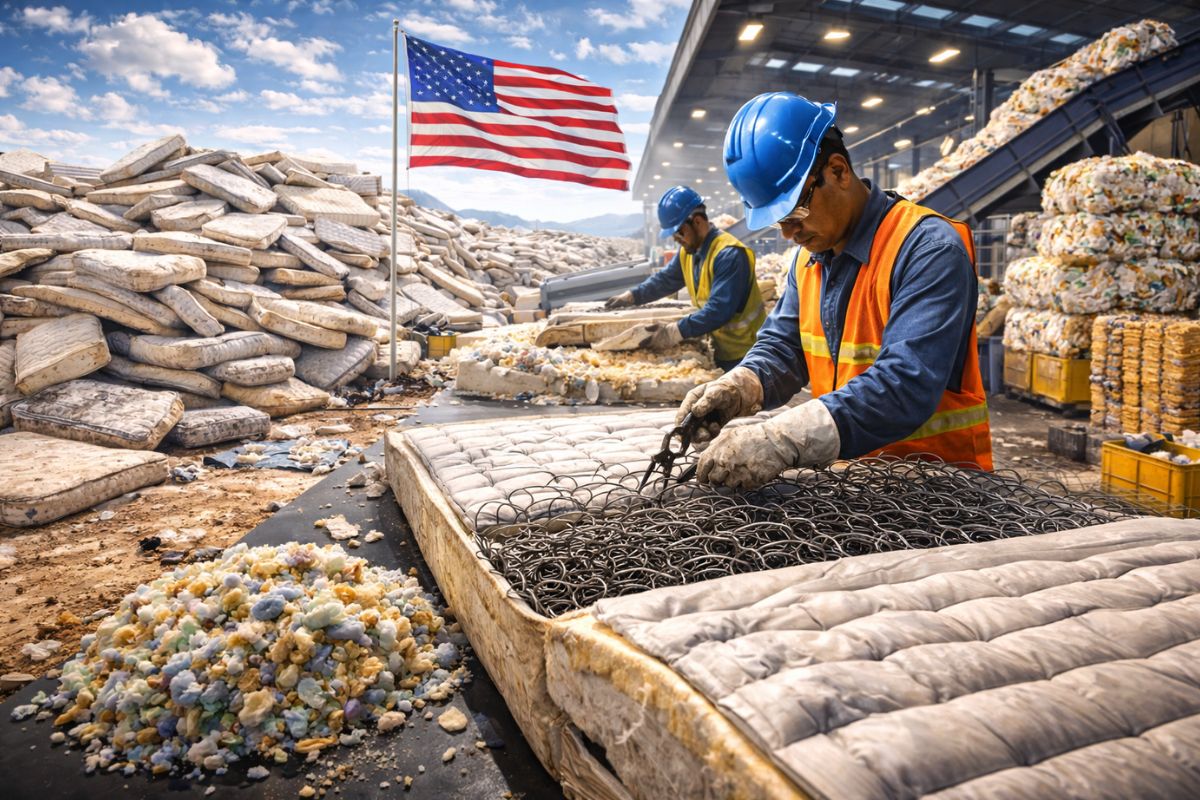


In the United States, Mattress Recycling Dismantles What Landfills Can’t Handle, Reuses Steel and Foam, Injects Value into the Circular Economy, and Shows How Mattresses in the United States Have Become a Business.
In the United States, over 20 million mattresses are discarded each year, clogging landfills, breaking heavy machinery, and creating a logistical nightmare. However, specialized factories have begun dismantling this bulky waste into steel, foam, jobs, and a billion-dollar business in the circular economy.
Every mattress that leaves a hotel, hospital, or home in the United States today carries an industrial secret: behind the dirty shell lies a treasure trove of steel and petroleum waiting to be reused, in an “industrial surgery” process that turns a massive environmental problem into valuable scrap, raw material for other sectors, and real relief for landfills.
Why the Modern Mattress Became a Landfill Enemy in the United States

In the past, a mattress was almost organic. Our grandparents slept on bags of straw, wool, or horsehair, materials that nature could decompose by itself. When that mattress ended up in a dump, the Earth could handle it over time.
-
Brazilian city bets on the business environment to generate jobs and attract investments in the energy sector — secretary reveals strategy at Macaé Energy 2026.

-
50 viaducts, 4 tunnels, 28 bridges, and 40 kilometers of bike paths: BR-262 in Espírito Santo will receive 8.6 billion reais for the largest engineering project in the state’s history, inspired by the Immigrant Highway in São Paulo.

-
Brazil produces too much clean energy and doesn’t know what to do with it: over 20% of solar and wind capacity was wasted in 2025 while investors flee and 509 renewable generation projects were abandoned in the last year.

-
Piauí will produce a new fuel that replaces diesel without needing to change anything in the truck’s engine and reduces pollutant gas emissions by half: truck drivers from all over the Northeast are already celebrating the news that will arrive later this decade.

Today, the story is different. The modern mattress that dominates bedrooms in the United States is a piece of industrial engineering.
Inside, it combines a tempered steel skeleton, layers of petroleum-derived foam, synthetic fabrics, and chemical fire barriers. It’s a mix designed to last for years in the bedroom, but it refuses to die in the landfill.
When this mattress arrives at a landfill, it doesn’t compress, doesn’t compact, and doesn’t break down easily. A single mattress takes up the space of dozens of compacted trash bags.
To make matters worse, the steel springs come loose, tangle in the machine axles, and destroy expensive equipment, jamming tractors and compactors that keep the operation running.
With over 20 million units arriving in landfills every year, the United States began to see mountains of mattresses piling up.
The landfills were overflowing, cities were spending more to deal with something that didn’t fit well into any traditional disposal process, and it became clear that the “throw it in the hole and cover it with dirt” model had hit its limit.
How Mattresses Start Their Journey Back Through the Economy
The turn did not come solely from environmental awareness. It came from a combination of law and money. New regulations pushed manufacturers and retailers to take responsibility for the end-of-life of mattresses, and economic logic began to see value where there was previously only cost.
In the United States, the journey of a recycled mattress usually begins far from the factory. Large hotels that change all rooms at once, university dormitories undergoing renovations, hospitals updating entire wings, in addition to regular homes replacing queen and twin mattresses.
In a single week, a hotel or a university can generate thousands of mattresses at once, creating a tsunami of volume that needs a quick destination.
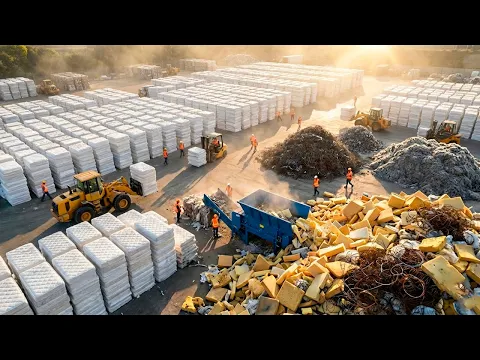
Gigantic trucks, designed to carry the maximum number of stacked mattresses, traverse roads and cities. When they arrive at recycling plants, the scene is impressive: entire yards covered with piles that seem to touch the sky.
Some factories in the United States receive thousands of units per day. To an outsider, it looks like chaos. For the engineers, it’s inventory, it’s raw material flow, it’s money waiting to be released.
Forklifts rush to organize the avalanche of mattresses. If the disassembly line stops, the piles grow so quickly that they can swallow the yard.
The order of priority is simple: keep the conveyor moving, because each stopped mattress takes up space, blocks logistics, and delays the chance to recycle steel, foam, and fabric.
In legislative documents in progress in Maryland, the estimate appears: 15 to 20 million mattresses are discarded annually in the U.S.
Industrial Surgery: Inside the Dismantling of Mattresses

Unlike other recycling chains, where shredders gulp everything at once, mattress recycling is almost mass surgery. The process is heavy, manual, and incredibly fast.
Inside the warehouse, the dominant sound is not metal, but rather the sound of fabric being torn. Workers with safety gear pull mattresses from the pile and take them to work tables.
The first step is to cut the “skin.” With sharp tools, they slice the outer fabric, like peeling a giant fruit.
In seconds, the interior is exposed: colorful layers of yellow and blue foam, white cotton blankets, synthetic fibers, and deep down, the steel spring structure. Human skill is crucial at this stage.
Quick hands instinctively separate materials: foam to one side, fabric to another, fibers and cotton into different piles. An experienced worker can dismantle a complex mattress in a few minutes.
On the line, there is no wasted movement. The conveyor doesn’t stop, and the “dance of destruction” continues at a steady pace. At the end of the dissection, the core of the beast remains: a bare metal skeleton, ready to become high-value scrap.
The Hidden King of Mattresses: Steel that Returns as Buildings, Cars, or New Mattresses

Steel is the great prize of this industrial surgery. It can make up to 70 percent of the weight of a mattress. In a country the size of the United States, 20 million mattresses form a huge reserve of steel that, if not reused, would have to be replaced by ore extracted from the Earth.
The spring frames are bulky and difficult to handle, but the factory machines show no mercy.
In many plants, hydraulic shears powerful enough to cut steel like paper come into play. They chop the structures into smaller pieces, which are soon pushed into compacting presses.
Under tons of pressure, that web of springs turns into dense, heavy blocks of steel scrap, easy to stack and transport.
These cubes go to foundries, where they face furnaces that melt, purify, and transform everything back into liquid metal.
The same steel that supported someone’s sleep for ten years can be reborn as a building beam, a car engine part, or even as part of a new mattress.
Every ton recycled avoids the mining of virgin ore, reduces energy consumption, and cuts emissions associated with new steel production, fitting the United States into a more mature circular economy logic.
From Soft Foam to Flooring That Withstands Heavy Use
If steel is king, foam and fibers are the challenge and the opportunity. Made from petroleum, they could last decades, even centuries, if simply buried. But inside the factory, the soft part gains a surprising second act.
All foam separated on the manual line is sent to voracious industrial shredders. Rotating blades turn soft blocks into a shower of colorful flakes. Next, these flakes are compressed under high pressure, creating a new, super-dense material.
The destination is very different from the original bed. This recycled foam becomes the base for carpets in offices, soundproofing in walls, and those thick mats that absorb impact in gyms and workout areas. What once softened sleep now cushions falls, footsteps, and heavy workouts.
Fabrics, cotton, and synthetic fibers also find applications: they can become stuffing, thermal insulation, or industrial filters.
The petroleum that once was transformed into mattress foam continues to circulate, instead of taking up eternal space in a landfill in the United States.
Circular Economy, Jobs, and Saved Landfills in the United States
Behind the piles of mattresses and the nonstop conveyor belts is a powerful economic logic. The goal of these factories is to recover between 80 and 90 percent of each mattress that enters through the door, sending as little waste as possible to the landfill.
Every separated fraction has value. Steel is sold as quality scrap. Densified foam has its own market in construction, sports, and coatings.
Fabrics and fibers complete the portfolio. This transforms what was once just a disposal cost into recurring revenue, moving millions of dollars a year in recycled material.
In addition to the direct environmental impact, this chain creates jobs along the route: truck drivers, forklift operators, line workers, supervisors, maintenance technicians, and process engineers.
In regions that once only saw the cost of burying waste, specialized industrial hubs are emerging, able to support entire families from something that nobody wanted in their homes anymore.
In the end, the United States transforms a symbol of modern consumption into a circular economy laboratory.
The mattress that filled landfills and broke machines is now seen as a temporary bank of steel, foam, and energy.
When it reaches the end of its useful life, it doesn’t need to become a forgotten corpse buried underground; it can be rescued, dismantled piece by piece, and returned to the economy as usable material.
Industry report (‘The State of the Mattress Recycling Industry’, 2017) estimates 20 million mattresses and box springs discarded annually in the U.S. Check the report.
The Massachusetts government (mass.gov) provides the estimate in range: “18–20 million mattresses annually” (18 to 20 million per year).
The next time you lie down on your bed, it’s worth reflecting: if your mattress were in one of those mountains in the United States, would you prefer it to die buried in a landfill or be reborn as steel, gym flooring, or insulation for a new building?








E no Brasil o que se faz com esses colchões descartados?
Com os colchões velhos que vão para ser RECICLADOS, deveriam fabricar colchões novos e DOAR para os países POBRES e CARENTES onde existem milhares de pessoas dormindo no chão forrado apenas com TAPETES e PANOS VELHOS. Principalmente as crianças.
Com os colchões velhos, deveriam fabricar novos colchões e doar para outros países pobres e carentes, onde a maioria das pessoas dormem no CHÃO de terra forrada com tapetes e panos. Principalmente as crianças.