





 Portuguese
  English
  Spanish
  4 min of reading
  0 comments


Linen Fabric With Conductive Sensors And Artificial Intelligence Promises To Transform Road Maintenance By Monitoring Roads In Real-Time Without Destructive Drilling
Scientists announced the development of a smart fabric capable of monitoring, in real-time, the structural health of paved roads. The material, which incorporates sensors into its composition, aims to make the repaving process more economical, sustainable, and less harmful to drivers.
The project is the result of a partnership between the Fraunhofer Institute for Wood Research, at the Wilhelm Klauditz Institute (WKI) in Germany, and specialists from the SenAD2 project.
Drilling-Free Monitoring
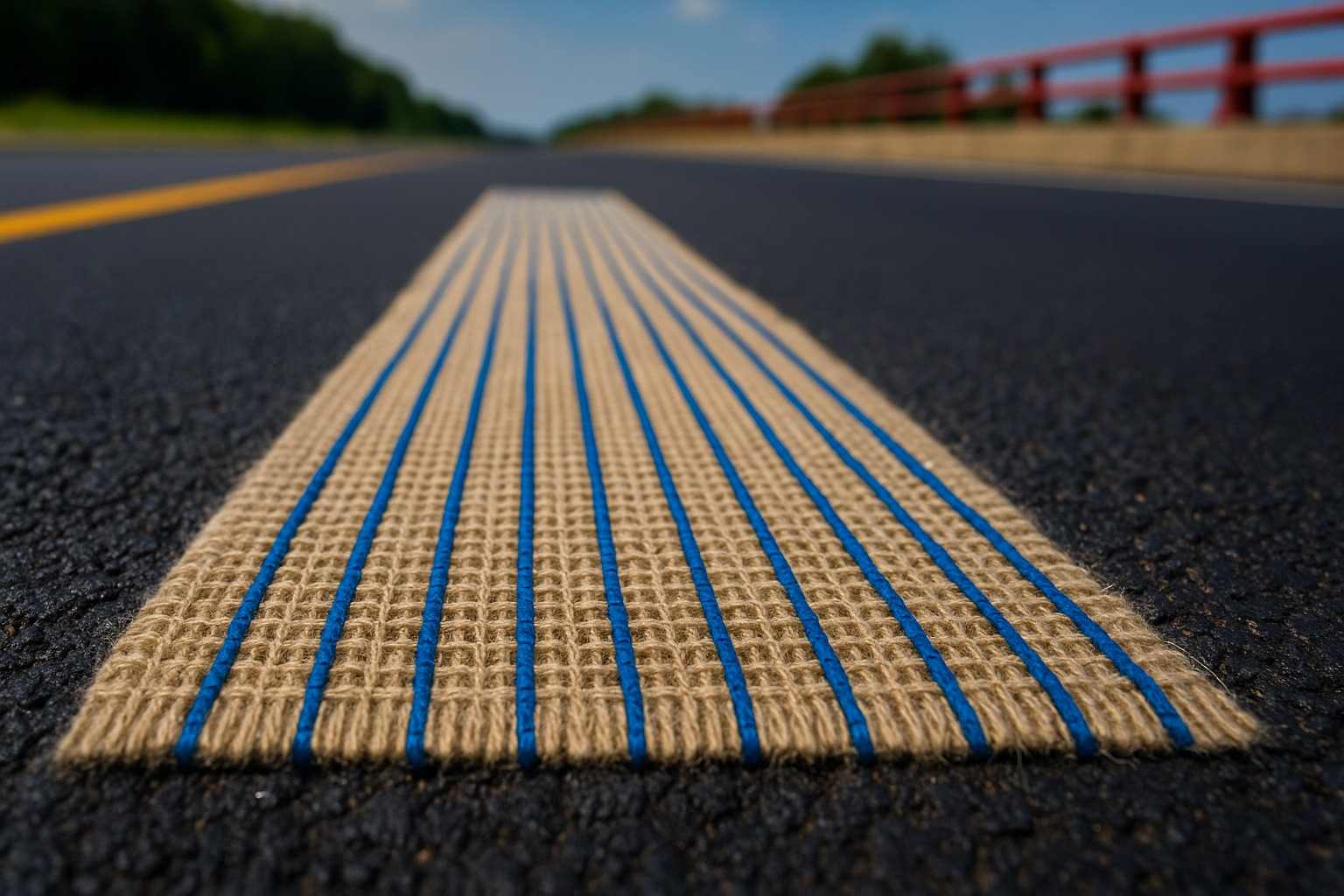
The solution created consists of a biologically based fabric, reinforced with conductive sensor wires, embedded directly in the asphalt.
-
They seemed like common bones, but scientists were surprised to find a relic over 12,000 years old that dates back to before the Bronze Age.
-
With an almost perfect ring of 70 km visible from space, known as the “Eye of Quebec” and over 100 km in length, the Manicouagan Crater in Canada reveals the colossal mark left by a giant asteroid and has become one of the most impressive formations ever identified on the Earth’s surface.

-
Scientists have found in China dinosaur embryos dating back 190 million years in various stages of development, and the discovery still preserves traces of extremely rare proteins in the bones, something that could change what is known about life before hatching.

-
The CEO of Honor in Spain says that smartphones will change with AI, foldables, and even robot phones; the component crisis is making cheap models more expensive in 2026 and shifting the focus to premium.

After installation, it measures the deformation and stress in the base layer, transmitting data to artificial intelligence algorithms.
These algorithms analyze the information and provide real-time insights into road conditions.
According to the institute, changes in the fabric modify its electrical resistance, enabling constant data generation about the pavement’s condition.
The expectation is that this integration between sensors and AI will allow for continuous and detailed assessment of road conditions.
The Challenge Of Road Maintenance
Traditionally, road maintenance depends on the visible wear of the surface or drilling core samples to identify deeper damages.
While cracks and surface fissures can be easily observed, the detection of microcracks and failures in the lower layers requires drilling and sample removal.
This procedure generates high costs, traffic interruptions, and often compromises the lifespan of the road.
To tackle the problem, researchers developed a system capable of monitoring the condition of the asphalt base in a non-destructive manner, covering large areas and offering greater efficiency in repair planning.
Long-Term Planning
Christina Haxter, a research scientist at Fraunhofer WKI, emphasized that the goal is to enable more extended and efficient planning. “Our objective is to be able to plan for a longer period, to continuously monitor changes in road conditions and, based on that, to make forecasts and incorporate them into maintenance management activities,” she explained.
Haxter noted that the system does not directly extend the lifespan of roads, but enhances monitoring and decision-making capabilities. The technology allows for more precise determinations of when and where repaving is needed, reducing waste and optimizing resources.
Roads With Linen Sensors
The developed fabric is lightweight and produced with linen fibers, a natural, renewable, and low-cost manufacturing material.
It is interwoven with ultra-thin conductive wires, less than a millimeter in diameter, incorporated directly into the fabric during weaving. This process ensures high resistance to displacements and ruptures.
Additionally, the use of thick wires and wide spacing provides greater stability to the material. “The fabric needs to be designed so that there is no rupture of the structure in the asphalt. The sensors should also not be damaged during the weaving process or when the fabric is inserted into the roadbed,” Haxter explained.
Another highlighted aspect is robustness: the fabric was designed to withstand the weight of trucks and pavers. Produced on a double-weft loom at Fraunhofer WKI, it can achieve widths of 50 centimeters and variable lengths, making it scalable for different projects.
From The Laboratory To The Road
According to researchers, initial tests confirmed the fabric’s resistance to environmental conditions and installation requirements.
Once applied, the sensors send data to a measurement unit installed at the roadside. This unit stores the information and transmits it for later analysis.
The next step involves artificial intelligence software that interprets the data, identifies damage patterns, and estimates the degradation of the road over time.
The information is presented on a digital dashboard, accessible to road agencies, companies, communities, and even regular users who can monitor maintenance schedules.
After validation in the laboratory, the system began testing on a flat stretch of road in an industrial area. In this experiment, the sensor covers the entire width of the roadway, and the measurement nodes record variations in electrical resistance as vehicles circulate.
With this advancement, researchers hope to make road monitoring more efficient, reducing costs and impacts from construction, and bringing road maintenance closer to a more preventive and intelligent management.





Seja o primeiro a reagir!