





 Portuguese
  English
  Spanish
  4 min of reading
  0 comments



Researchers Identified Signs That The Earth’s Inner Core May Have Changed Its Movement In Recent Decades, After A Detailed Analysis Of Seismic Waves Registered Between 1990 And 2021. The Phenomenon, Considered Rare, Suggests A Natural Cycle That May Subtly Influence Physical Processes On The Planet.
Below the surface where cities, oceans, and continents slowly shift, there exists a solid sphere composed mainly of iron and nickel that spins at the center of the planet. Recent studies indicate that the Earth’s inner core may have slowed down, temporarily stopped, and even reversed its rotation in recent decades.
The discovery was made possible by analyzing seismic records collected over more than thirty years. By studying how the waves generated by earthquakes travel through the planet’s interior, researchers identified signs that the movement of the Earth’s inner core may have changed significantly in relation to the Earth’s surface.
How Scientists Discovered Changes In The Earth’s Inner Core
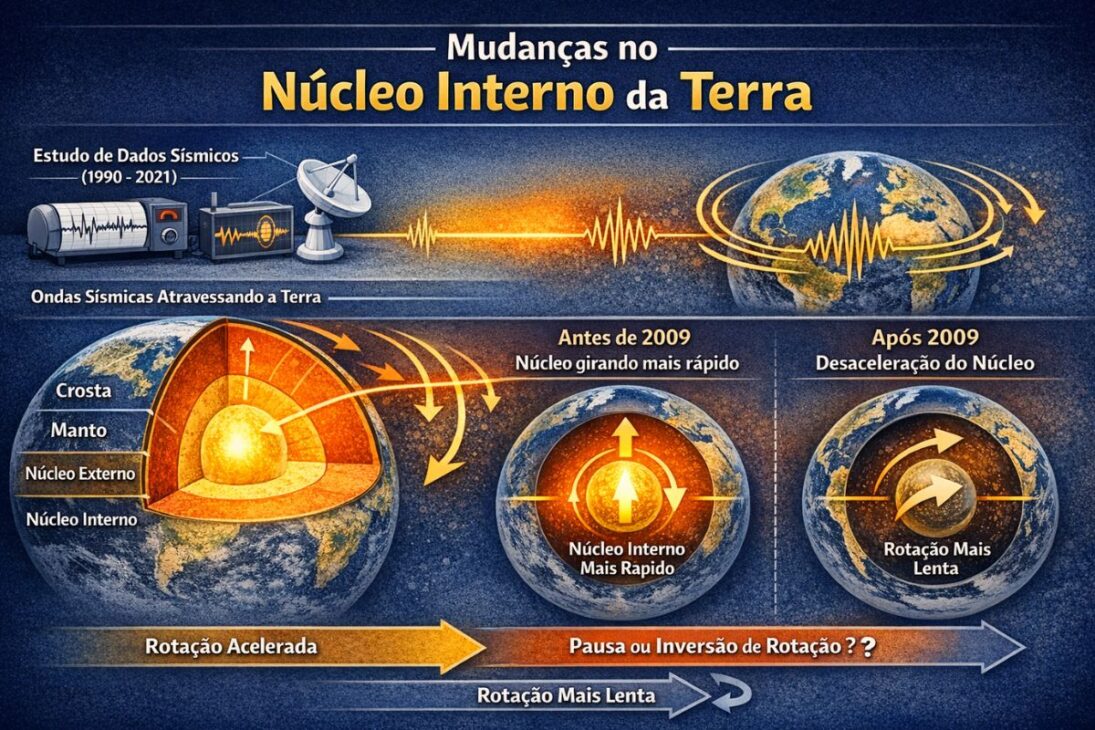
To understand what is happening in the planet’s deeper layers, scientists analyzed seismic data recorded between 1990 and 2021. Each earthquake generates waves that travel through different layers of the Earth, and these waves carry valuable information about the structure and internal movement of the planet.
-
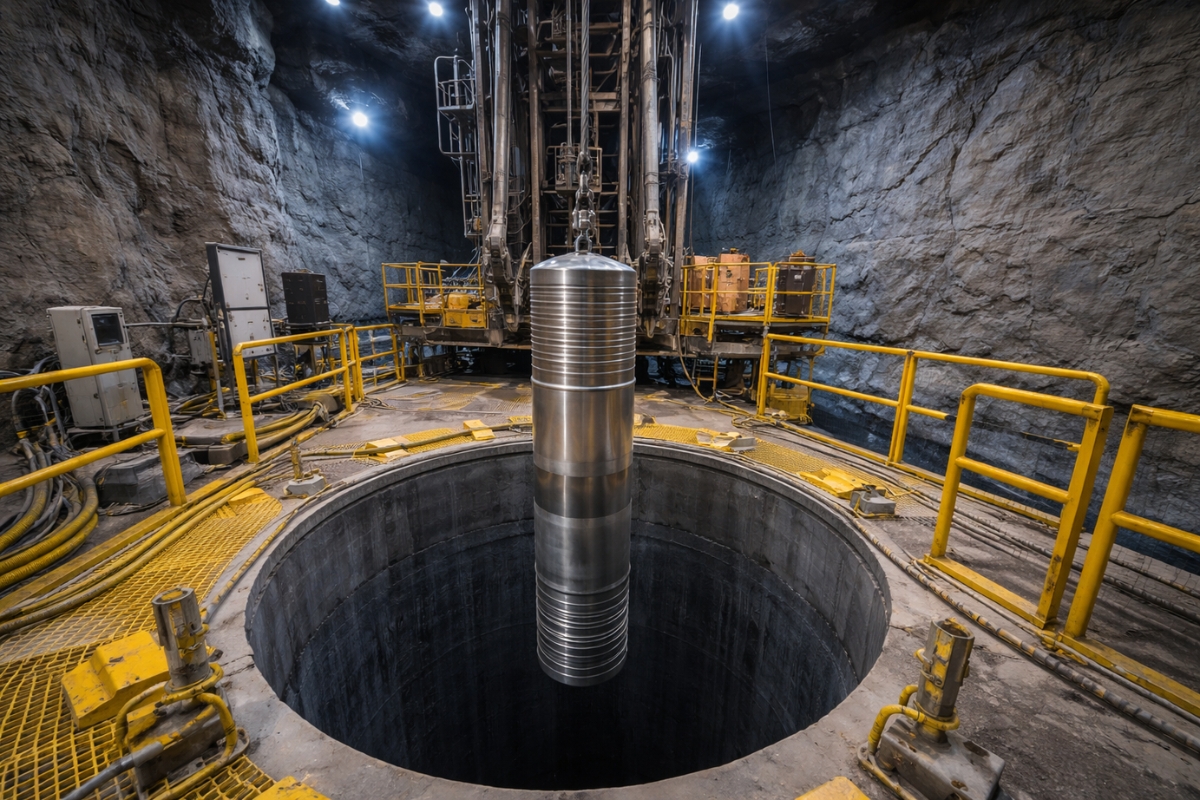
Technology created in the United States uses deep drilling to store high-level nuclear waste.
-
Dozens of Chinese research ships are discreetly mapping the ocean floor in three oceans – and naval analysts see a military pattern.

-
The winter of 2026 in Brazil will not be what you expect: meteorologists warn that the season will be warm and rainy at the same time due to the advance of El Niño, which is already warming the Pacific and changing the climate of the entire country.

-
For the first time, humanoid robots will compete in a full half-marathon without any human assistance in Beijing, with over 100 teams from China registering machines that need to complete the course with autonomous navigation on two legs.


By comparing the time these waves take to traverse the Earth’s interior over different periods, researchers noticed subtle variations in seismic propagation. These small differences indicate changes in the behavior of the Earth’s inner core, allowing the identification of alterations in its rotation over the last few decades.
According to information from the portal NDMAIS, the results indicate that until about 2009, the inner core was rotating slightly faster than the Earth’s surface. After that period, the data shows that the movement began to gradually slow down, suggesting that a temporary pause or even a relative inversion of rotation may have occurred.
Why The Earth’s Inner Core May Change Rotation
The Earth’s inner core is a solid sphere surrounded by a liquid layer called the outer core. This liquid region is fundamental to generating the planet’s magnetic field, creating a dynamic system in which different physical forces constantly act within the Earth.
Various factors can influence the movement of this deep region. Among them are gravitational interactions between the core and the Earth’s mantle, forces associated with the magnetic field, and temperature and density differences between the planet’s internal layers.
Slight variations in this balance can cause oscillations in the core’s movement over time. These changes do not happen abruptly, but rather in cycles that can last decades, reflecting the complex dynamics of the Earth’s interior.
Signs That The Phenomenon Follows Natural Cycles
Researchers also found signs that this change in the core’s movement is not unprecedented. Similar evidence indicates that a reversal in the behavior of the Earth’s inner core may have occurred previously in the 1970s.
This historical comparison led scientists to suggest that the phenomenon may follow a cycle of approximately 70 years. Within this interval, the inner core may alternate between periods of acceleration, deceleration, and possible inversion in relation to the Earth’s surface.
This pattern reinforces the idea that the interior of the Earth is far from static. On the contrary, the planet functions as a dynamic system in constant adjustment, where geophysical forces continuously interact.
Changes In The Earth’s Inner Core May Affect The Planet?
Although the phenomenon occurs thousands of kilometers deep, it can have indirect effects on the surface. Research indicates that changes in the rotation of the Earth’s inner core may be associated with small variations in day length, usually on the scale of milliseconds.
Additionally, scientists are investigating possible relationships between these changes and broader natural processes, such as variations in the Earth’s magnetic field, influences on seismic activities, and alterations in tectonic plate dynamics over long geological periods.
Still, experts emphasize that the direct impacts on human daily life are extremely subtle. These changes occur over very long time scales and do not pose an immediate risk to the population.
What Scientists Still Want To Discover
Despite recent advances, many aspects of the behavior of the Earth’s inner core remain under investigation. Researchers continue to analyze global seismic records and geophysical data to better understand how the planet’s deep layers interact with each other.
Among the main questions under study are the exact duration of the core’s rotation cycles, the relationship between the core and the magnetic field, and the extent to which these oscillations may influence long-term geological processes.
Understanding this dynamics is fundamental because the Earth’s magnetic field plays an essential role in protecting the planet from solar radiation and also influences modern technologies, such as navigation and communication systems.
The more scientists investigate the Earth’s interior, the clearer it becomes that the planet still holds complex processes that continue to be discovered.
The possibility that the Earth’s inner core may have slowed down or even reversed its rotation reveals how little we understand about the planet’s interior. Even occurring thousands of kilometers deep, this type of phenomenon helps scientists better understand how the Earth evolves over time.
Now an interesting question arises for those following these discoveries: do you believe that deep changes like this could influence the future of the planet in ways still unknown? Share your opinion and join the discussion.








-

-

-

-

18 pessoas reagiram a isso.